
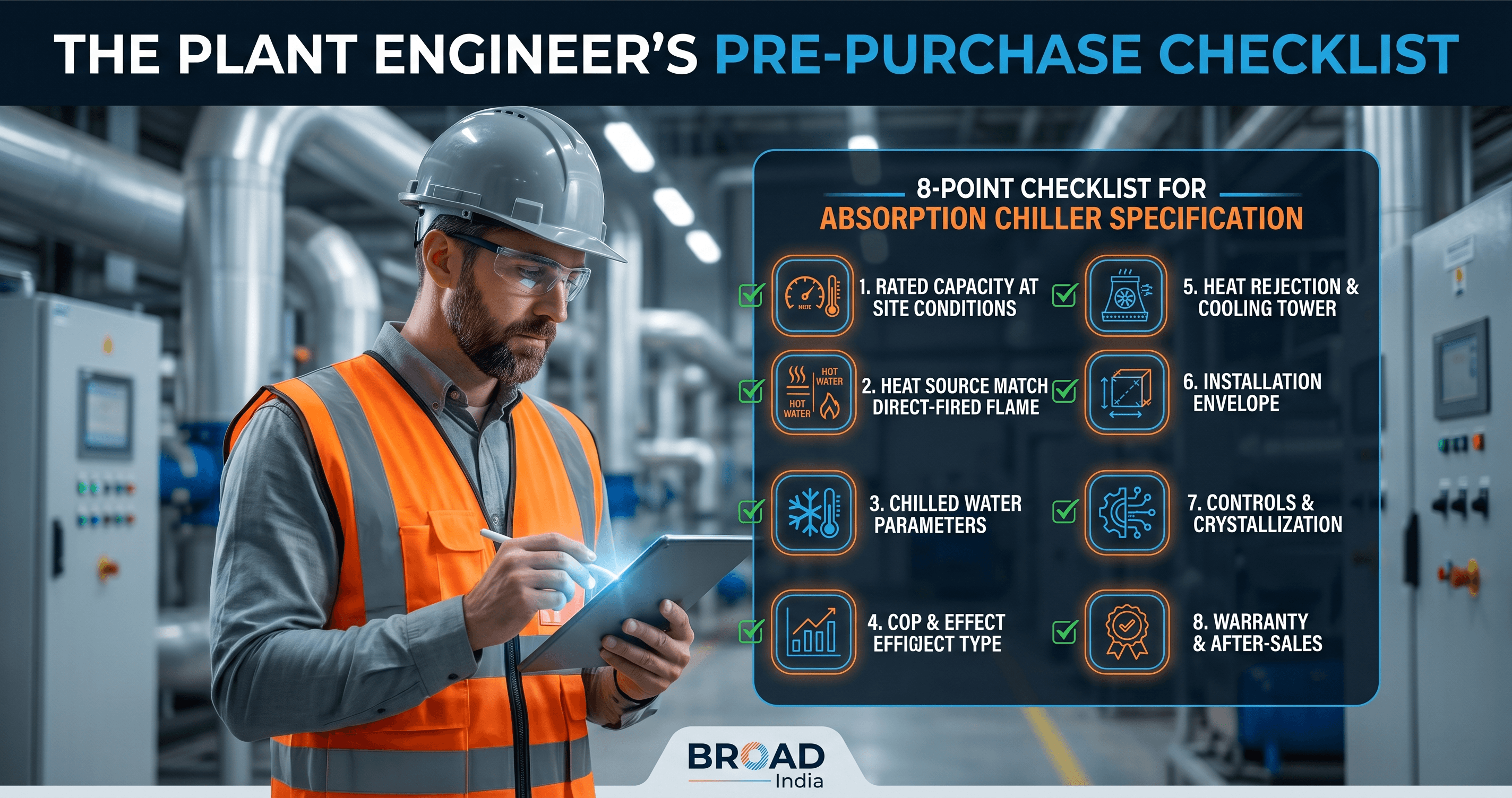
Absorption Chiller Specification: 8-Point Checklist
The Plant Engineer's VAC Checklist: 8 Specs to Verify First
An absorption chiller specification is the set of performance and installation parameters a vapour absorption chiller must meet for your site, and verifying them before purchase prevents the costly surprises that surface after commissioning. Almost every checklist online covers annual maintenance, not buying decisions. This is the pre-purchase version: eight specs to confirm on any quote or datasheet before you sign.
Why a pre-purchase spec check matters more for absorption chillers
Absorption chillers carry site-sensitivities that electric chillers do not, so a generic datasheet rarely tells you what you will actually get. Their rated capacity shifts with cooling-water temperature, their output is capped by heat input, and they reject far more heat than a compression machine.
The stakes are long-term. A well-maintained absorption chiller lasts 20 years or more, and its operating economics are largely fixed at the moment of purchase. The verification you do up front sets the cost of cooling for two decades, which is why the eight specs below deserve scrutiny before price is even discussed.
The 8 specs to verify before you buy
Each row is a line item to confirm in writing on the quotation or datasheet. If a supplier cannot answer one, treat that as a finding.
| # | Spec to verify | What to confirm before you buy |
|---|---|---|
| 1 | Rated capacity at your conditions | TR is guaranteed at your cooling-water temperature and chilled-water setpoint, not catalogue conditions |
| 2 | Heat source match | Required heat type, temperature, pressure and flow match your steam, hot water, or waste-heat supply |
| 3 | Chilled-water parameters | Supply/return temperature and flow are met; setpoint stays at or above ~5°C for a lithium bromide unit |
| 4 | COP and effect type | Single, double, or triple-effect rating and the heat input needed to reach full TR are both stated |
| 5 | Heat rejection and cooling tower | Rejection load and condenser-water flow are sized for the ~1.85 factor, not a compression rule of thumb |
| 6 | Installation envelope | Footprint, weight, floor loading, service clearances, altitude (<1000 m or derated) and machine-room temperature |
| 7 | Crystallization and controls | Auto-decrystallization, purge system, vacuum integrity and a dilution cycle on shutdown are included |
| 8 | Warranty and after-sales | Warranty terms, local service response, spares availability and expected service life are documented |
Which specs get overlooked most often?
Three items account for most post-purchase regret. The first is capacity at real site conditions, a chiller rated on catalogue cooling-water temperature can fall short on a hot day, so a written performance guarantee at your design point matters more than the headline TR. Our sizing-errors guide covers why this gap appears.
The second is heat rejection: an undersized cooling tower throttles even a correctly selected chiller. The third, and the one most specific to India, is after-sales support, a 20-year machine is only as reliable as the service network and spares behind it. Confirm local response times and spare-part availability before you compare prices, not after.
Pro tips for evaluating an absorption chiller quote
Insist on a performance guarantee at your site design conditions, stated in writing rather than implied by a nameplate. A guarantee tied to your actual cooling-water temperature is worth more than any catalogue figure.
Ask for reference installations in your own industry and load type, and weigh lifecycle cost, capital plus two decades of fuel and maintenance, rather than purchase price alone. Finally, check that the heat-source assumptions on the quote match a measured survey of your plant; confirm what heat you really have using our heat-source guide and, where relevant,
your waste heat recovery potential.Specify Your Chiller with Confidence
BROAD India's engineers provide technical specifications and sizing for absorption systems against actual Indian site conditions, with 200+ installations nationwide.
Talk to BROAD India's HVAC engineersFrequently Asked Questions
Need Help With Your Cooling System?
BROAD India's engineering team can assess your facility's cooling requirements and recommend the most energy-efficient solution — from vapour absorption chillers to waste heat recovery systems.



BROAD Air Conditioning India Pvt. Ltd. (BROAD India) is a subsidiary of BROAD Group.
Powered by