
Absorption Chiller vs Compressor Chiller: A Side-by-Side Cost and Efficiency Comparison
Capex vs Opex Cost Breakdown (India)
While absorption chillers carry a higher initial Capex, the operational savings (Opex) are substantial when factoring in Indian industrial grid tariffs.
- Average Grid Electricity (₹/kWh): ₹7 to ₹10+ (Peak)
- Absorption Running Cost: Often ₹0/kWh if using existing waste heat, or minimal gas costs.
- Breakeven Point: Typically 18 to 36 months, saving millions in Opex over a 20+ year lifespan.
Absorption Chiller vs Compressor Chiller: A Side-by-Side Cost and Efficiency Comparison
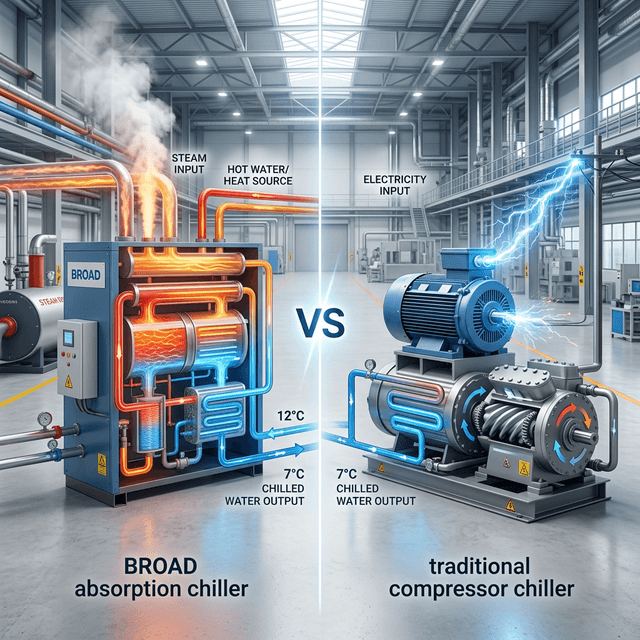
The boardroom debate happens at almost every industrial facility considering cooling upgrades: absorption or compressor? One camp argues for proven compressor chiller technology, electric-driven, widely understood, competitively priced. The other makes the case for BROAD absorption chillers, thermal-powered, waste heat compatible, operationally simpler.
Both sides marshal data supporting their position. But most comparisons miss critical nuances that determine which technology actually delivers better value for specific applications. Here's the side-by-side analysis that cuts through marketing claims and reveals where each technology truly excels.
How They Work: Fundamental Differences
Compressor (Centrifugal/Screw)
Electric motor drives mechanical compressor. The compressor consumes 85-90% of total system power.
BROAD Absorption
Thermal energy (steam, hot water, gas) separating water vapour. Minimal electricity (0.01-0.02 kW/TR) only for pumps.
Capital Cost Comparison (500 TR System)
| Cost Element | Compressor Chiller | BROAD Absorption |
|---|---|---|
| Equipment | $3.5 - $4.2M | $3.2 - $3.8M |
| Cooling Tower | $0.45 - $0.60M | $0.65 - $0.80M (Larger) |
| Total CAPEX | $4.65M - $5.70M | $5.25M - $6.70M |
Winner: Compressor (10-15% lower capital cost). However, operating costs write the rest of the story.
Operating Cost Comparison (Annual)
500 TR Compressor @ $218,200/yr
Based on $162k Electricity + $43k Demand + $13k Maintenance.
Maintenance and Reliability
- Compressor: Rebuild every 10-15 years ($400k-$600k). Oil management required. Lifespan: 15-20 yrs.
- BROAD Absorption: No compressor. Minimal moving parts (just solution pump). Solution analysis required annually. Lifespan: 20-30 yrs.
Environmental and Regulatory
Compressors use synthetic refrigerants (GWP 600-2000+) requiring leak detection and regulatory reporting. BROAD Absorption uses water (GWP 0), making it future-proof from refrigerant phase-outs.
The 20-Year Total Cost Reality
| Metric | Compressor | BROAD (Waste Heat) |
|---|---|---|
| Initial CAPEX | $5.0M | $6.0M |
| 20-yr OPEX | $2.1M | $0.18M |
| Lifecycle Total | $7.6M | $6.3M |
Lifecycle savings: $1.3M (17% reduction) for the BROAD system when using waste heat.
Hybrid Strategy: The Best of Both Worlds
Sophisticated facilities use BROAD absorption for base load (utilizing waste heat) and compressor chillers for peak load spikes. This maximizes energy efficiency while maintaining operational flexibility.
Need a Lifecycle Cost Analysis?
Contact BROAD India for a detailed side-by-side comparison based on your energy costs.
Get AnalysisFrequently Asked Questions
What is a Vapour Absorption Chiller?
Can BROAD chillers run on waste heat?
Do you provide after-sales service in India?
Need Help With Your Cooling System?
BROAD India's engineering team can assess your facility's cooling requirements and recommend the most energy-efficient solution - from vapour absorption chillers to waste heat recovery systems.
Related Articles
Disadvantages of Absorption Refrigeration Systems: When NOT to Choose Absorption Cooling
Read Post
How Many TR Does Your Facility Need? Chiller Sizing Guide
Read Post