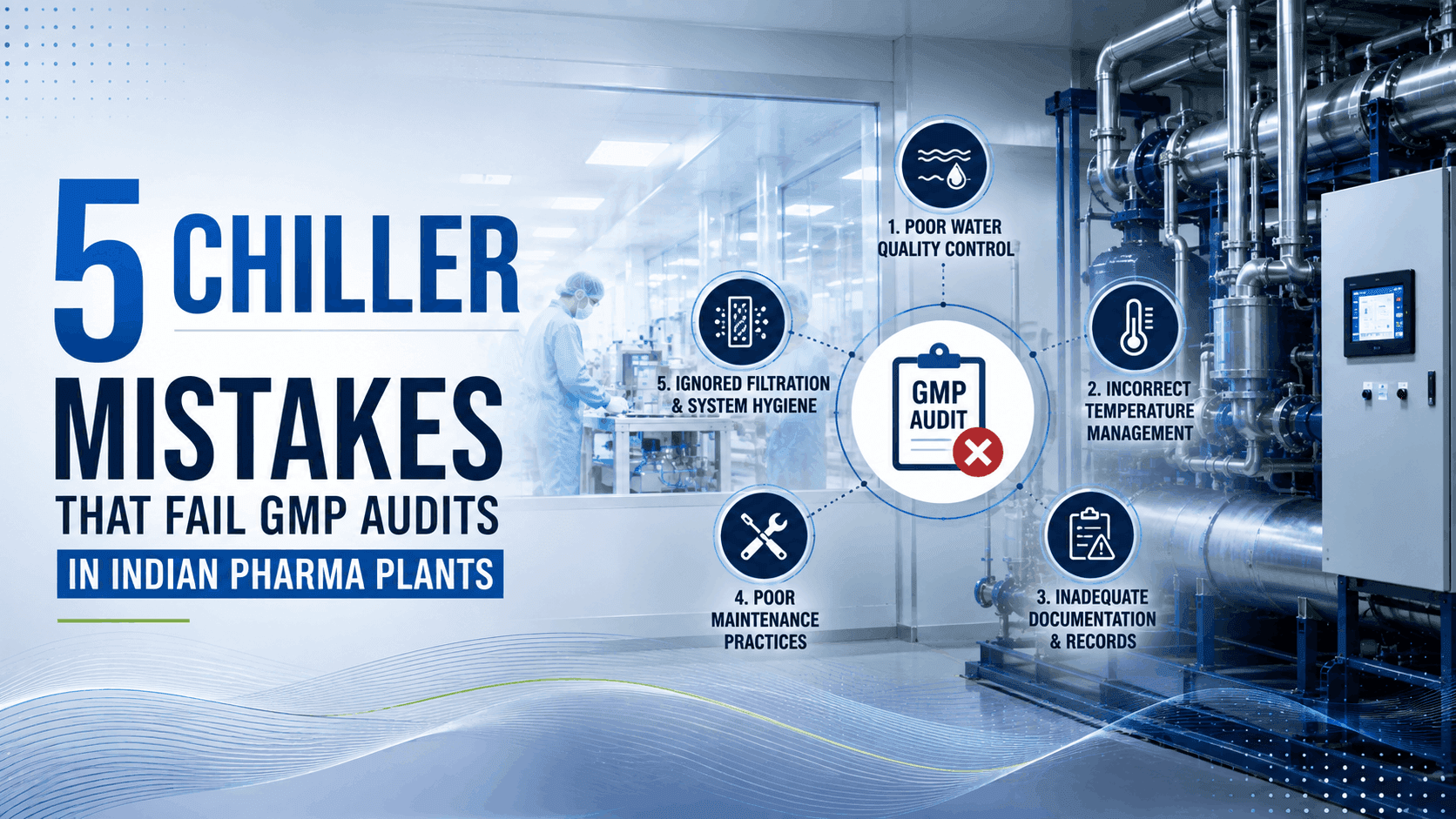
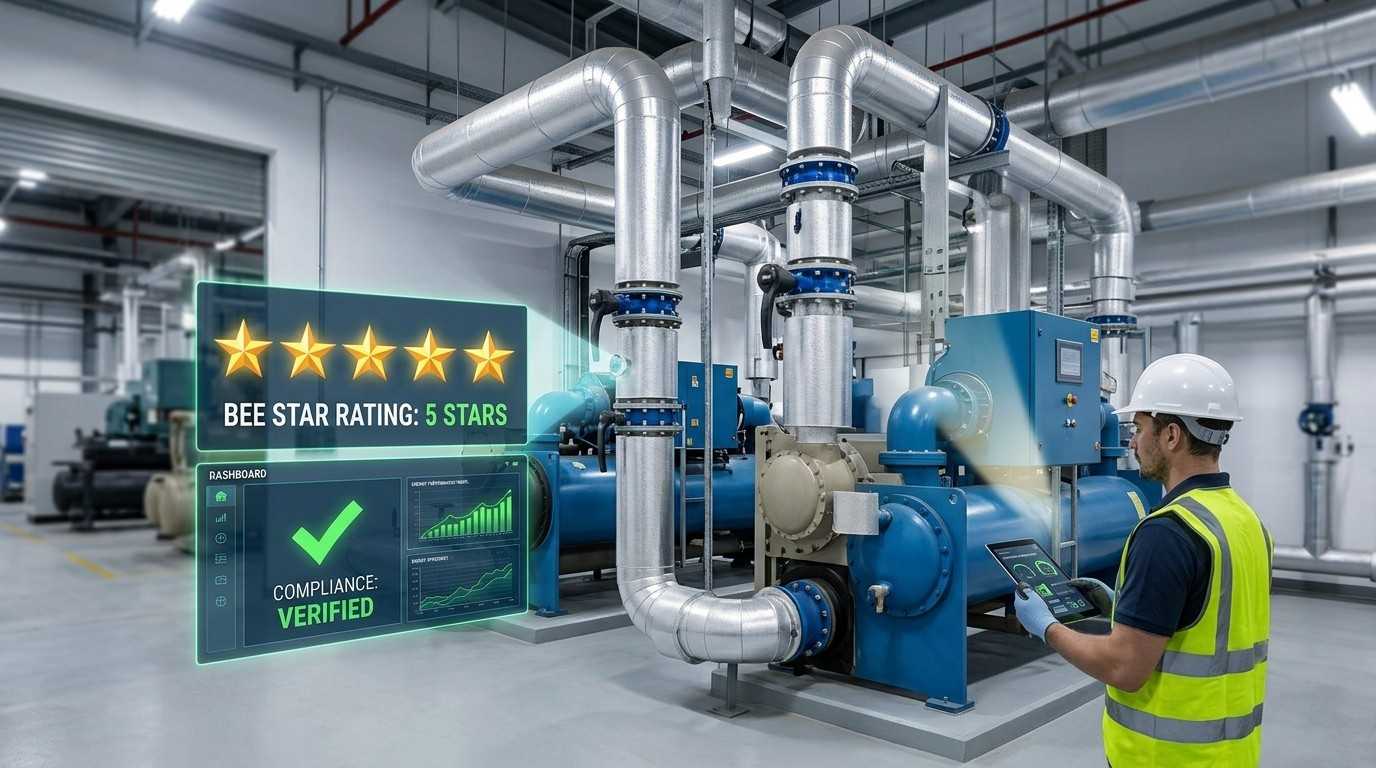
The BEE chiller star rating is India's official energy efficiency benchmark for cooling systems, issued by the Bureau of Energy Efficiency under the Ministry of Power on a scale of 1 to 5 stars, where more stars mean lower energy consumption for the same cooling output. From January 1, 2026, star labelling for chillers became mandatory across commercial and industrial categories, which means operating a non-compliant or unregistered chiller is now a regulatory violation - not a paperwork gap. This post covers the five most common compliance failures plant engineers encounter, and the fix for each.
Why the 2026 BEE mandate changed the compliance stakes for plant engineers
BEE's January 2026 notification did two things that plant teams often underestimate. First, it moved chillers from voluntary to mandatory labelling - so equipment that was compliant under the old voluntary framework may now be non-compliant simply by not being registered. Second, it raised the efficiency thresholds: a chiller that earned 4 or 5 stars under the pre-2026 rules may no longer qualify for those bands, because the recalibrated standards demand better performance, according to BEE's 2026 framework reviewed by Croma Unboxed.
The consequence of non-compliance is concrete. According to compliance consultancy Silvereye Certifications, products that fail BEE registration requirements face withdrawal from the market, legal action, and the direct cost of stock sitting idle instead of running. For a plant that has already installed a chiller, the risk is not just procurement - it is whether an auditor or energy inspector finds the machine running without a valid star label or with a label that does not reflect current thresholds.
Failure 1: Assuming the old star rating is still valid
A chiller registered under pre-2026 BEE standards carries a star label with a validity period - and once that period lapses, the rating is no longer current. Because BEE recalibrated efficiency thresholds from January 2026, a chiller that held a 4-star or 5-star rating under the old framework may now fall into a lower band or require re-testing to confirm its current standing.
The fix is to check the label's validity date and cross-reference the machine's tested COP and IPLV against the current BEE band definitions for its chiller category. If the label has expired or the thresholds have changed, the chiller must be re-registered before it can lawfully display a current star rating.
Failure 2: Testing on a non-production model or uncertified lab
BEE requires that every chiller model be tested on an actual production unit - not a prototype, not a reference sample - at a NABL-accredited laboratory under tightly controlled conditions of temperature, voltage, and humidity, according to Silvereye Certifications. Plants that source chillers from manufacturers who used pre-production samples for testing carry ratings that do not reflect what the installed machine actually delivers.
The fix is to request the full test report from the manufacturer, confirm that the tested unit matches the installed model exactly, and verify that the issuing laboratory holds current NABL accreditation. A test report from an uncredited lab or an unmatched model number invalidates the registration.
Failure 3: Misunderstanding what COP and IPLV actually measure
BEE chiller ratings are based on two metrics: COP (Coefficient of Performance), which measures full-load efficiency, and IPLV (Integrated Part-Load Value), which measures weighted efficiency across four part-load conditions. According to BEE registration guidance from EVTLindia, both must meet the prescribed thresholds for the target star band - not just one of them.
A plant that selects a chiller with an impressive full-load COP but a weak IPLV may find the machine fails to meet the star band's combined requirement. This is particularly relevant for facilities where the chiller runs at partial load for most of its operating hours, as discussed in our magnetic bearing chiller and IPLV breakdown. The fix is to request both COP and IPLV values from the manufacturer before procurement, verified against the current BEE band thresholds for the relevant capacity range.
Failure 4: Installing a higher-capacity chiller without checking if it falls under mandatory scope
BEE's mandatory labelling covers specific chiller categories - and the scope has expanded with the 2026 notification. Plants that install large-capacity or specialty chillers sometimes assume their category is still voluntary, only to find it has moved to mandatory compliance. Running an unregistered chiller in a mandatory category is a direct regulatory violation regardless of the machine's actual efficiency.
The fix is to confirm the chiller's category against the current BEE mandatory list before procurement and installation. If the category is mandatory, the manufacturer must have completed BEE registration and the machine must display a valid star label before being put into service.
Failure 5: Ignoring the BMS data that proves in-situ performance
A valid BEE star label certifies the chiller at the time of testing, not during operation. If a chiller's in-situ performance degrades - from tube fouling, refrigerant loss, cooling-water temperature drift, or poor part-load control - the actual efficiency may fall below the rated band even though the label remains on the machine.
During an energy audit, an inspector will compare the plant's metered chiller performance data against the star rating claim. A large gap between rated and measured performance is a compliance finding, not just an efficiency observation. The fix is to track COP and kW/TR in your BMS continuously, flag deviations from the rated value, and schedule maintenance before the gap widens to audit-reportable levels.
BEE chiller compliance - failures and fixes at a glance
#
Compliance failure
The fix
1
Old star rating assumed still valid
Check label validity date; re-register if expired or threshold has changed
2
Non-production or uncertified lab test
Request full NABL test report; confirm model match
3
Only COP checked, not IPLV
Verify both COP and IPLV against current band thresholds
4
Category assumed voluntary
Confirm chiller category against current mandatory scope before purchase
5
In-situ performance not tracked
Monitor kW/TR and COP via BMS; close the gap before an audit
Check Your Chiller's BEE Compliance Before the Next Audit
A valid star label at procurement is only the start - in-situ performance, label validity, and category scope all need active management. BROAD India's engineers help plant teams specify and maintain BEE-compliant chillers across India's mandatory categories.
Talk to BROAD India's HVAC engineers