
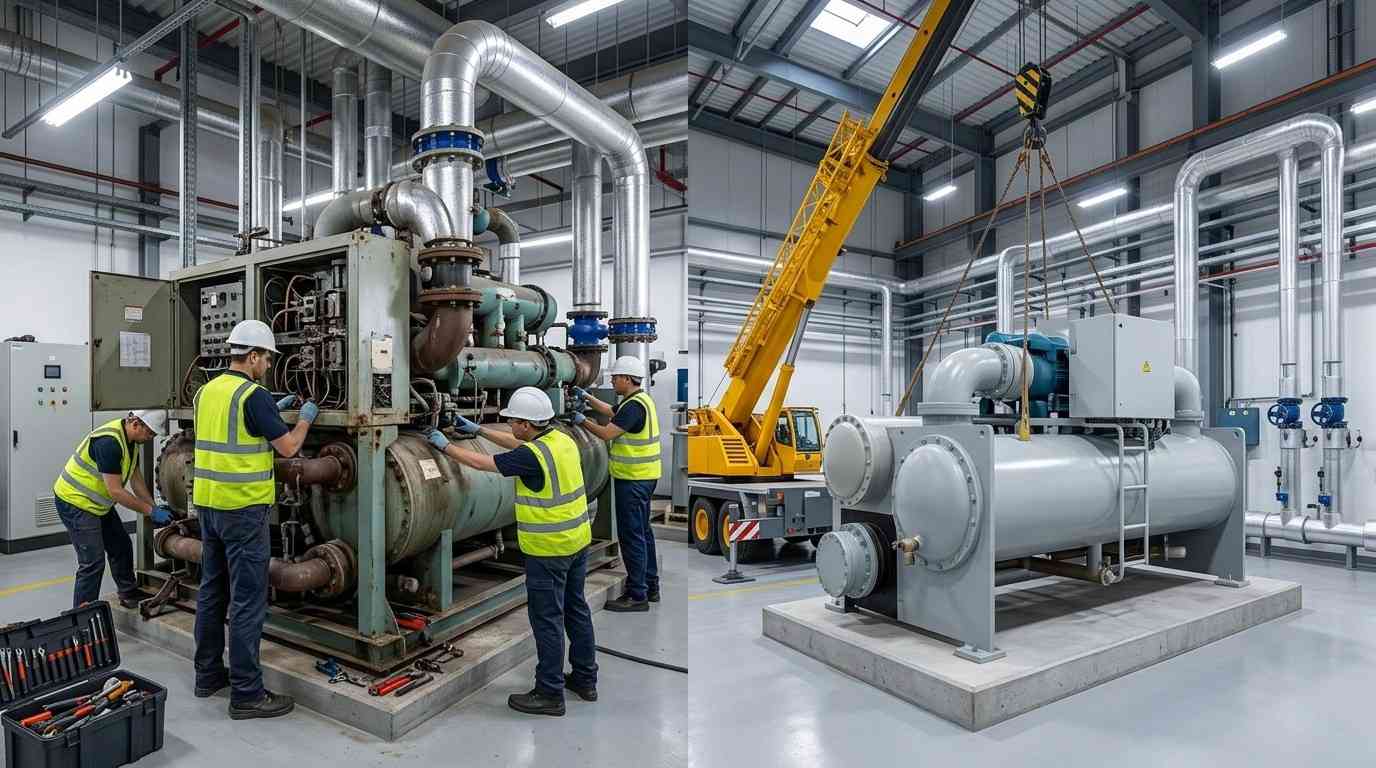
A chiller retrofit upgrades specific components of an existing machine - controls, compressor, refrigerant, or heat exchangers - while keeping the base equipment in place, at a cost that typically runs 30–60% of full replacement, according to R&R Refrigeration's chiller analysis. Replacement installs a new machine at full capital cost but with a modern efficiency baseline, a fresh warranty, and no legacy refrigerant liability. For Indian plant engineers in 2026, two regulatory shifts - BEE mandatory star labelling and R-22 phase-out pressure - have added new criteria to a decision that used to be purely about payback and remaining equipment life.
Retrofit consistently wins on upfront cost and payback speed. Retrofit payback typically runs 2–5 years against 7–12 years for full replacement, and annual energy savings of 15–40% are achievable depending on the age and condition of the existing machine, according to a January 2026 review of chiller efficiency improvements by Eureka/Patsnap. Well-executed retrofits can extend a chiller's useful life by 15–20 years, making them especially valuable for machines that are structurally sound but have obsolete controls or inefficient compressor drives.
The standard decision rule, confirmed by OxMaint's 2026 HVAC lifecycle cost framework, is: if retrofit payback is under 3 years and the machine has 8 or more years of remaining useful life, retrofit wins on lifecycle economics. Below that remaining-life threshold, replacement usually recaptures more value over the long run.
At Indian electricity tariffs of ₹7–10 per unit, the energy-savings multiplier on both options is higher than in most global comparisons, which compresses retrofit payback further - a 20% efficiency gain on a 500 TR chiller running 6,000 hours per year at ₹8/kWh produces meaningful annual savings that a global benchmark payback figure will systematically understate.
Six criteria determine which option fits a given machine and site. The table below maps each one to the retrofit or replacement outcome it typically points toward.
Criterion
Points to retrofit
Points to replacement
Machine age
Under 15 years, structurally sound
Over 20 years, or chronic failure history
Remaining useful life
8+ years confirmed by inspection
Under 8 years
Refrigerant type
HFCs still in supply
R-22 or phased-out refrigerant - rising recharge cost and regulatory risk
BEE compliance status
Controls/VSD upgrade closes the star-band gap
Machine fails current COP/IPLV threshold even after upgrade
Retrofit payback
Under 3 years at your tariff rate
Over 5 years - replacement lifecycle cost is lower
Downtime tolerance
Plant can absorb phased upgrade
No downtime tolerance - a new machine with shorter commissioning is safer
When retrofit is the right call for Indian plants
A chiller between 10 and 15 years old with a reliable mechanical history but fixed-speed compressors and obsolete controls is the classic retrofit candidate. Adding variable speed drives (VSDs) to constant-speed compressors delivers energy savings of 20–40% on those loads alone, according to OxMaint's HVAC lifecycle framework. Upgrading controls to enable BMS integration, part-load optimisation, and alarm management adds further savings without touching the core refrigeration circuit.
For Indian plants, the BEE compliance angle adds a specific retrofit trigger: if a machine's existing COP and IPLV can be brought into the 3-star or higher band through a controls or compressor upgrade, a retrofit is the cheaper and faster route to mandatory compliance than full replacement. The five BEE compliance failures that trigger audit findings are all addressable through targeted retrofits in machines with sound base equipment.
When replacement is the right call
Replacement wins decisively in three India-specific situations. The first is R-22 refrigerant. India's HCFC phase-out schedule, aligned with the Montreal Protocol, has tightened recharge supply and pushed R-22 prices sharply higher. A chiller running on R-22 faces escalating recharge costs, shrinking service availability, and an eventual hard stop on legal recharge. For these machines, the economics of refrigerant conversion often approach replacement cost anyway, and a new machine with a modern, low-GWP refrigerant eliminates the liability entirely.
The second is machines with a chronic failure history. According to OxMaint's April 2026 lifecycle analysis, a facility that spent ₹38 lakh (example equivalent) on repairs to a 17-year-old chiller over three years - with each repair individually appearing cheaper than replacement - was ultimately ₹22 lakh worse off than if it had replaced two repairs earlier. Cumulative maintenance cost, tracked honestly, often reverses the retrofit case for machines that look sound on age alone.
The third is BEE compliance where the machine's base efficiency is too far below the current thresholds for a retrofit to close the gap. A very old, single-speed machine may require a near-full mechanical rebuild to approach the current star bands - at which point a new, factory-certified machine with a valid star label is both cheaper and carries lower performance risk, as covered in our BEE chiller compliance guide and our electric chiller efficiency breakdown.
The decision framework for Indian plant engineers
Start with a condition audit, not a cost comparison. A physical inspection, refrigerant log, and BMS energy trend review establish what the machine actually costs to run today versus its rated performance at commissioning - the gap between those two figures is the retrofit opportunity. If the machine has lost 15–19% efficiency against its commissioning baseline (a figure OxMaint's lifecycle tracking has documented on 14-year-old AHUs), replacement ROI can pay for itself on energy savings alone in under 3 years.
Then apply two India-specific filters: refrigerant liability (R-22 or not), and BEE band gap (can a targeted upgrade close it?). If both answers point to replacement, the lifecycle economics almost always confirm it. If both point to retrofit, a well-scoped VSD and controls upgrade at 30–60% of replacement cost, paying back in 2–5 years, is the defensible capital recommendation.
Run the Numbers Before the Emergency Forces the Decision
Sixty percent of chiller replacements happen reactively - after a failure, with no planned capital case. The plant engineers who avoid that outcome start the retrofit-vs-replacement analysis 18–24 months before the decision is forced. BROAD India's engineers run lifecycle cost assessments for Indian industrial conditions and help plant teams make the case to finance before the emergency arrives.
Talk to BROAD India's HVAC engineers