
Cogeneration vs Trigeneration: Which Fits India?
Two plants can run the same engine on the same fuel - and end up with completely different energy bills, because one of them also chills water.
Conventional power generation wastes roughly 70% of fuel energy as heat vented to the atmosphere, and both cogeneration and trigeneration exist to capture that waste instead of losing it. The difference is what happens to that recovered heat: cogeneration uses it for power and process heating, while trigeneration pushes a portion through an absorption chiller to produce cooling as well. For Indian plants, where summer AC demand drives the sharpest electricity peaks, that one extra step can decide the payback. This comparison breaks down which fits which kind of Indian facility.
Cogeneration vs Trigeneration: Which Fits Indian Plants?
Cogeneration produces electricity and heat from a single fuel source, while trigeneration adds a third output - cooling - by routing recovered heat through an absorption chiller. For Indian plants, where conventional power generation wastes roughly 70% of fuel energy as heat, the choice between the two comes down to one question: does your facility need cooling as much as it needs heat? This comparison breaks down the technical and economic difference, and which one fits which Indian operation.
What is the core difference between cogeneration and trigeneration?
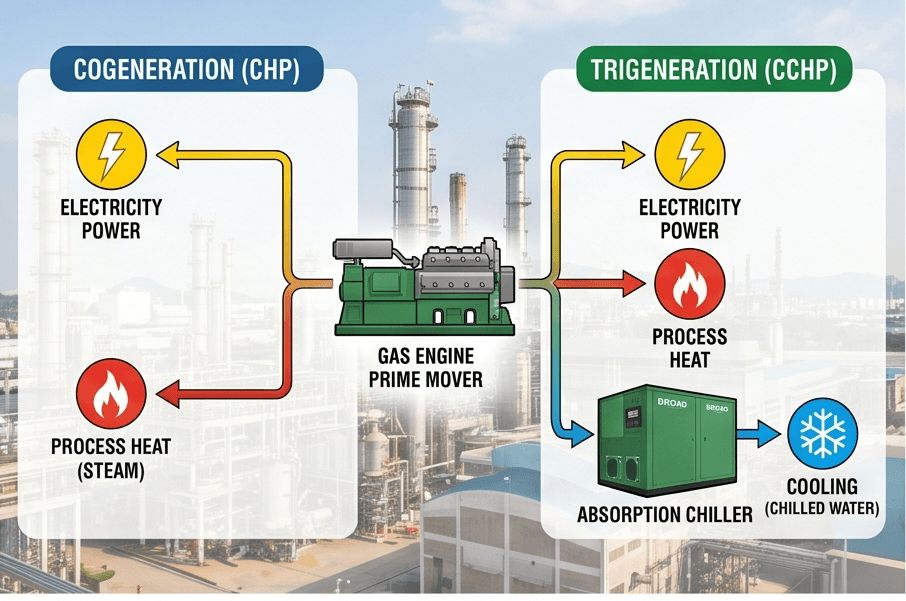
Cogeneration, or combined heat and power (CHP), captures the waste heat from on-site electricity generation and uses it directly for process heating or steam. Trigeneration, or combined cooling, heat, and power (CCHP), takes that same recovered heat and diverts a portion of it into an absorption chiller to produce chilled water as well.
The mechanical difference is small - trigeneration is cogeneration plus an absorption chiller - but the operational difference is significant. A cogeneration plant matches well to facilities with year-round heat demand and little need for cooling. A trigeneration plant fits facilities that need substantial cooling alongside power and heat, because it captures value from the heat that a cogeneration-only system would otherwise discard during low-heat-demand periods.
How do the two compare on efficiency and cost?
Trigeneration systems can convert up to 80% of their thermal output to chilled water, pushing total system efficiency well beyond the roughly 30% a conventional power plant achieves when only electricity is counted, according to Renewable Watch. Both technologies dramatically outperform separate generation of power, heat, and cooling, but trigeneration captures more of that gain wherever cooling demand exists.
Cogeneration systems generally carry lower upfront capital cost, since they skip the absorption chiller and additional fluid loops. Trigeneration costs more to install and requires a more sophisticated energy management system to balance heat use between heating and cooling - but in facilities with continuous cooling loads, it often delivers a faster payback by eliminating high electricity consumption for cooling, the same load a cogeneration-only system can't offset.
| Criterion | Cogeneration (CHP) | Trigeneration (CCHP) |
|---|---|---|
| Outputs | Power + heat | Power + heat + cooling |
| Best for | Year-round heat demand, minimal cooling | Significant cooling load alongside power/heat |
| Upfront cost | Lower | Higher (added absorption chiller, EMS) |
| Thermal efficiency potential | High | Higher - up to 80% of thermal output to chilled water |
| Typical ROI | 3-7 years | 4-7 years |
| Best Indian application | Process industries, sugar mills, textiles | Data centers, hospitals, pharma, hotels, commercial buildings |
Which Indian industries fit cogeneration best?
Cogeneration suits facilities that run on heat year-round but have limited cooling demand, which describes much of India's process manufacturing base. Sugar mills are a defining Indian example: cogeneration using bagasse, the fibrous residue left after crushing cane, lets a mill generate its own steam and power and even export surplus electricity to the grid, with output rising further as steam pressure and temperature increase.
Textile, chemical, and refinery plants follow a similar pattern - continuous process steam demand with cooling needs that are secondary or seasonal. For these sites, the lower capital cost and operational simplicity of cogeneration usually outweighs the added complexity of a trigeneration system whose cooling capacity would go underused.
Which Indian facilities fit trigeneration best?
Trigeneration fits any Indian facility where cooling is a year-round, non-negotiable load - which is an increasingly large category given the country's climate and growing digital infrastructure. Data centers, hospitals, pharmaceutical plants, and commercial complexes all carry continuous cooling demand that a cogeneration-only system cannot offset.
The Indian-specific case for trigeneration is stronger than the global average for one reason: peak electricity demand here is driven heavily by air conditioning load in the hottest months, exactly when grid strain and tariffs are at their highest. A trigeneration system that converts recovered heat into chilled water removes that peak cooling load from the grid entirely, which a cogeneration plant generating only power and process heat cannot do. It also adds resilience where grid blackouts are common, since the same fuel source keeps both production and critical cooling running.
Frequently Asked Questions
What is the difference between cogeneration and trigeneration?
Is trigeneration more expensive than cogeneration?
What is the payback period for trigeneration in India?
Which industries in India use cogeneration the most?
Why is trigeneration well-suited to Indian data centers?
Can a cogeneration plant be upgraded to trigeneration later?
Find the Right Fit for Your Plant's Energy Profile
Whether cogeneration or trigeneration makes sense depends on how much of your load is heat versus cooling, and how that splits across the year. BROAD India's engineers assess fuel availability, heat demand, and cooling load to recommend the right configuration, with 200+ installations nationwide.
Talk to BROAD India's HVAC engineersFrequently Asked Questions
What is a Vapour Absorption Chiller?
Can BROAD chillers run on waste heat?
Do you provide after-sales service in India?
Need Help With Your Cooling System?
BROAD India's engineering team can assess your facility's cooling requirements and recommend the most energy-efficient solution - from vapour absorption chillers to waste heat recovery systems.