
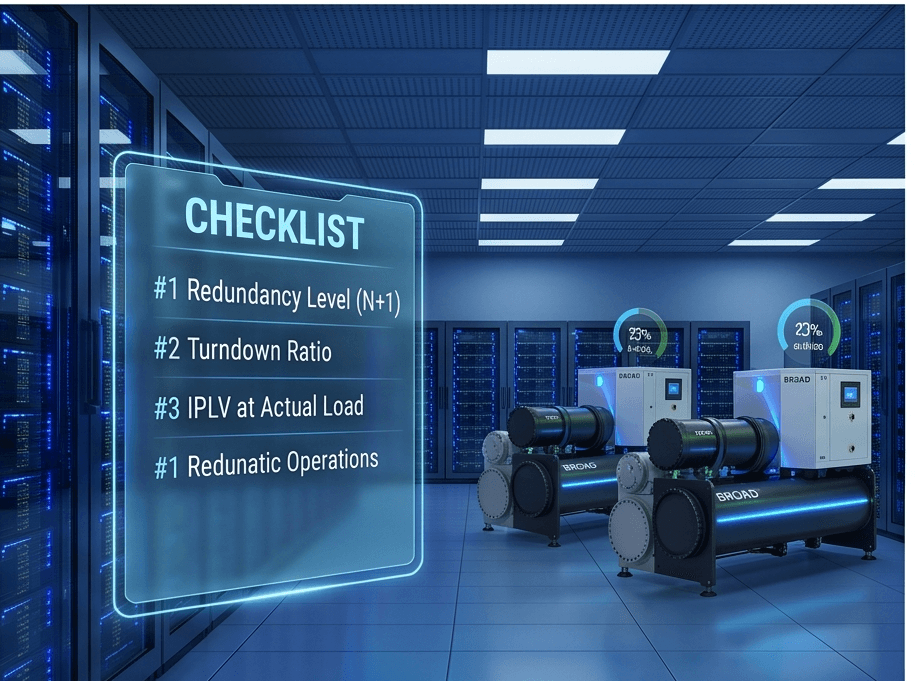
Data Center Chiller Specs: 6 Magnetic Chiller Checks
In a properly redundant data center, your "backup" chiller isn't sitting idle - it's running at partial load right alongside everything else, all the time.
That detail changes which chiller technology actually makes sense, because cooling already accounts for nearly 40% of a data center's total energy use, and partial-load performance decides most of that bill. A chiller spec built around full-load numbers misses how an N+1 system genuinely operates. This checklist covers six specs to verify before choosing a magnetic bearing chiller for a data center, including the one most teams assume instead of confirm.
Data Center Cooling Checklist: 6 Specs for Magnetic Chillers
A data center chiller specification has to account for redundancy, continuous operation, and tight temperature control in ways a typical industrial cooling spec does not. Cooling accounts for nearly 40% of a data center's total energy consumption, which makes the chiller's real-world efficiency, not just its nameplate rating, a direct line item on the power bill. This checklist covers six specs to verify before choosing a magnetic bearing chiller for a data center application.
Why is data center chiller specification different from standard industrial cooling?
Redundancy requirements change how the chiller actually runs, which is the detail most generic chiller specs miss. A Tier III data center requires N+1 chiller capacity at minimum, meaning every running unit has at least one backup, and that backup unit typically shares load at partial capacity rather than sitting idle.
That single requirement matters enormously for chiller selection. A facility that needs 300kW of cooling under N+1 design might run on a 5+1 arrangement, where each unit spends most of its life well below full load. Picking a chiller technology that performs well at partial load isn't optional in a redundant design - it's the normal operating condition.
The 6 specs to verify
| # | Spec to verify | Why it matters for magnetic bearing chillers |
|---|---|---|
| 1 | Redundancy level (N+1, 2N, 2N+1) | Determines how many units run at partial load simultaneously - confirm the chiller's part-load IPLV, not just full-load COP |
| 2 | Turndown / load ratio | Magnetic bearing units can modulate across a 20-100% load ratio; confirm this matches your variable IT load |
| 3 | IPLV at your actual load profile | A high published IPLV means little if your real load sits outside the standard test points - request load-specific performance data |
| 4 | Chilled and condenser water temperature range | ASHRAE recommends 18-27°C inlet air, but verify chilled-water supply temperature against your CRAH/CRAC design, not a generic range |
| 5 | Concurrent maintainability | Each chiller, pump, and valve should be isolable for service without disrupting the critical environment - confirm piping supports this |
| 6 | Vibration and noise tolerance | Magnetic bearing units run near-zero vibration, an advantage in raised-floor or vibration-sensitive halls; verify this is specified and tested |
Which spec gets overlooked most often?
Turndown ratio is the spec most commonly assumed rather than verified. A chiller can carry a high IPLV on paper while still being a poor fit if its practical turndown range doesn't match how the facility actually operates under N+1 redundancy.
This is also where magnetic bearing technology earns its place in a data center spec. Because the compressor has no mechanical wear from running at reduced speed, it can sustain a 20-100% load ratio without the efficiency penalty conventional fixed-speed units suffer at low load, a limitation covered in our electric chiller efficiency breakdown. For a redundant design where backup capacity runs continuously at partial load, that is precisely the operating condition the technology is built for.
What is the most common spec mistake for redundant cooling designs?
Sizing each unit to the full design load and assuming redundancy is "free" capacity is the most common mistake. In an N+1 design, all running units typically share load together, including the redundant one, so each chiller spends most of its operating life at well below full capacity - and a chiller chosen on full-load specs alone won't reflect that reality.
The fix is to specify performance at the load percentage your redundancy configuration actually produces, not at 100%. For most N+1 designs, that means requesting IPLV and turndown data at the 40-70% range where the chillers will spend the majority of their runtime.
Frequently Asked Questions
What is N+1 redundancy in data center cooling?
What chiller specs matter most for a data center?
Are magnetic bearing chillers good for data centers?
What temperature should data center chilled water be?
How much energy does cooling use in a data center?
What is concurrent maintainability in a chiller system?
Specify Your Data Center Chiller Against Real Load Conditions
Redundancy changes how a chiller actually runs - verify performance at your real load percentage, not just at full capacity. BROAD India's engineers help data center and critical-facility teams specify magnetic bearing chillers against actual redundancy and load requirements.
Talk to BROAD India's HVAC engineersFrequently Asked Questions
What is a Vapour Absorption Chiller?
Can BROAD chillers run on waste heat?
Do you provide after-sales service in India?
Need Help With Your Cooling System?
BROAD India's engineering team can assess your facility's cooling requirements and recommend the most energy-efficient solution - from vapour absorption chillers to waste heat recovery systems.