Diesel Fired Chiller vs Electric Chiller: Total Cost of Ownership in Indian Conditions (2026)
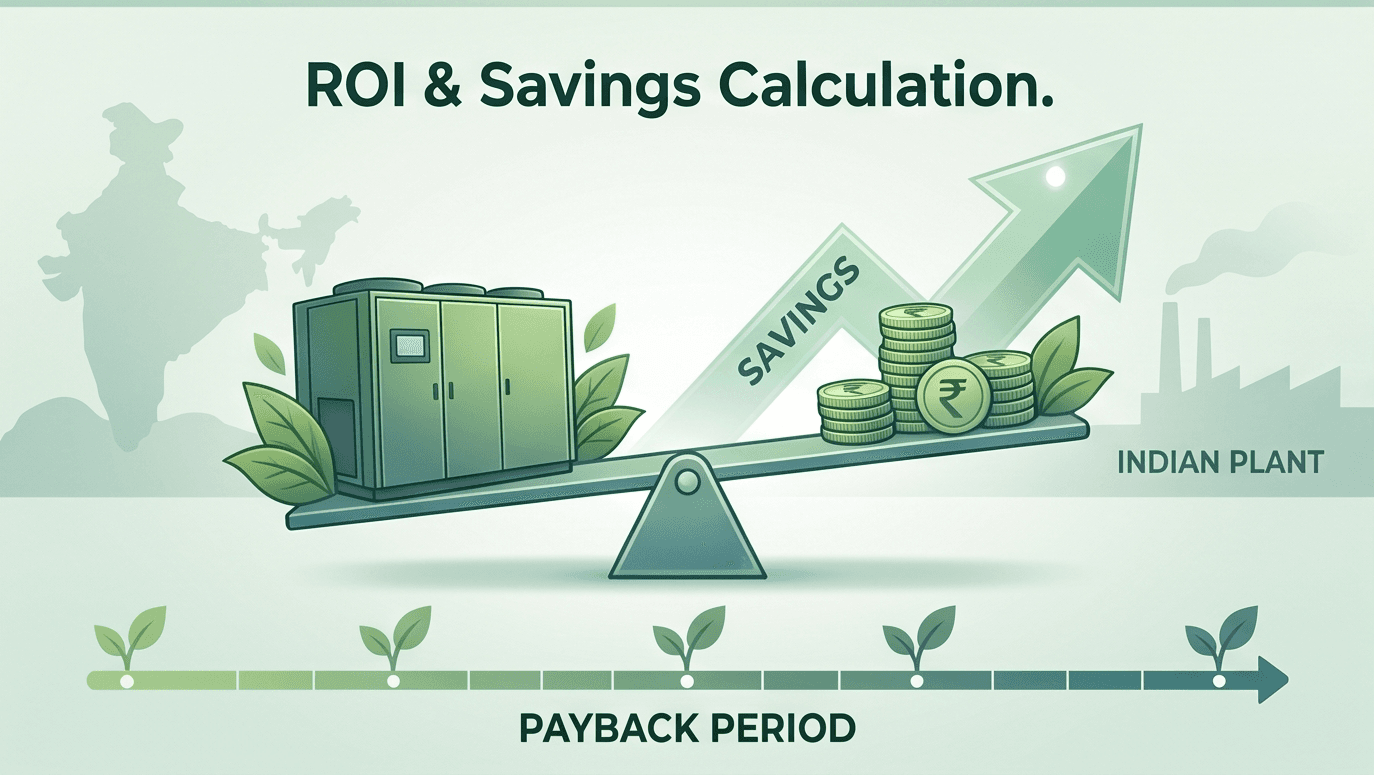
Price tag comparisons between diesel fired and electric chillers miss the point. The machine you buy on day one is a fraction of what you will spend operating it over 20 years. In India's varied tariff and fuel price landscape, total cost of ownership tells a very different story depending on where your facility is and how it runs.
Why Upfront Price Is the Wrong Metric
When Indian procurement teams compare a diesel fired absorption chiller against an electric screw or centrifugal chiller, the instinct is to compare capital cost. On that basis, an electric chiller almost always appears cheaper - the equipment cost per TR is lower, the installation is simpler, and the supply chain is more commoditised.
But a large industrial chiller runs for 15–25 years. Over that period, the CAPEX is typically 8–15% of total lifecycle cost. The remaining 85–92% is energy, maintenance, refrigerant, and water. A comparison that ignores these costs does not reflect the decision you are actually making.
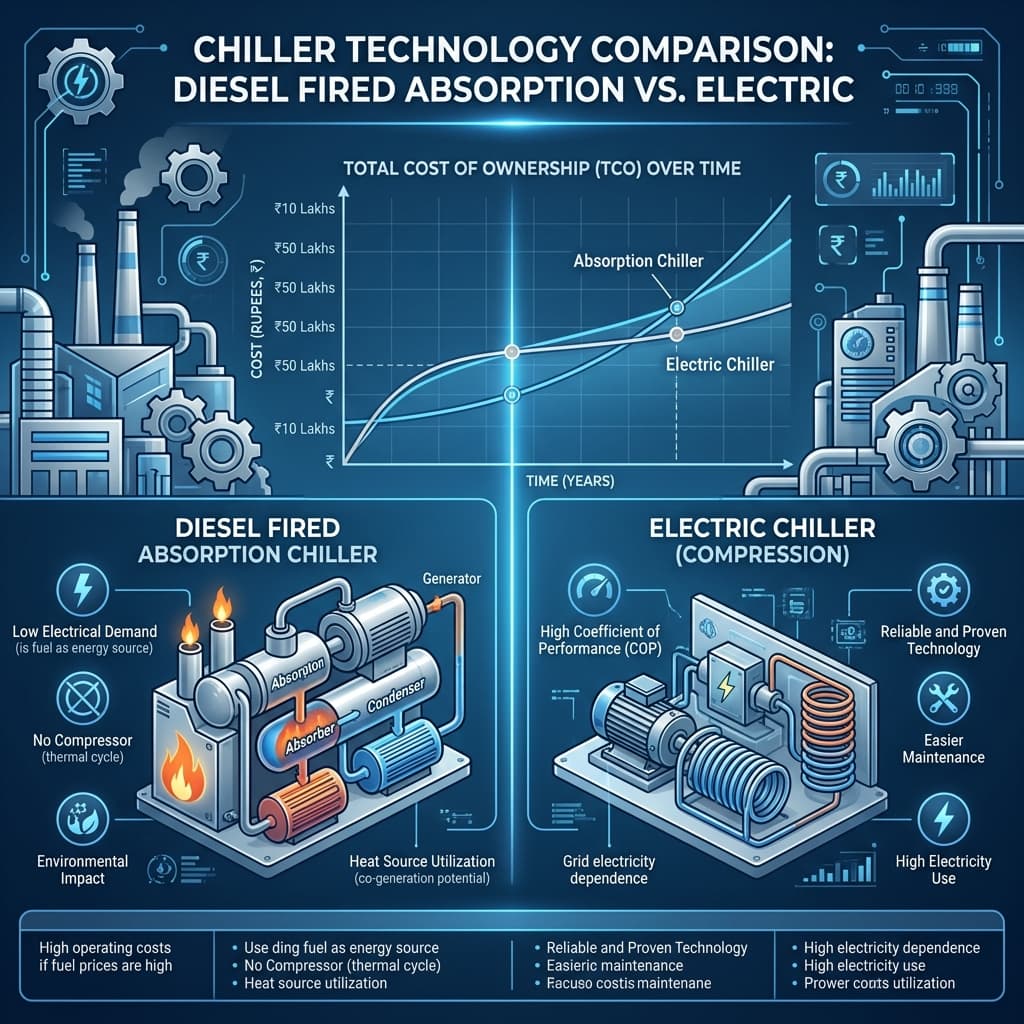
This article builds the Total Cost of Ownership (TCO) comparison for both technologies at Indian conditions - with honest numbers, clear assumptions, and the scenarios where each choice wins.
The Comparison Framework: 500 TR, 20-Year Lifecycle
All comparisons in this article are modelled at 500 TR capacity - a common scale for large commercial complexes, industrial HVAC, and mid-size manufacturing process cooling. The base scenario is a facility in Maharashtra with the following parameters:
- Operating hours: 6,000 per year
- Grid electricity tariff: ₹10/kWh (HT industrial)
- Diesel price: ₹90/litre HSD
- Discount rate for NPV: 10% per annum
- Both systems operating at 80% average load factor
Year 1 Cost: CAPEX and Installation
| Cost item | Electric screw chiller | Diesel fired absorption chiller |
|---|---|---|
| Equipment (500 TR) | ₹2.5–3.5 crore | ₹5.5–7.5 crore |
| Cooling tower | ₹40–60 lakh | ₹60–90 lakh (larger) |
| Piping, civil, electrical | ₹50–80 lakh | ₹55–80 lakh |
| Commissioning | ₹10–15 lakh | ₹15–25 lakh |
| Fuel system (diesel tank, lines) | - | ₹15–25 lakh |
| Total installed CAPEX | ₹3.5–5.0 crore | ₹7.0–10.5 crore |
The electric chiller is meaningfully cheaper to install - by approximately ₹2.5–5.5 crore at 500 TR. This is the gap that must be recovered through lower operating costs over the lifecycle.
Annual Operating Cost: Where the TCO Gap Is Determined
Electric Chiller OPEX
| Electricity | ₹5.04 crore |
| Demand charges | ₹16.8 lakh |
| Maintenance | ₹15–22 lakh |
| Water & Chemicals | ₹10–14 lakh |
| Total Annual OPEX | ₹5.5–5.8 crore |
Diesel Fired Chiller OPEX
| Diesel Fuel | ₹1.73 crore |
| Electricity (aux) | ₹12 lakh |
| Maintenance | ₹8–12 lakh |
| Water & Chemicals | ₹12–18 lakh |
| Total Annual OPEX | ₹2.1–2.3 crore |
Annual OPEX saving in favour of diesel absorption chiller: ₹3.2–3.7 crore per year.
20-Year Total Cost of Ownership
| Metric | Electric chiller | Diesel fired absorption |
|---|---|---|
| Initial CAPEX (midpoint) | ₹4.2 crore | ₹8.7 crore |
| Annual OPEX saving | - | ₹3.45 crore/year |
| Simple payback on premium | - | 15–16 months |
| 20-year cumulative OPEX | ₹113 crore | ₹44 crore |
| 20-year total lifecycle cost | ₹117 crore | ₹52.7 crore |
| 20-year NPV saving (10% DR) | - | ₹22–28 crore |
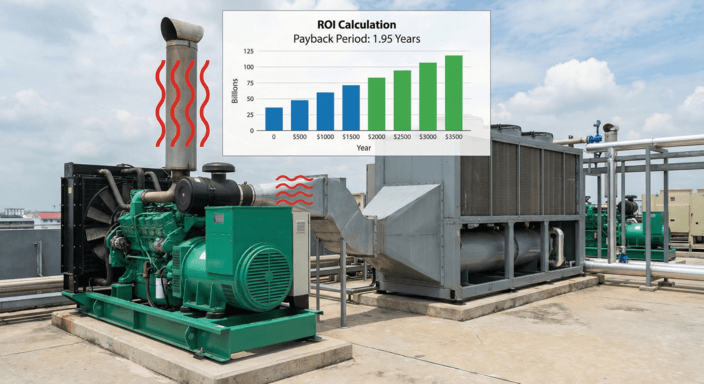
At ₹10/kWh electricity and ₹90/litre diesel, the diesel fired absorption chiller delivers a CAPEX payback in approximately 15–16 months at 500 TR and 6,000 operating hours. Over 20 years, the total cost saving exceeds ₹60 crore at nominal values - or ₹22–28 crore in NPV terms.
How Diesel Price and Electricity Tariff Shift the Decision
The TCO crossover point shifts with fuel and electricity prices. Here is what happens to the annual OPEX comparison as these variables change:
| Diesel price | Electricity tariff | Annual OPEX: Electric | Annual OPEX: Diesel | Annual saving |
|---|---|---|---|---|
| ₹85/L | ₹10/kWh | ₹5.65 crore | ₹2.05 crore | ₹3.60 crore |
| ₹90/L | ₹10/kWh | ₹5.65 crore | ₹2.20 crore | ₹3.45 crore |
| ₹95/L | ₹10/kWh | ₹5.65 crore | ₹2.35 crore | ₹3.30 crore |
| ₹90/L | ₹8/kWh | ₹4.52 crore | ₹2.20 crore | ₹2.32 crore |
| ₹90/L | ₹7/kWh | ₹3.96 crore | ₹2.20 crore | ₹1.76 crore |
The Demand Charge Factor: Often Overlooked
Indian HT industrial consumers pay two charges on their electricity bill: an energy charge (₹/kWh consumed) and a demand charge (₹/kVA of maximum demand). Demand charges often represent 20–35% of the total electricity bill for large consumers.
A 500 TR electric chiller adds approximately 350 kVA of demand to the facility's maximum demand at full load. At ₹400/kVA/month, that is ₹16.8 lakh per year in demand charges alone - regardless of how many hours the chiller actually runs.
Maintenance and Lifecycle Cost Comparison
Electric Chiller
- Maintenance: ₹15–22 lakh/year
- Major Overhaul: 8–12 years (compressor)
- Overhaul Cost: ₹50–90 lakh
- Regulatory Risk: HFC phase-down (Kigali)
- Equipment Life: 15–18 years
Diesel Fired Absorption
- Maintenance: ₹8–12 lakh/year
- Major Overhaul: 15–20 years (no compressor)
- Overhaul Cost: ₹20–35 lakh
- Regulatory Risk: Zero (Water + LiBr)
- Equipment Life: 20–25 years
When the Electric Chiller Still Wins
The TCO analysis above is built for Maharashtra at ₹10/kWh. There are real scenarios where the electric chiller is the better financial choice:
- Low electricity tariff states: At ₹5.5–6/kWh, the OPEX saving narrows and payback stretches beyond 5 years.
- Intermittent cooling: Chillers running only 2,000–2,500 hours per year accumulate savings slowly.
- Very low capacity: Below 100 TR, fixed costs for diesel firing make the project uneconomical.
Frequently Asked Questions
Does the diesel fired chiller economics work if I already have a natural gas connection?
How does GST affect the TCO comparison?
Conclusion
The TCO comparison between a diesel fired absorption chiller and an electric chiller in India is not close at tariffs above ₹8/kWh - the absorption machine pays back its CAPEX premium in under 18 months and then delivers ₹3–3.5 crore in annual savings for the next 18–22 years.
Get a Facility-Specific TCO Model
Contact BROAD India at akshay@broad.net or +91 94278 51584 to discuss your facility's cooling and fuel supply conditions.
Contact Technical TeamFrequently Asked Questions
What is a Vapour Absorption Chiller?
Can BROAD chillers run on waste heat?
Do you provide after-sales service in India?
Need Help With Your Cooling System?
BROAD India's engineering team can assess your facility's cooling requirements and recommend the most energy-efficient solution - from vapour absorption chillers to waste heat recovery systems.