
Disadvantages of Absorption Refrigeration Systems: When NOT to Choose Absorption Cooling
Disadvantages of Absorption Refrigeration Systems: When NOT to Choose Absorption Cooling
Most absorption chiller manufacturers focus exclusively on advantages: waste heat recovery, grid independence, environmental safety, and operational simplicity. BROAD's 25,000+ global installations prove these benefits are real. But honest technical discussion requires acknowledging where absorption technology has limitations and when conventional compressor chillers represent better choices.
1. Higher Capital Cost
The reality: Absorption chillers cost 15-30% more than equivalent-capacity compressor chillers. A 500 TR BROAD absorption system runs $5.5-6.5M installed, while a compressor chiller costs $4.5-5.5M.
Why the premium exists: More complex heat exchangers (generator, absorber), larger equipment footprint, specialized vacuum-rated construction, and heat source integration costs.
When this matters: Capital-constrained projects, small cooling loads (<200 TR), or rental buildings where owners pay CAPEX but tenants pay energy bills.
2. Requires Thermal Energy Source
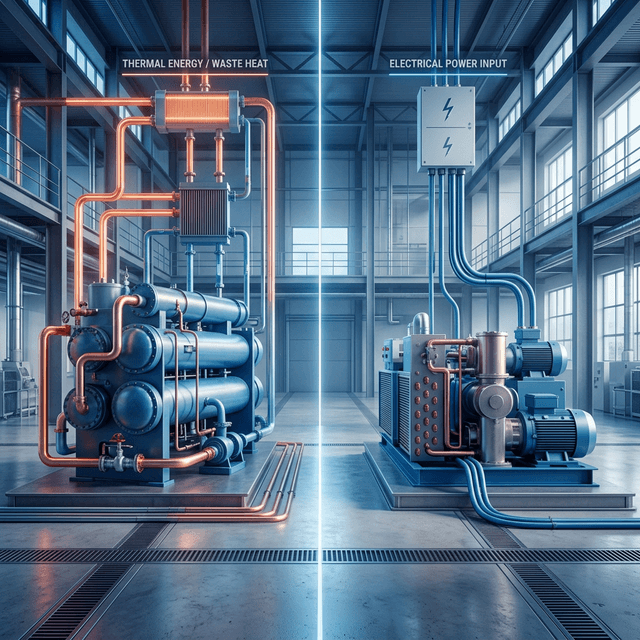
Absorption chillers need heat, steam, hot water, exhaust gases, or combustion fuel. If your facility has no existing thermal infrastructure or gas access, absorption becomes a difficult sell.
Mitigation: Direct-fired BROAD chillers eliminate dependence on waste heat but require fuel supply infrastructure and environmental permits.
3. Lower Coefficient of Performance (COP)
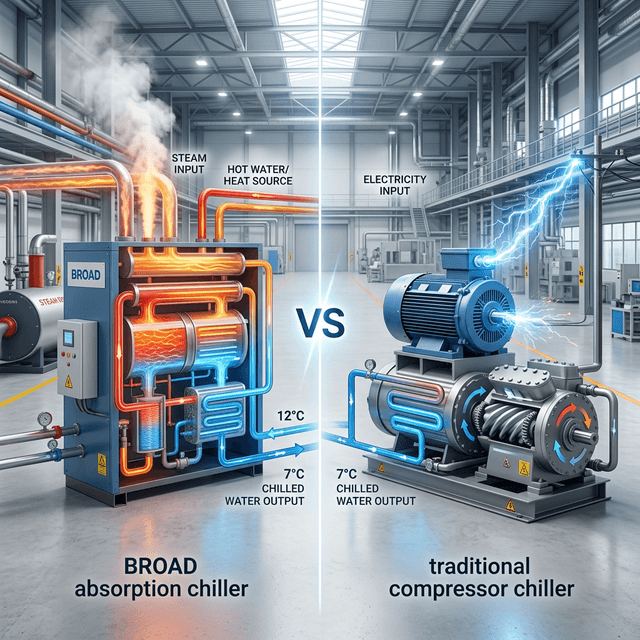
BROAD single-effect units achieve COP 0.70-0.75, while compressors reach COP 5.0-6.5. This measurement is incomparable (thermal vs. electrical), but it matters if you're burning expensive fuel specifically for cooling rather than using waste heat.
4. Larger Physical Footprint
A 500 TR absorption chiller occupies 40-50 sq m, vs 25-30 sq m for compressor units. This is a critical factor in urban retrofits with severe space constraints.
5. Cooling Tower Requirements
Due to lower COP, BROAD absorption chillers reject more heat. A 500 TR system needs an 800 TR cooling tower, leading to higher water consumption and chemical costs.
6. Technical Risks: Crystallization & Corrosion
- Crystallization: If LiBr solution becomes too concentrated (e.g., due to air leaks or power failure), it can solidy. BROAD uses advanced prevention systems to mitigate this.
- Corrosion: LiBr is corrosive to steel. Annual solution analysis and inhibitor adjustments are mandatory for a 20+ year lifespan.
Comparison Checklist
| Factor | Absorption | Compression |
|---|---|---|
| Space Needed | High (40-50 m²/500TR) | Compact (25-30 m²) |
| Water Usage | Higher (+25-30%) | Standard |
| Lifespan | 20-30 Years | 15-20 Years |
When to Choose Compressor Instead:
- No thermal energy source exists.
- Capital budget is strictly limited (<3yr payback).
- Electricity costs are very low (< $0.05/kWh).
- Space/Water is severely restricted.
Ready for an Honest Assessment?
Contact BROAD India for a site-specific evaluation comparing absorption and compression options.
Contact An EngineerFrequently Asked Questions
What is a Vapour Absorption Chiller?
Can BROAD chillers run on waste heat?
Do you provide after-sales service in India?
Need Help With Your Cooling System?
BROAD India's engineering team can assess your facility's cooling requirements and recommend the most energy-efficient solution - from vapour absorption chillers to waste heat recovery systems.
Related Articles
Absorption Chiller vs Compressor Chiller: A Side-by-Side Cost and Efficiency Comparison
Read Post
How Many TR Does Your Facility Need? Chiller Sizing Guide
Read Post