
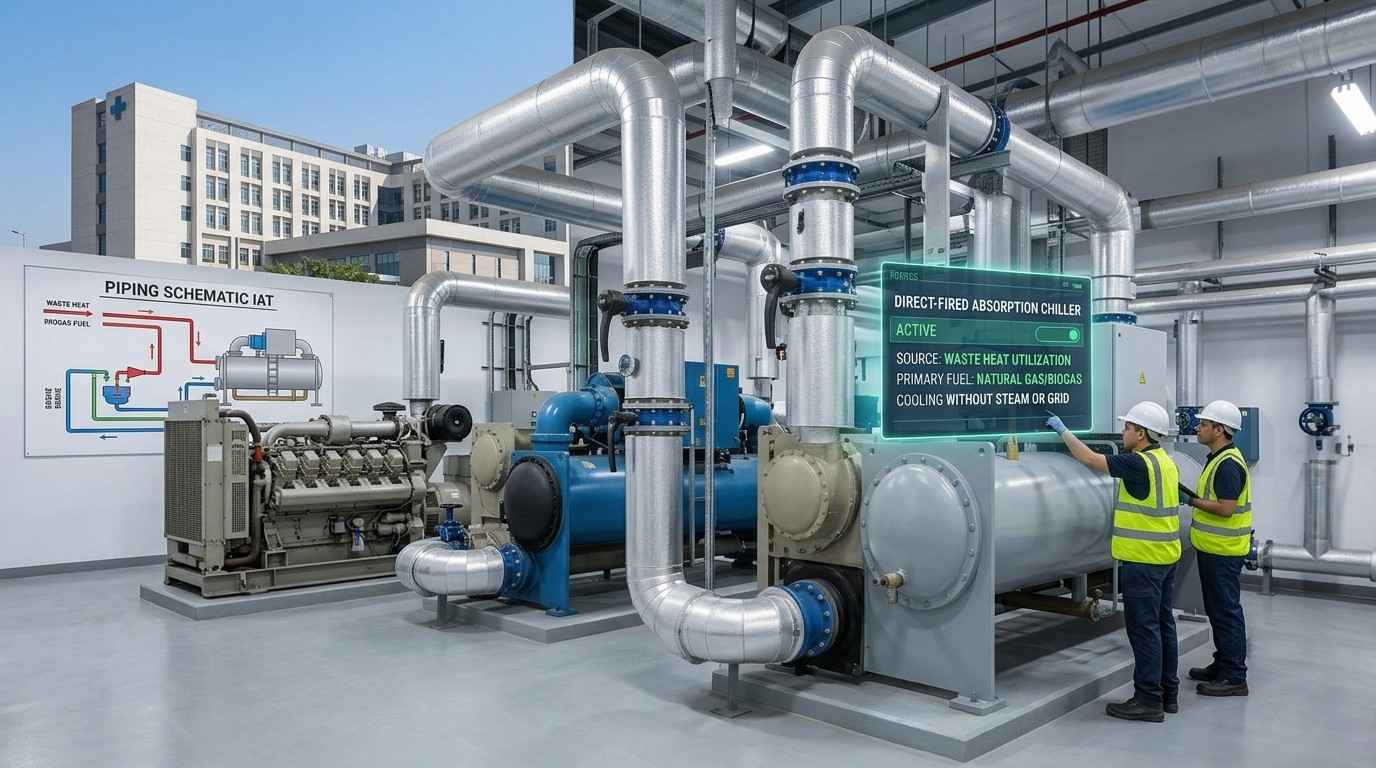
A direct-fired absorption chiller cools a building using natural gas, diesel, or biogas combustion instead of electricity or process steam - making it the most practical cooling solution for Indian hospitals that have neither a reliable grid nor a boiler-derived steam supply. With healthcare facilities carrying non-negotiable 24/7 cooling obligations across operating theatres, ICUs, and imaging suites, this guide covers five steps to designing a hospital cooling system that doesn't depend on grid stability.
Why standard chiller selection fails Indian hospitals
Electric centrifugal and screw chillers dominate the global market, but their single-point dependency on grid power makes them poorly suited to much of India's healthcare estate. According to a 2024 industry analysis in Thermal Control magazine, India's grid still suffers from load shedding and frequency fluctuations that directly threaten chiller uptime - and diesel generator backup for large electric chillers is expensive, fuel-intensive, and itself maintenance-critical.
Steam-fired absorption chillers avoid grid dependency, but only where a boiler or process-steam source exists. Most stand-alone hospitals, clinics, and mid-tier healthcare facilities in Tier 2 and Tier 3 Indian cities have neither. A direct-fired absorption chiller resolves both constraints simultaneously: it burns fuel to drive its own generator cycle and carries an electrical load only for its pumps, typically just 2 kW for a unit serving hundreds of tons of cooling.
Step 1: Match chiller type to your hospital's actual energy profile
Start by auditing what your facility reliably has, not what it ideally should have. A hospital with a natural gas connection, an LPG supply, or access to biogas is a strong direct-fired absorption candidate. BROAD India's direct-fired range spans 66 to 3,307 RT and accepts dual-fuel burner configurations - natural gas as the primary with diesel as automatic backup - so the chiller switches fuels without interruption if one supply fails.
Where a hospital operates on-site power generation such as a gas engine or diesel genset, that engine's exhaust heat can drive an exhaust-gas absorption chiller instead, making the cooling essentially free from the generator's waste stream. This is the CCHP configuration covered separately in our cogeneration vs trigeneration guide.
Step 2: Design for N+1 redundancy from the start
Cooling failure in a hospital is a clinical event, not an infrastructure inconvenience. An operating theatre, ICU, or neonatal ward that loses cooling can force patient transfers within hours. N+1 redundancy - installing one more chiller than the minimum required to carry full load - is the baseline for any critical healthcare cooling design, and direct-fired absorption units fit naturally into this configuration.
Because direct-fired machines modulate output across a wide load range, they handle the partial-load condition that N+1 designs produce continuously. Each unit runs below peak, which also extends equipment life. VEGA Chiller's hospital engineering guidance confirms that N+1 and 2N configurations, paired with BMS integration for alarm management and load balancing, are the standard for critical-zone cooling continuity.
Step 3: Size each zone separately, not as one aggregate load
Hospital cooling loads are not uniform, and oversizing a central plant to serve all zones from one large machine creates single-point failure risk. Critical zones - operating theatres, ICUs, MRI suites, and laboratories - carry precise temperature requirements (±0.5°C stability for imaging equipment per Tempcon's medical chiller specifications) and must be isolated from comfort-cooling circuits.
Size critical-zone chillers to their actual continuous load, then add N+1 capacity for that zone. Comfort cooling in wards, corridors, and administrative areas can share a separate, less redundant circuit. This separation also simplifies maintenance: a critical-zone chiller can be taken offline for service without affecting ward cooling.
Step 4: Specify dual-fuel capability as a non-negotiable
A hospital cooling system that runs on a single fuel is one supply disruption away from failure. BROAD's direct-fired absorption chiller ships with a dual-fuel burner that switches automatically between natural gas and diesel - no manual intervention needed. This mirrors the dual-fuel logic that boiler manufacturers now treat as mandatory for healthcare: as Weil-McLain's hospital division noted in HFM Magazine, redundancy of both equipment and fuel sources is essential for continuous operation.
For facilities in natural-gas-limited areas, biogas and LPG are also viable fuels for the direct-fired cycle. The absorption chiller's fuel flexibility gives a hospital's energy manager more options than a single-fuel system permits, particularly as gas infrastructure expands across Indian Tier 2 cities.
Step 5: Integrate controls with your BMS for load balancing
A direct-fired absorption chiller running in isolation misses significant efficiency savings. BMS integration allows the chiller to modulate output in response to real-time zone-level demand, shift load between machines in an N+1 array, and flag anomalies before they become failures. For hospitals, the alarm management and trend-monitoring functions of a well-integrated BMS are as important as the chiller specification itself.
Absorption chillers also deliver hot water as a co-product - BROAD's direct-fired unit produces hot water up to 65°C - which can serve sterilisation, laundry, or domestic hot water loads, reducing the facility's boiler dependency further. That dual output (chilled water + hot water) from one gas input makes the machine a practical fit for hospitals that need both.
Design Your Hospital's Cooling Around Your Grid, Not Despite It
Indian hospitals need cooling systems built for real conditions - intermittent gas supply, grid instability, and clinical loads that cannot tolerate interruption. BROAD India's engineers design direct-fired and dual-fuel absorption cooling systems for healthcare facilities across India, with 200+ installations nationwide.