If your facility is generating hot water as a process byproduct and still paying full electricity tariffs to run your cooling, you are leaving significant money on the table. This guide explains how hot water chillers work, what they cost in India, and whether one is right for your plant.
The Problem Most Indian Facilities Overlook
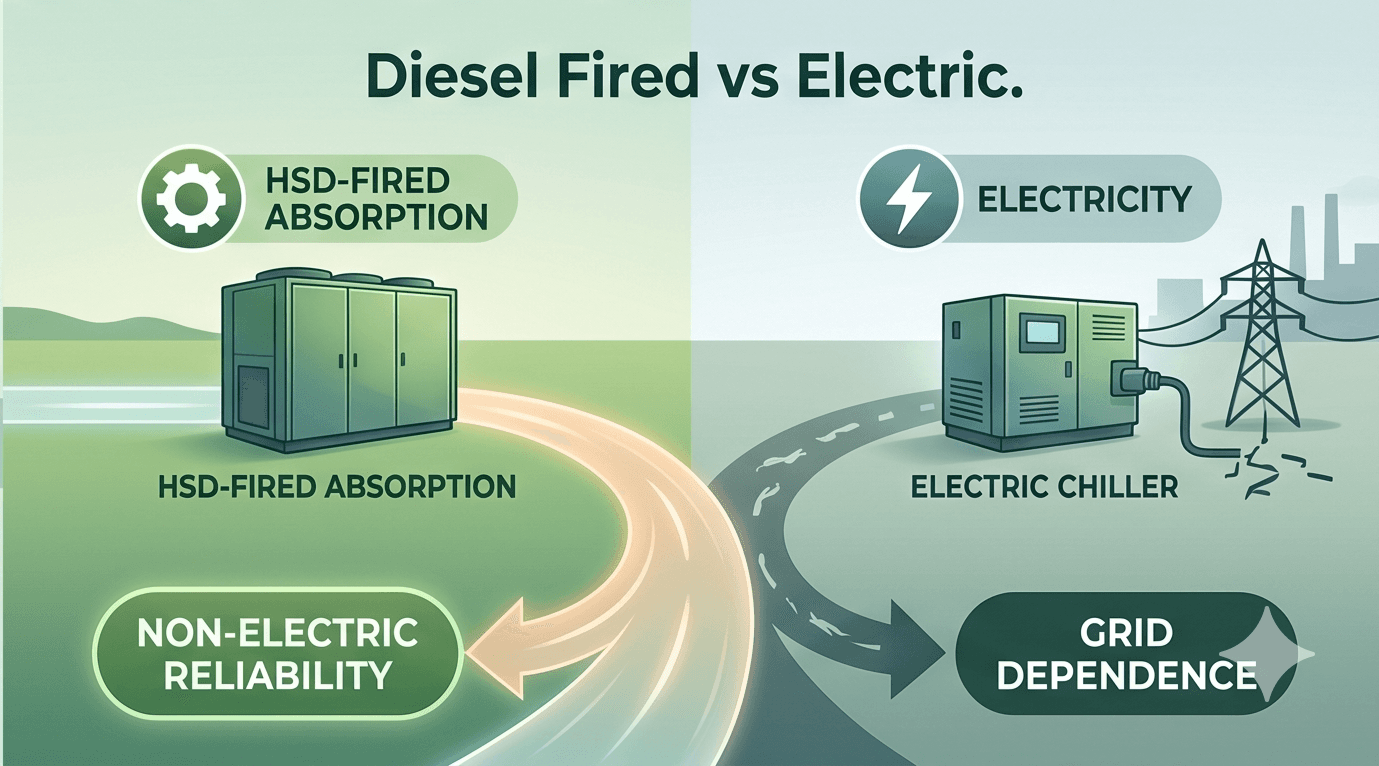
Walk through any large manufacturing facility in Pune, Ahmedabad, or the industrial corridors of Delhi NCR and you will find two things running simultaneously: a boiler or heat exchanger producing hot water as part of the process, and a bank of electric chillers drawing 0.5 to 1.2 kW of electricity per ton of refrigeration.
Both are expensive to run. Neither talks to the other.
A hot water absorption chiller solves exactly this. It takes thermal energy sitting in that process hot water water most plants either dump into a cooling tower or vent as waste and uses it to drive a refrigeration cycle. No compressor. Minimal electricity. The same plant now produces chilled water from heat it was already generating.
In India, where industrial electricity tariffs in Maharashtra, Karnataka, and Gujarat regularly exceed ₹8 to 12 per kWh, and where the PAT scheme mandates measurable energy reductions for designated consumers, this matters enormously.
What Is a Hot Water Chiller?
A hot water chiller is a vapour absorption machine (VAM) that uses hot water typically between 70°C and 95°C as its primary energy input to produce chilled water, usually between 6°C and 15°C, for air conditioning or process cooling.
It belongs to the broader family of thermally driven chillers, which also includes steam-fired, direct-fired, and exhaust-fired absorption machines. What sets the hot water variant apart is its energy source: instead of burning fuel directly or consuming dedicated steam, it recovers thermal energy from hot water that already exists in the facility.
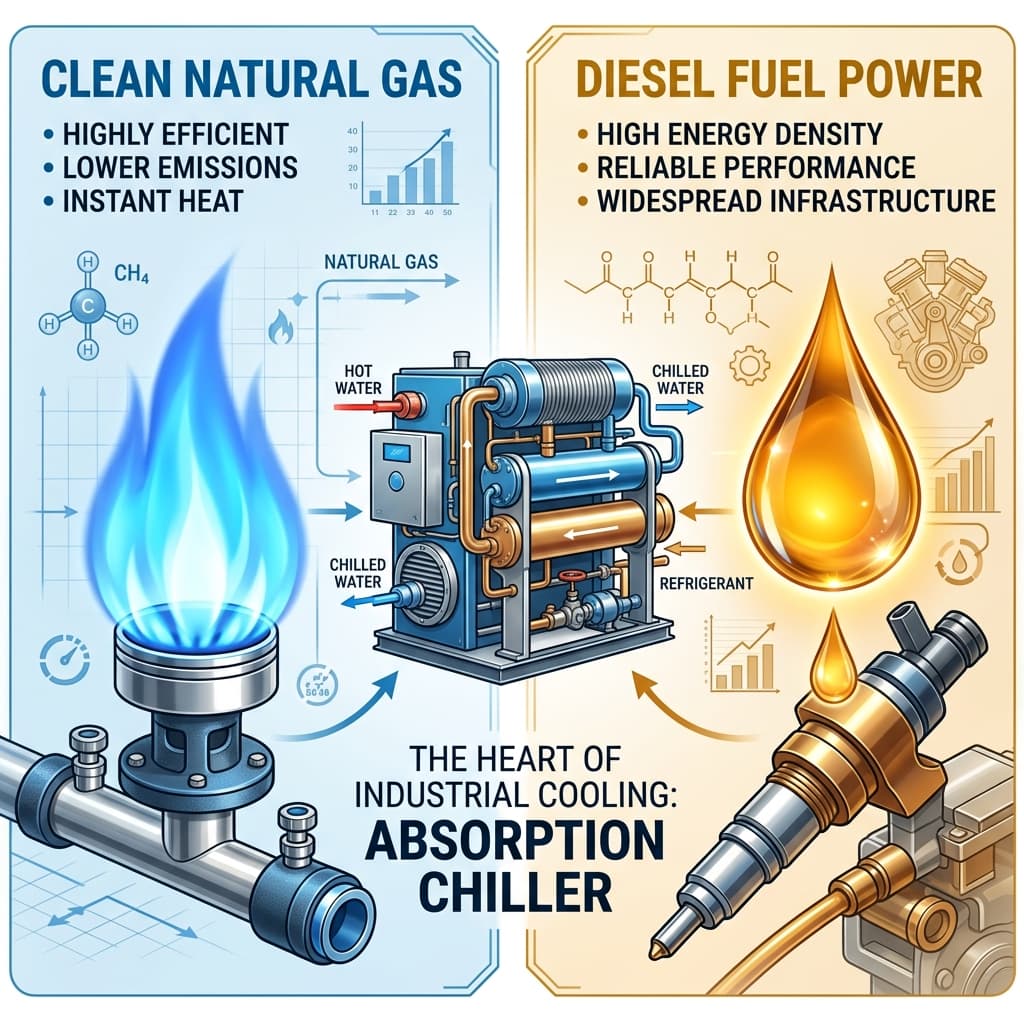
One important clarification: the term "hot water chiller" is used loosely in the market. A direct-fired chiller burns natural gas or diesel internally to generate heat it is a different product. A hot water absorption chiller uses an external hot water supply. The distinction matters when evaluating proposals.
How It Works: The Four-Stage Absorption Cycle
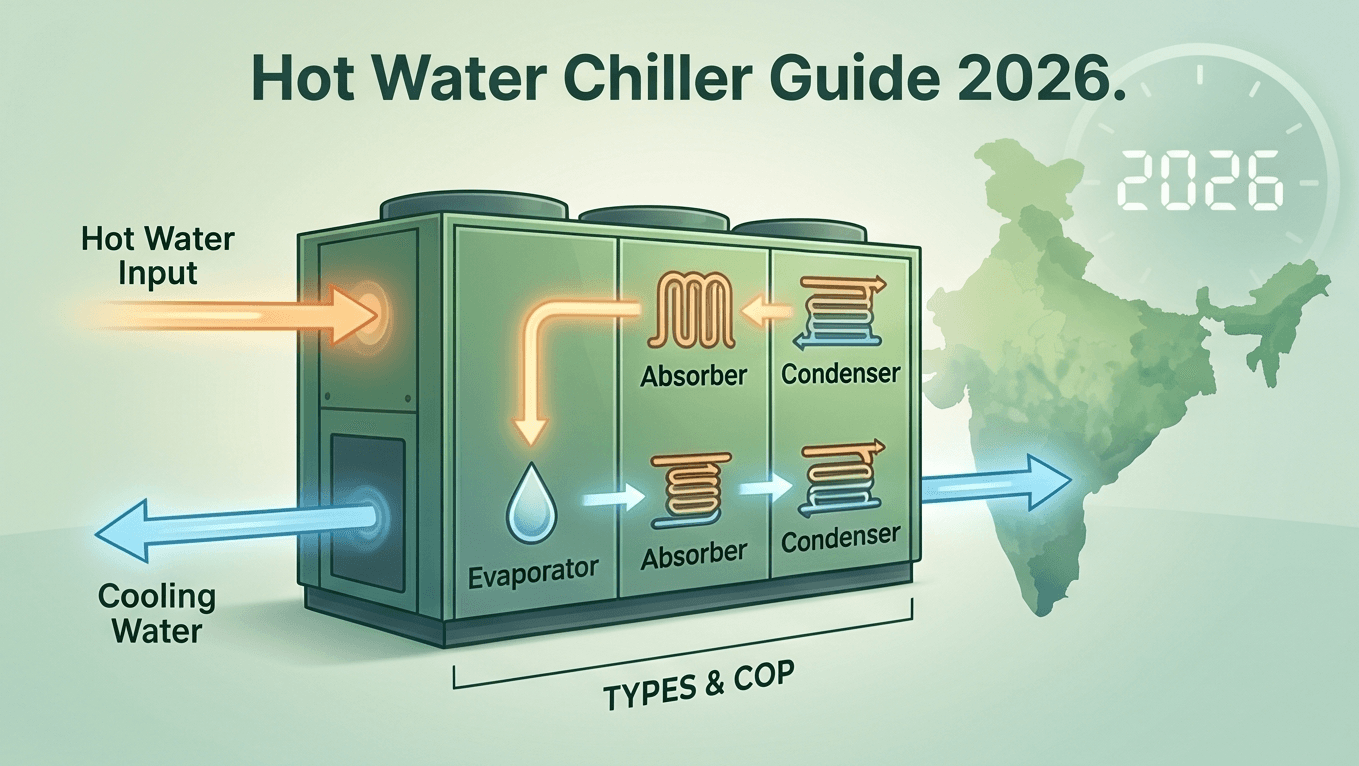
A conventional electric chiller uses a mechanical compressor to drive refrigeration. A hot water absorption chiller replaces the compressor with a thermochemical process using two fluids: water as the refrigerant and lithium bromide (LiBr) as the absorbent.
The cycle moves continuously through four chambers:
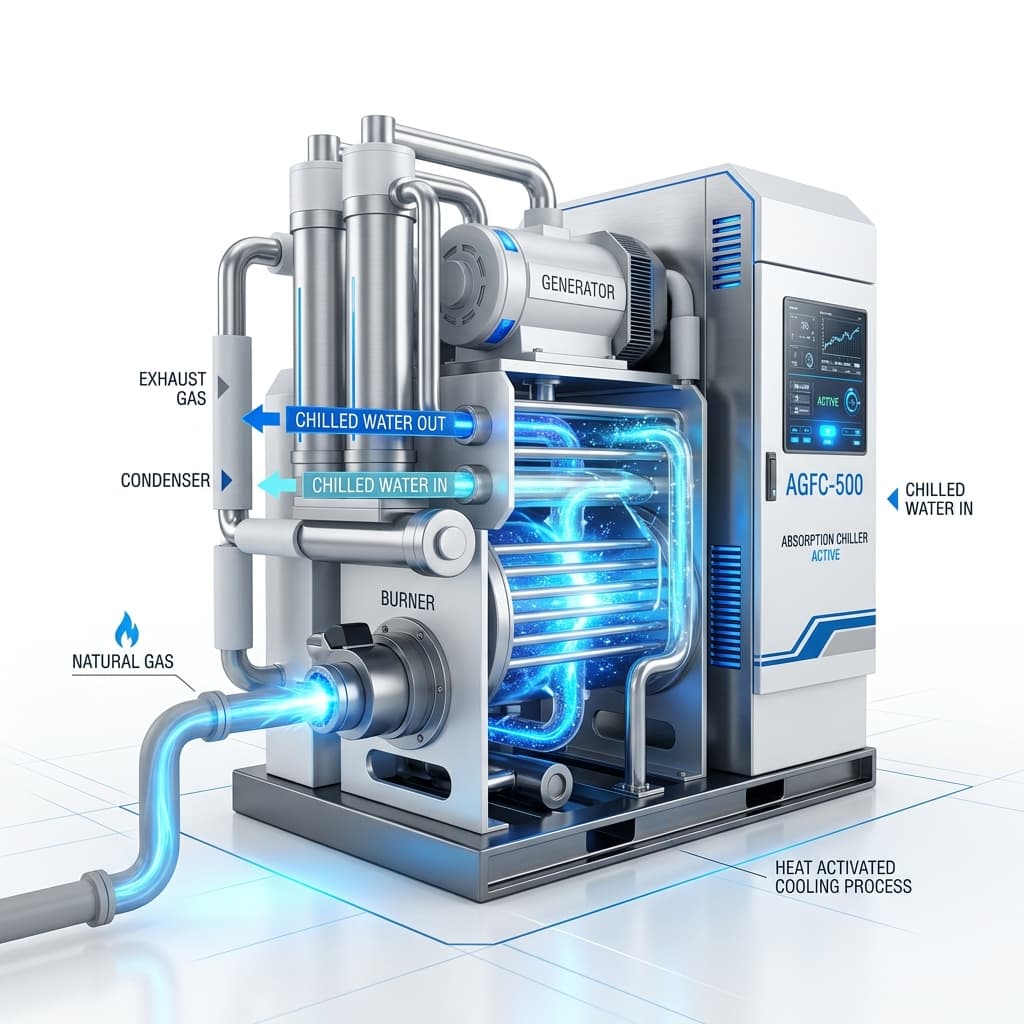
- Generator: Hot water from your facility flows through the generator and causes the dilute LiBr-water solution to boil. Water vapour separates and rises; concentrated LiBr flows back toward the absorber. This is where your waste hot water does the work a compressor would otherwise do.
- Condenser: Water vapour from the generator enters the condenser, where cooling water (from a cooling tower at 29 to 32°C) removes its heat and condenses it back into liquid water.
- Evapourator: The liquid water enters the evapourator, which operates at near-vacuum pressure (approximately 0.87 kPa). At this pressure, water boils at around 4.5°C absorbing heat from the chilled water circuit flowing through the evapourator tubes. This is your useful cooling output.
- Absorber: Water vapour from the evapourator is absorbed by the concentrated LiBr solution, maintaining the low pressure essential to the cycle. This releases heat, which is removed by cooling water. The dilute solution is then pumped back to the generator.
Three practical implications for plant engineers: the cooling tower is mandatory (and must be sized generously), hot water temperature at the machine inlet governs output more than flow rate, and total electrical consumption is only 15 to 25 kW for a 500 TR machine versus 350 to 600 kW for an equivalent electric chiller.
Single Effect vs Double Effect: Which Type Do You Need?
Single effect machines are the standard choice for Indian industrial waste heat recovery they accept lower-grade hot water and cover the widest range of applications. Double effect machines deliver better efficiency but require pressurised hot water or steam above 140°C, which is typically only available in refineries, petrochemical plants, and paper mills.
The practical rule: If your available hot water is below 100°C, specify single effect. If you have pressurised high-grade heat and want maximum COP, consider double effect or steam-fired.
COP and What It Actually Means for Your Energy Bill
A single effect hot water absorption chiller has a thermal COP of 0.65 to 0.75. An electric centrifugal chiller has an electrical COP of 5.0 to 6.5. These numbers look incomparable and they are, unless you also ask: what does each unit of energy actually cost?
When waste hot water is available at near-zero marginal cost, the absorption chiller delivers cooling at ₹0.10 to 0.20 per kWh versus ₹1.50 to 2.20 per kWh for an electric chiller at Indian industrial tariffs. That gap is the entire business case.
The honest caveat: if you must fire a boiler specifically to generate hot water for the chiller, the economics change significantly. The technology only makes unambiguous financial sense when the hot water is genuinely a byproduct already being generated and currently being wasted.
Want us to build this for you?
Talk to our teamIndicative Cost in India (2026)
Ex-works equipment prices range from ₹55 lakh to ₹90 lakh for 50 to 100 TR, up to ₹3.8 crore to ₹7.5 crore for 600 to 1,200 TR.
These are ex-works equipment prices. Total installed project cost including cooling tower, piping, insulation, civil works, and commissioning typically runs 40 to 65% above equipment price. For a 500 TR installation in Mumbai or Delhi NCR, budget ₹7 to 10.5 crore all-in.
Annual operating cost for a 500 TR hot water absorption chiller is approximately ₹24 to 42 lakh, versus ₹5.8 to 7.0 crore for an equivalent electric chiller. The gap in OPEX is the payback engine.
When It Makes Sense and When It Does Not
Strong fit:
- Waste hot water at 70°C+ is already being generated by your process
- Industrial electricity tariffs exceed ₹7 per kWh
- Cooling load is continuous and large (above 100 TR)
- Noise and vibration matter (absorption chillers have no compressor)
- You are targeting LEED, IGBC, or BEE star ratings
Weaker fit:
- No waste heat source exists and hot water must be generated from scratch
- Cooling is intermittent or highly variable
- Available floor space is severely constrained
- Chilled water below 5°C is required for process applications
Frequently Asked Questions
Conclusion
The case for a hot water absorption chiller is strong but specific. The technology performs at its best when continuous waste hot water above 70°C meets high electricity tariffs and large, sustained cooling loads. Those conditions are present at thousands of industrial facilities across Delhi, Mumbai, Bengaluru, Ahmedabad, and Gurgaon.
If your facility generates process hot water that is currently being wasted, a heat source assessment is the logical first step. The assessment takes a day. The savings, if the conditions are right, last decades.
For a site-specific feasibility study, contact BROAD India at akshay@broad.net or +91 94278 51584.
Pricing and performance figures are indicative and based on 2026 market conditions. Site-specific performance must be confirmed through a formal technical assessment.
Ready to optimize your industrial cooling?
Contact BROAD India's technical team to discuss your facility's cooling requirements and evaluate if absorption technology is the right fit.
Contact Us Today