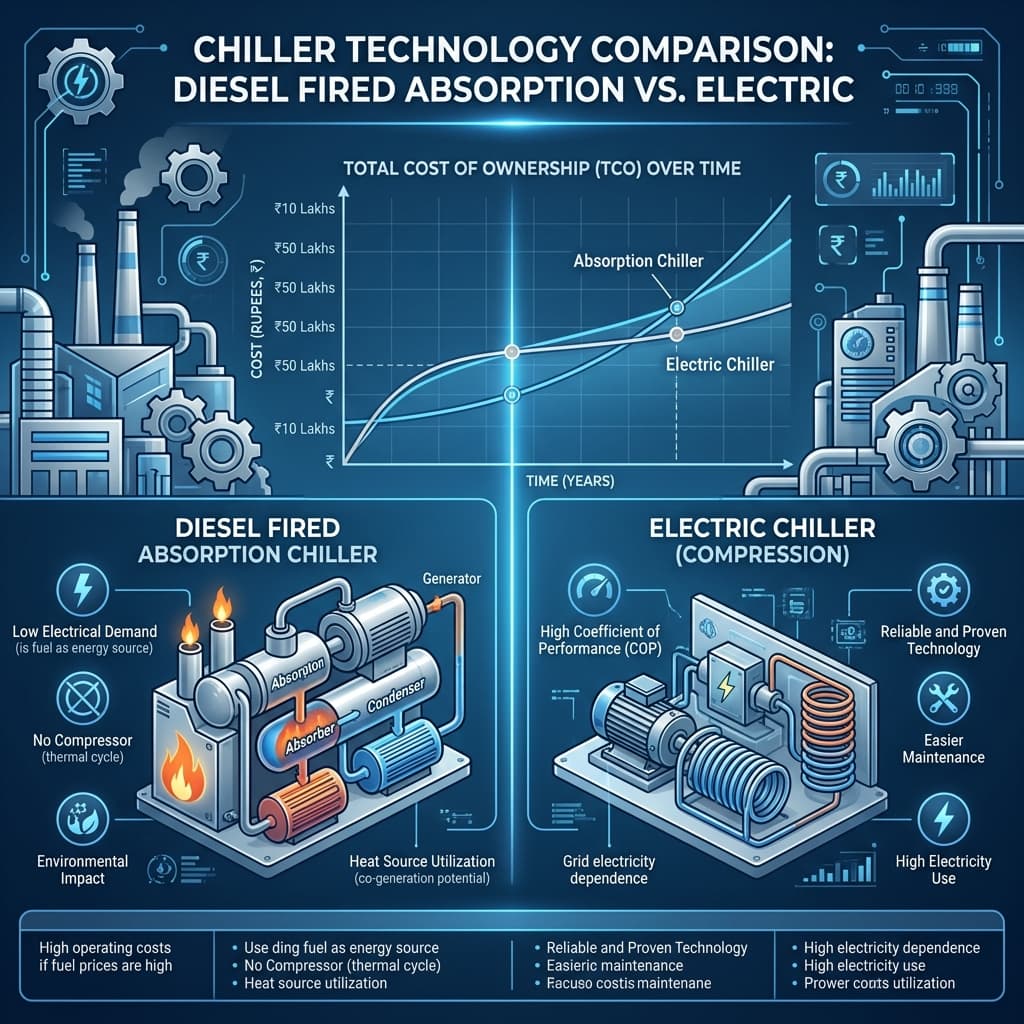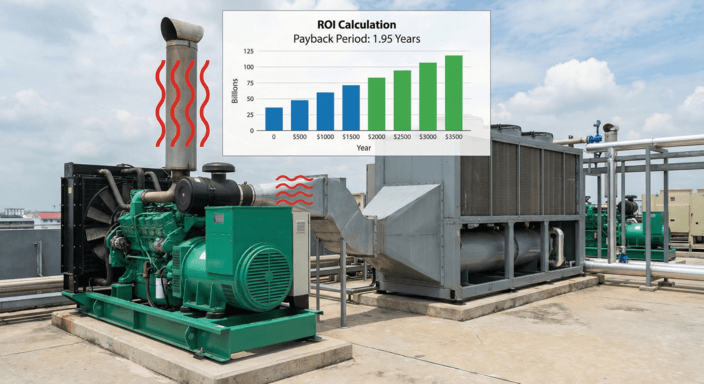
The business case for a hot water absorption chiller does not require complex modelling. Three numbers your electricity tariff, your cooling hours, and your available heat source temperature determine whether the investment pays back in 18 months or 4 years. This article shows you how to run the numbers for your facility.
Why Most Indian Facilities Delay This Decision
The hot water absorption chiller sits in an uncomfortable position in most Indian capital budget cycles. It is not cheap upfront a 300 TR installation runs ₹3.5 to 5.5 crore all-in. It is not a revenue-generating asset in the conventional sense. And because it produces the same output as the electric chiller it replaces (chilled water), the benefit is entirely in what you stop spending rather than what you start earning.
This framing spending more upfront to spend less over time creates a paralysis that delays decisions for years. Facilities in Mumbai, Gurgaon, and Ahmedabad routinely spend ₹4 to 6 crore annually on electricity for cooling that a ₹5 crore absorption system could deliver for ₹30 to 40 lakh. The payback arithmetic is not complicated. What is missing is a structured way to present it internally.
This article provides that structure.
The Four Variables That Determine Your ROI
Every hot water absorption chiller ROI model rests on four site-specific inputs. Get these right and the rest follows.
Variable 1: Your Electricity Tariff (₹/kWh)
This is the single most important number. Industrial and commercial electricity tariffs vary significantly across Indian states:
Approximate industrial HT tariff (2026): Maharashtra (Mumbai, Pune) ₹9.5 to ₹12; Karnataka (Bengaluru) ₹8 to ₹11; Gujarat (Ahmedabad, Surat) ₹7.5 to ₹10; Delhi NCR / Haryana (Gurgaon) ₹8 to ₹11; Rajasthan ₹7 to ₹9.
Use your actual billed rate, not the published tariff demand charges, time-of-use charges, and power factor penalties often add 15 to 25% to the headline figure.
Variable 2: Annual Cooling Hours
How many hours per year does your cooling system run at significant load? This varies dramatically by industry and location:
- Continuous process industries (pharma, petrochemical, textile): 6,000 to 8,000 hours/year
- Commercial HVAC (offices, hotels, malls in Delhi, Mumbai): 2,500 to 4,000 hours/year
- Seasonal manufacturing (food processing, with summer peak): 3,000 to 5,000 hours/year
More operating hours means faster payback. A system running 7,000 hours/year pays back nearly twice as fast as one running 3,500 hours.
Variable 3: Hot Water Availability and Temperature
The economics of waste heat recovery depend on the marginal cost of the heat source. If your hot water is genuinely a byproduct already being generated and currently being wasted the marginal cost is near zero. If you are firing a boiler specifically for the chiller, you must account for that fuel cost.
Heat source temperature affects output: a single effect machine at 88°C inlet delivers full rated capacity; at 78°C it delivers approximately 85 to 90% of rated capacity. Always calculate savings based on delivered temperature, not source temperature.
Variable 4: System Capacity (TR) and Baseline Power Draw
What size chiller are you replacing or supplementing? The baseline electricity consumption of the existing system establishes your savings reference. For a standard electric screw chiller:
- Energy consumption ≈ 0.65 to 0.75 kW per TR at full load (older equipment: 0.85 to 1.2 kW/TR)
- A 300 TR electric chiller draws approximately 195 to 225 kW at full load
- A 300 TR hot water absorption chiller draws 8 to 12 kW at full load
The difference is your annual electricity saving.
The ROI Calculation: A Worked Example
Scenario: A pharmaceutical manufacturing plant in Ahmedabad. Existing 300 TR electric screw chiller. Waste hot water available from reactor cooling at 84°C, continuous during production hours. Electricity tariff: ₹9.5/kWh. Operating hours: 6,500/year.
Step 1: Calculate annual electricity cost of existing electric chiller. Power draw at full load: 300 TR × 0.70 kW/TR = 210 kW. Annual energy consumption: 210 kW × 6,500 hrs = 13,65,000 kWh. Annual electricity cost: 13,65,000 × ₹9.5 = ₹1.30 crore
Step 2: Calculate annual electricity cost of hot water absorption chiller. Power draw (pumps only): ~10 kW. Annual energy consumption: 10 kW × 6,500 hrs = 65,000 kWh. Annual electricity cost: 65,000 × ₹9.5 = ₹6.2 lakh
Step 3: Calculate annual electricity saving. ₹1.30 crore − ₹6.2 lakh = ₹1.24 crore per year
Step 4: Calculate annual maintenance differential. Electric chiller annual maintenance: ₹8 to 12 lakh. Hot water absorption chiller maintenance: ₹4 to 6 lakh. Annual maintenance saving: ₹4 to 6 lakh
Step 5: Total annual saving. Electricity saving + maintenance saving = ₹1.28 to 1.30 crore per year
Want us to build this for you?
Talk to our teamStep 6: Estimate total project cost. Equipment: ₹1.8 to 2.4 crore. Cooling tower: ₹30 to 50 lakh. Piping & civil: ₹35 to 55 lakh. Commissioning: ₹12 to 20 lakh. Total project cost: ₹2.6 to 3.7 crore.
Step 7: Simple payback. ₹3.0 crore (midpoint) ÷ ₹1.29 crore/year = 2.3 years. At ₹9.5/kWh electricity and 6,500 operating hours, a 300 TR waste heat recovery project pays back in approximately 26 to 28 months.
How Tariff and Hours Affect Payback: A Sensitivity Table
The table makes the decision framework clear: if your tariff is above ₹8/kWh and your cooling system runs more than 5,000 hours per year, payback is under 4 years in almost every scenario. Above ₹10/kWh and 6,000 hours, payback under 2.5 years is routinely achievable.
Beyond Simple Payback: The Lifecycle View
Simple payback is a useful first filter, but it understates the value of absorption chiller investments because it ignores what happens after payback. A hot water absorption chiller has a 20 to 25 year operational life. An investment that pays back in 2.3 years then generates net savings for another 18 to 22 years.
Net Present Value (NPV) analysis discounting future savings at a 10 to 12% hurdle rate typical for Indian industrial capex consistently shows strongly positive results for facilities with tariffs above ₹8/kWh and 5,000+ operating hours. Internal Rate of Return (IRR) on well-specified projects in Maharashtra, Gujarat, and Karnataka regularly exceeds 35 to 50%.
Two additional value elements that simple payback calculations typically exclude:
- Carbon credit and PAT cycle value: Under India's PAT scheme, energy savings from absorption chiller projects generate Energy Saving Certificates (ESCerts). For large designated consumers, these have measurable financial value in addition to the direct electricity saving.
- Peak demand charge elimination: Electric chillers draw substantial power at peak demand periods often the most expensive electricity tariff bands. Absorption chillers draw near-zero electricity regardless of time of day, eliminating peak demand charges entirely. For facilities in Maharashtra on time-of-day tariffs, this alone can add ₹15 to 25 lakh annually to the savings figure.
The Most Common Financial Modelling Mistakes
- Using average electricity cost instead of marginal cost: If you are on a demand charge tariff structure (most Indian industrial consumers above 500 kVA contracted demand are), the correct comparison is marginal cost including demand charges which is typically 20 to 30% higher than the per-unit energy charge alone.
- Ignoring cooling tower operating cost: The larger cooling tower a VAM requires consumes more water and pumping energy. This adds ₹8 to 14 lakh annually to operating cost at 500 TR scale and should be in the model.
- Assuming 100% load operation: Real cooling systems do not run at full load year-round. A part-load efficiency factor of 0.80 to 0.85 applied to annual hours gives a more conservative and more accurate savings estimate.
Frequently Asked Questions
Conclusion
The ROI case for a hot water absorption chiller in India is not difficult to make at the right tariff, the right operating hours, and with genuine waste heat available, the numbers are compelling. The challenge is typically the internal capital allocation process, not the project economics.
The worked example in this article is a template. Substitute your actual tariff, your measured hot water temperature, and your cooling system operating hours and the calculation produces your site-specific payback period in under an hour.
If the result is under 36 months, the conversation with your CFO should be straightforward. If it is over 48 months, the project may need a co-generation or CCHP angle to improve the economics before it clears hurdle rates.
For a detailed financial model specific to your facility, contact BROAD India at akshay@broad.net or +91 94278 51584.
Tariff data and cost estimates are indicative based on 2026 Indian market conditions.
Ready to optimize your industrial cooling?
Contact BROAD India's technical team to discuss your facility's cooling requirements and evaluate if absorption technology is the right fit.
Contact Us Today