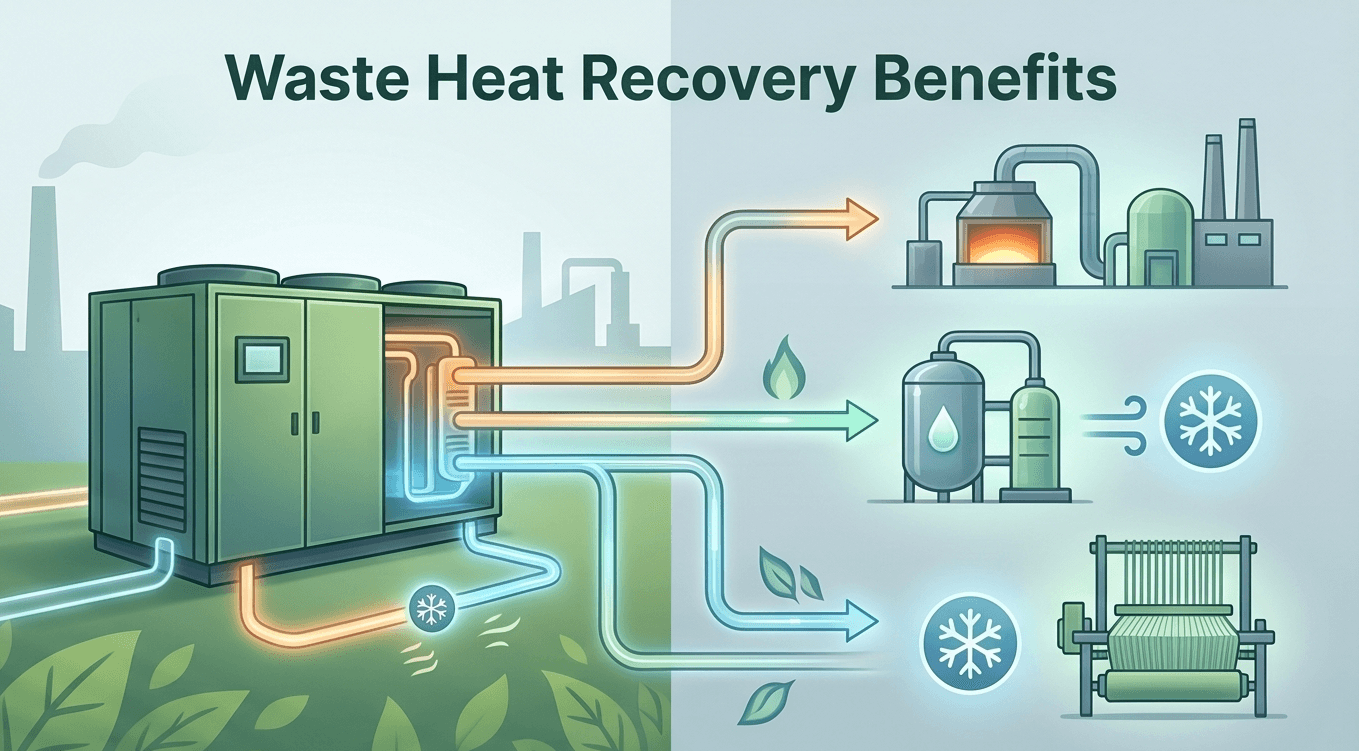
India wastes an estimated 40 to 60% of its industrial thermal energy as hot water, flue gas, and steam condensate. For facilities across Ahmedabad, Mumbai, Delhi NCR, and Bengaluru, a hot water absorption chiller converts that waste directly into chilled water turning a cost centre into a cooling asset.
Two Conversations Happening in the Same Building
In most large Indian manufacturing plants, the process team and the utilities team are solving the same problem from opposite ends.
The process team says: "We have 500 kW of hot water exiting our reactor at 84°C and we are rejecting it through the cooling tower. The tower is overloaded in summer."
The utilities team says: "Our electricity bill for HVAC and process cooling is ₹3.8 crore this quarter. We need to cut it."
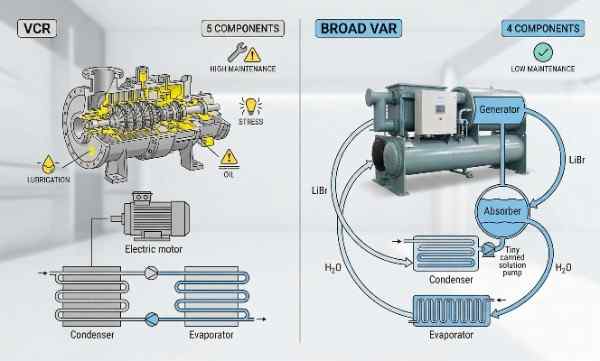
Both problems share a single solution: a hot water vapour absorption chiller. It recovers the thermal energy the process team is dumping and uses it to produce the chilled water the utilities team is paying electricity to generate. The cooling tower load drops. The electricity bill drops. The waste heat becomes productive.
This article identifies the five Indian industries where this opportunity is largest, what the heat source looks like in each, and what an absorption chiller project realistically delivers.
What Qualifies as Usable Waste Heat?
Not every hot water stream is suitable to drive an absorption chiller. The minimum viable conditions for a standard single effect LiBr machine are:
- Temperature: Hot water at or above 70°C at the chiller inlet (80 to 88°C is optimal for full output)
- Flow rate: Consistent and sufficient approximately 1.45 to 1.55 kW of heat input per kW of cooling required
- Availability: Continuous or near-continuous, aligned with cooling demand hours
- Quality: TDS and pH within acceptable limits for the generator tube material
Intermittent or low-temperature streams (below 65°C) are not suitable for standard single effect machines. However, if a facility generates multiple low-grade streams that can be combined, or if heat exchangers can consolidate streams to reach the required temperature, the feasibility changes.
With that baseline established, here are the industries where the fit is strongest in India.
Industry 1: Textile Manufacturing Ahmedabad, Surat, Coimbatore
Textile dyeing and finishing is one of the most heat-intensive manufacturing processes in India, and one of the best matches for hot water absorption cooling.
Dyeing machines operate at 90 to 130°C and discharge process water at 70 to 85°C after the cycle. Finishing processes heat-setting, stentering, and drying generate exhaust air and condensate at similar temperatures. In large integrated mills processing hundreds of tonnes of fabric per day, the aggregate waste heat can reach 2,000 to 5,000 kW enough to drive 300 to 700 TR of absorption cooling continuously.
The cooling need in textile plants is also substantial: air conditioning for weaving and spinning halls (humidity control is critical to yarn quality), process cooling for dye houses, and comfort cooling for large workforces in non-air-conditioned production areas.
In the industrial clusters of Ahmedabad and Surat, where electricity tariffs for large industrial consumers regularly exceed ₹9 to 11 per kWh and summer ambient temperatures push cooling loads hard, hot water VAM systems consistently achieve payback in 18 to 30 months.
Key heat source: Dye bath discharge water, stentering machine exhaust, steam condensate return. Temperature: 72 to 88°C.
Industry 2: Pharmaceutical Manufacturing Ahmedabad, Hyderabad, Baddi
Pharmaceutical production is one of the most electricity-intensive industrial sectors in India and one of the most cooling-dependent. Clean rooms, cold storage, reactor temperature control, lyophilisation, and HVAC for controlled environments all require precise, reliable chilled water.
Simultaneously, pharma plants are significant heat generators. Batch reactors operate at 60 to 150°C and discharge cooling water at 70 to 90°C after the reaction cycle. Autoclave and sterilisation cycles produce steam condensate at 75 to 85°C. Hot water from CIP (Clean-In-Place) systems exits at 80 to 90°C.
The challenge in pharma is consistency: batch processes generate heat intermittently, and cooling demand patterns may not align perfectly with heat availability. This makes thermal storage a buffer tank of hot water an important design element for pharmaceutical VAM projects. With a correctly sized buffer tank, the absorption chiller can continue operating smoothly between batch cycles.
Pharmaceutical clusters in Ahmedabad (Changodar, Bavla), Hyderabad (Genome Valley, IDA Bollaram), and Baddi have seen significant adoption of hot water VAM systems, driven by high electricity costs and increasingly stringent ESG reporting requirements from multinational pharma clients.
Key heat source: Batch reactor cooling, autoclave condensate, CIP hot water return. Temperature: 74 to 90°C.
Industry 3: Food and Beverage Processing Pune, Mumbai, Delhi NCR
Food and beverage processing generates waste hot water at almost every stage: pasteurisation, sterilisation, cooking, blanching, and CIP all involve heating water to 70 to 95°C and then cooling it back down. Historically, this heat has been rejected through cooling towers simultaneously wasting energy and consuming water.
In dairy plants, the pasteuriser heating and cooling circuit is a particularly clean heat source: well-controlled temperature, continuous flow, and consistent quality. A 50,000-litre-per-day dairy plant generating hot water at 80 to 85°C from its pasteuriser circuit typically has enough thermal energy to drive 80 to 150 TR of absorption cooling sufficient for all facility air conditioning and cold room pre-cooling.
Beverage plants breweries, soft drink manufacturers, and juice processors in Pune, Delhi, and Mumbai have similar profiles, with bottle washing and pasteurisation lines generating consistent hot water streams at 72 to 85°C.
The food industry also has a strong sustainability narrative for this technology: reducing electricity consumption from grid power reduces Scope 2 emissions, which is increasingly required in supply chain sustainability disclosures from global retail buyers.
Key heat source: Pasteuriser heating circuit, CIP returns, blancher cooling water. Temperature: 70 to 85°C.
Industry 4: Petrochemical and Refinery Operations Gujarat, Mumbai, Vizag
Refineries and petrochemical plants are, by the nature of their processes, vast heat generators. Crude distillation, catalytic cracking, reforming, and fractionation all produce streams at temperatures ranging from 80°C to several hundred degrees Celsius. The available waste heat vastly exceeds what can be usefully recovered by hot water absorption alone making these sites candidates for both single and double effect machines, as well as steam-fired and exhaust-fired VAM configurations.
Want us to build this for you?
Talk to our teamFor hot water absorption specifically, the relevant streams are the lower-temperature process cooling circuits: column bottoms cooling, product coolers, and utility systems that operate in the 75 to 100°C range. These streams are continuous, high-volume, and typically at well-controlled temperatures ideal heat sources.
Gujarat's Dahej, Hazira, and Vadodara petrochemical corridors, and Mumbai's Trombay and Mahul refinery complex, have multiple operating hot water VAM installations. The scale of these plants often 10,000+ TR of total cooling demand means even a single absorption unit capturing a fraction of available waste heat represents crores in annual electricity savings.
Key heat source: Process cooling circuits, column bottom coolers, utility cooling water. Temperature: 78 to 105°C.
Industry 5: Commercial Complexes with Co-Generation Delhi NCR, Bengaluru, Gurgaon, Mumbai
Co-generation running a diesel generator set or gas engine on-site and recovering waste heat from its cooling circuits is one of the most financially compelling applications for hot water absorption chillers in India's commercial real estate and IT park sector.
A 1 MW diesel generator produces approximately 350 to 450 kW of recoverable heat from its jacket water cooling circuit, typically at 80 to 90°C. Without heat recovery, this energy is rejected through a radiator and wasted. With a hot water absorption chiller, it drives 100 to 150 TR of cooling.
Large commercial campuses in Gurgaon, Bengaluru Electronic City, Mumbai's BKC, and Delhi's Connaught Place area operate DG sets as primary or backup power sources. The economics are particularly strong in Delhi NCR where industrial and commercial electricity tariffs are among the highest in India and DG set usage hours are significant.
The co-generation configuration also provides a resilience benefit: when the grid fails and the DG set runs, the absorption chiller continues to provide cooling with no additional electricity demand on the generator reducing the DG set capacity required.
Key heat source: DG set jacket water, lube oil cooler, after-cooler. Temperature: 80 to 92°C.
How to Assess Your Facility's Waste Heat Potential
Before specifying equipment, four things must be confirmed:
- Delivered temperature: Measure hot water temperature at the proposed chiller connection point not at the source. Uninsulated pipe runs lose 1 to 3°C per 10 metres in Indian ambient conditions.
- Flow rate and availability: Is the heat source continuous during cooling hours? If not, what buffer storage is feasible?
- Water quality: Conduct a basic analysis TDS, pH, hardness. This determines tube material selection and maintenance intervals.
- Heat quantity: Calculate total kW available. You need 1.45 to 1.55 kW of heat input per kW of cooling output at standard conditions.
A one-day heat source audit at the facility, conducted before equipment specification, eliminates the most common causes of post-installation underperformance.
Frequently Asked Questions
Conclusion
The industries described in this article textiles, pharmaceuticals, food processing, petrochemicals, and commercial co-generation collectively represent thousands of facilities across India's major industrial cities. In each of them, hot water above 70°C is being generated continuously and discarded as waste while electricity meters run for cooling.
The conversion rate is straightforward: every 1 kW of waste hot water recovered at the right temperature replaces ₹1.50 to 2.20 of electricity cost per operating hour at current Indian tariffs. At scale, the annual figures are significant.
The question is not whether the technology works. It does, consistently, across all these industries. The question is whether your specific waste heat stream meets the conditions and that is what a heat source assessment answers.
Contact BROAD India at akshay@broad.net or +91 94278 51584 to schedule a site assessment.
Performance and cost figures are indicative based on 2026 Indian market conditions and standard operating parameters.
Ready to optimize your industrial cooling?
Contact BROAD India's technical team to discuss your facility's cooling requirements and evaluate if absorption technology is the right fit.
Contact Us Today