
Magnetic Bearing Chiller: How Oil-Free Cooling Works
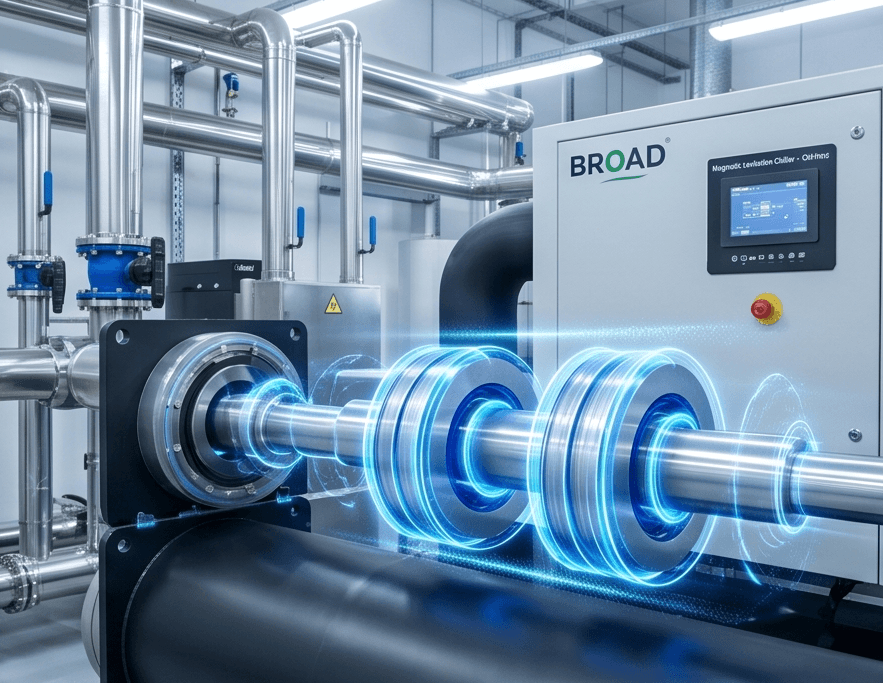
A magnetic bearing chiller's compressor shaft never touches anything while it spins - no oil, no gears, no mechanical contact at all.
For facilities that can't run a heat-driven absorption chiller, this is the most efficient electric cooling technology available, with part-load efficiency gains of more than 50% over conventional designs. But the headline efficiency number, IPLV, hides a sizing mistake that quietly costs many buyers that exact advantage. This guide explains how magnetic levitation replaces oil-lubricated bearings, what the real efficiency numbers mean, and where this technology fits when waste heat or steam isn't an option.
What Is a Magnetic Bearing Chiller? Oil-Free Cooling Explained
A magnetic bearing chiller is an electric cooling system whose compressor shaft floats on a magnetic field instead of resting on oil-lubricated bearings, which removes mechanical friction and the maintenance that comes with it. For Indian facilities that cannot run a heat-driven absorption chiller - no waste heat, no steam, no spare fuel - this is the most efficient electric alternative available today. This guide explains how the technology works, what it actually delivers at part load, and the one specification mistake that undermines its biggest advantage.
How does a magnetic bearing chiller work without oil?
The compressor shaft is suspended by an active magnetic field that keeps it from touching any surface as it spins, which is why the design is also called oil-free. According to Hitachi, this eliminates mechanical wear, removes the need for a lubrication system, and cuts the energy losses that friction normally causes.
The motor pairs with a direct-drive, high-speed design that skips the speed-increasing gears conventional centrifugal compressors rely on, removing another source of transmission loss. BROAD India's Power-Efficient Chiller uses Danfoss Turbocor twin-impeller compressors with R-513A refrigerant - a low-global-warming-potential fluid that meets AHRI, ASHRAE, and FEMP standards. With no oil entering the evapourator, heat-transfer surfaces stay cleaner over the chiller's life, which is a second, less-obvious efficiency gain.
Why does removing oil make the chiller more efficient?
Oil fouls heat-exchanger tubes over time, gradually degrading the heat transfer that determines how efficiently a chiller cools. Removing oil keeps tube surfaces clean for the life of the machine, which is part of why magnetic bearing units sustain high performance for longer than conventional designs, per Chiller & Cooling Best Practices.
The efficiency advantage compounds at partial load. Because the compressor runs on a variable-speed drive with no mechanical drag, it can throttle output far more precisely than a fixed-speed unit. BROAD's design modulates capacity down to 0.1 Hz and delivers part-load performance gains of more than 50% compared with conventional systems - and most chillers run at part load far more often than at full design capacity.
What efficiency numbers do magnetic bearing chillers actually deliver?
Top-tier magnetic bearing chillers post some of the highest efficiency ratings in the industry. BROAD's Power-Efficient Chiller reaches an IPLV (Integrated Part-Load Value) of up to 13.26, while Hitachi's VM series claims a full-load COP of 7.0 and an IPLV of 9.5, and Mitsubishi Heavy Industries' ETI-N series rates a COP of 6.4 with an IPLV of 9.1.
| Manufacturer | Full-load COP | IPLV | Refrigerant |
|---|---|---|---|
| BROAD (Danfoss Turbocor) | - | Up to 13.26 | R-513A (low-GWP) |
| Hitachi VM series | 7.0 | 9.5 | - |
| MHI ETI-N series | 6.4 | 9.1 | HFO-1233zd(E) |
Why can IPLV alone be misleading?
IPLV is a single weighted average across four standard load points, and treating it as the whole story can lead to the wrong chiller size. According to Michigan Air Products, the real efficiency advantage of magnetic bearing compressors appears at loads of 85% and below - which means an undersized "least premium cost" chiller, forced to run near full load most of the time, never reaches the efficiency its IPLV rating implies.
The fix is straightforward: oversize slightly. A facility with a 300-ton load gets more value from a 350-400-ton magnetic bearing chiller running in its efficient part-load range than from a 300-ton unit running near capacity. Selecting on IPLV alone, without checking where the chiller will actually operate against your load profile, is the single most common specification mistake with this technology.
Where does a magnetic bearing chiller fit if your site already uses a VAC?
A magnetic bearing chiller is not a substitute for a vapour absorption chiller where waste heat or steam is available - it is the right electric option when that heat doesn't exist. Mission-critical loads with no spare thermal energy, such as standalone data center halls, hospital critical-care wings, or sites without a boiler or process-steam source, are the natural fit.
It also integrates into a broader system: BROAD's unit can run standalone, as part of a district cooling network, or alongside a CCHP system, picking up cooling load that an absorption chiller cannot reach economically. The decision isn't "electric versus non-electric" - it's matching each load to whichever energy source serves it most efficiently, heat where it's available, and the most efficient electric option where it isn't.
Frequently Asked Questions
How does a magnetic bearing chiller work?
What is IPLV in a chiller, and why does it matter?
Are magnetic bearing chillers more efficient than conventional chillers?
Do magnetic bearing chillers need oil maintenance?
Can a magnetic bearing chiller replace a vapour absorption chiller?
What refrigerant do magnetic bearing chillers use?
Find the Right Cooling Technology for Every Load
Whether your site runs on waste heat, steam, or grid power, the right chiller depends on what energy you actually have to work with. BROAD India's engineers assess your load profile and heat sources to recommend the most efficient fit, with 200+ installations nationwide.
Talk to BROAD India's HVAC engineersFrequently Asked Questions
What is a Vapour Absorption Chiller?
Can BROAD chillers run on waste heat?
Do you provide after-sales service in India?
Need Help With Your Cooling System?
BROAD India's engineering team can assess your facility's cooling requirements and recommend the most energy-efficient solution - from vapour absorption chillers to waste heat recovery systems.