
India's PAT scheme - Perform, Achieve and Trade - is a mandatory energy efficiency mechanism that sets Specific Energy Consumption (SEC) reduction targets for large industrial plants across more than eight energy-intensive sectors, with financial penalties for under-achievers and tradeable Energy Savings Certificates (ESCerts) as rewards for over-achievers. For plant engineers in cement, steel, textile, fertilizer, and paper operations, the PAT scheme is already reshaping which cooling technologies get approved in capital plans - because chiller electricity use is a direct input to the SEC calculation that decides whether a plant earns or buys ESCerts. This guide explains how the mechanism works and what it means for cooling decisions.
The Bureau of Energy Efficiency launched PAT in July 2012 under the National Mission for Enhanced Energy Efficiency (NMEEE), as part of India's National Action Plan on Climate Change. It covers Designated Consumers (DCs) - industrial plants above specific energy-use thresholds - and assigns each a unit-level SEC reduction target over a three-year cycle, according to BEE's official scheme documentation.
The sectors covered now include aluminium, cement, chlor-alkali, fertilizer, iron and steel, pulp and paper, textiles, thermal power, refineries, and commercial buildings - precisely the industries where industrial cooling is a significant energy load. Plants that overachieve their SEC targets receive ESCerts; those that under-achieve must buy ESCerts from over-achievers or pay a penalty calculated on the remaining gap, per BEE's compliance framework.
SEC is calculated on a gate-to-gate basis: all energy consumed within the plant boundary - electricity, fuel, and steam - divided by total production output. That calculation includes every unit of grid power drawn by electric chillers, every kilogram of steam diverted to absorption cooling, and every cubic metre of gas burned for direct-fired cooling.
This is the connection most plant engineers miss. Reducing cooling-related electricity consumption directly lowers the plant's SEC, which directly affects whether the plant over- or under-achieves its PAT target. A plant running large fixed-speed electric chillers at low part-load efficiency is accumulating SEC points that a more efficient cooling solution would eliminate. According to a 2026 peer-reviewed analysis in the Journal of Environmental Management (ScienceDirect), PAT improved the energy intensity of designated firms by 2.7% in cement and 1.6% in the fertilizer sector - and in both, cooling and compressed air are among the largest non-process electricity loads.
Three chiller technology changes have the most direct impact on SEC for PAT Designated Consumers. Replacing fixed-speed electric chillers with variable-speed or magnetic bearing units cuts kW/TR, which reduces grid electricity draw and lowers the SEC numerator directly. The part-load efficiency gains of over 50% documented for magnetic bearing designs mean every hour of partial-load operation contributes less to SEC than the same cooling output from a conventional machine.
Converting cooling loads from electric to heat-driven - through steam-fired or waste-heat-driven absorption chillers - removes those loads from grid electricity entirely and reclassifies them against process heat or waste energy. Where that heat is already counted as a by-product in the SEC calculation (for example, recovered boiler exhaust), the cooling effectively costs the plant near-zero SEC impact. This is the mechanism that makes absorption cooling a PAT strategy, not just an energy strategy.
Waste heat recovery more broadly - including absorption heat pump installations that upgrade low-grade heat to process hot water - similarly reduces the total energy input per unit of production, improving SEC even where cooling is not the primary application.
ESCerts are issued by BEE to plants that over-achieve their SEC reduction targets and are tradeable on the Indian Energy Exchange and Power Exchange India, with prices determined by market supply and demand. In PAT Cycle I, ESCerts worth approximately ₹1,000 million were traded, according to peer-reviewed analysis from KREA University (Energy Economics, 2024).
A plant that upgrades its cooling to cut SEC below its assigned target earns ESCerts it can sell - converting an energy efficiency investment into a direct revenue stream. The inverse is equally real: a plant that under-achieves its SEC target must purchase ESCerts at market price or pay a financial penalty. The net financial exposure of PAT compliance is therefore not limited to the cost of efficiency upgrades; it includes the cost of buying ESCerts if those upgrades are not made.
The penalty for PAT non-compliance is calculated on what remains to be achieved against the assigned SEC target - so the larger the gap, the larger the penalty, per BEE's compliance framework. Plants that continue running inefficient cooling without upgrading face a compounding risk: rising electricity tariffs increase the energy cost of the gap, while the SEC deficit accumulates across the three-year cycle before the compliance assessment year.
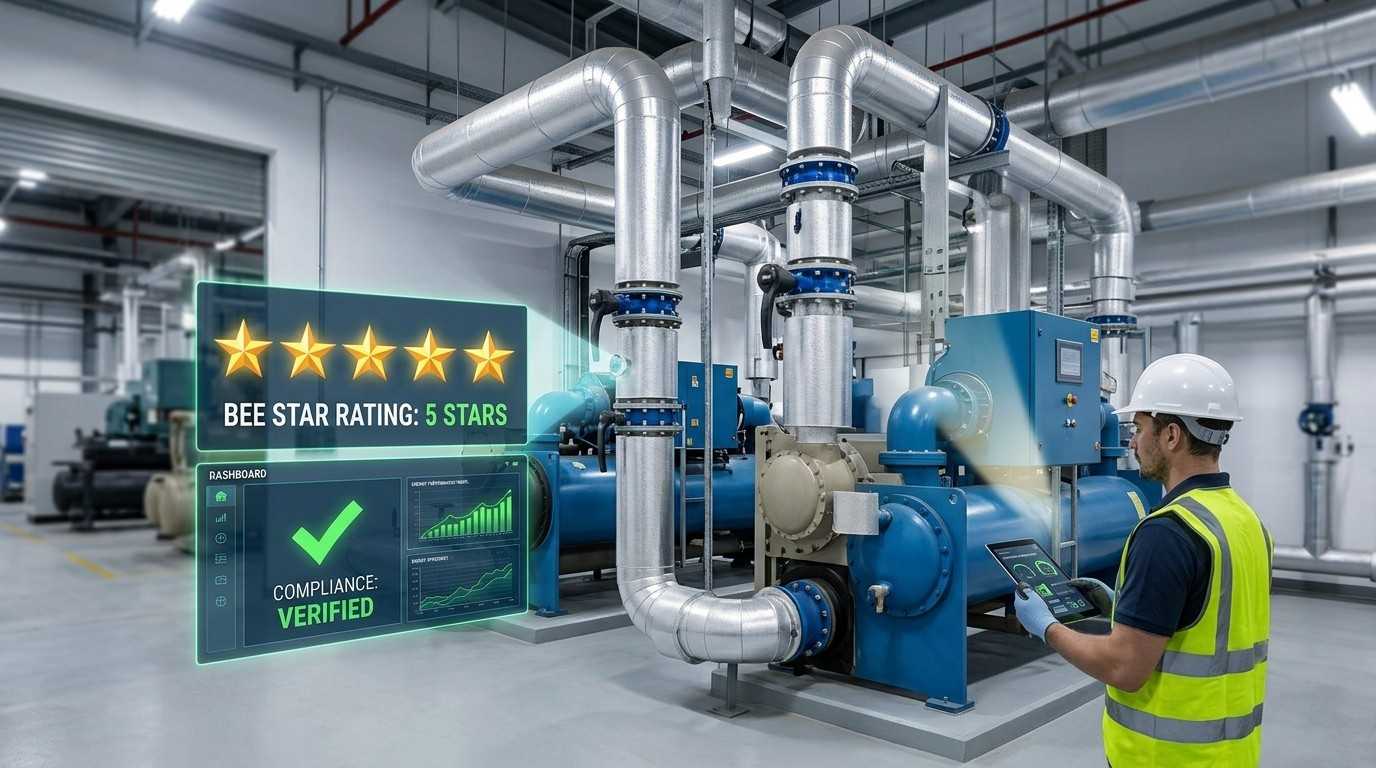
The BEE mandatory chiller star labelling that became effective from January 2026 sits alongside PAT as a separate but reinforcing compliance layer. A plant that upgrades chillers to achieve BEE 4-star or 5-star compliance simultaneously reduces its SEC contribution from cooling - satisfying both regulatory requirements with one capital investment, which is the strongest financial case for a chiller upgrade in a PAT Designated Consumer.
Make Your Cooling System Work for Your PAT Target
For PAT Designated Consumers, the chiller upgrade decision is no longer just an energy question - it is a compliance and revenue question. BROAD India's engineers help plant energy managers calculate the SEC impact of absorption, magnetic bearing, and waste-heat cooling upgrades before the capital case goes to finance.
Talk to BROAD India's HVAC engineers