
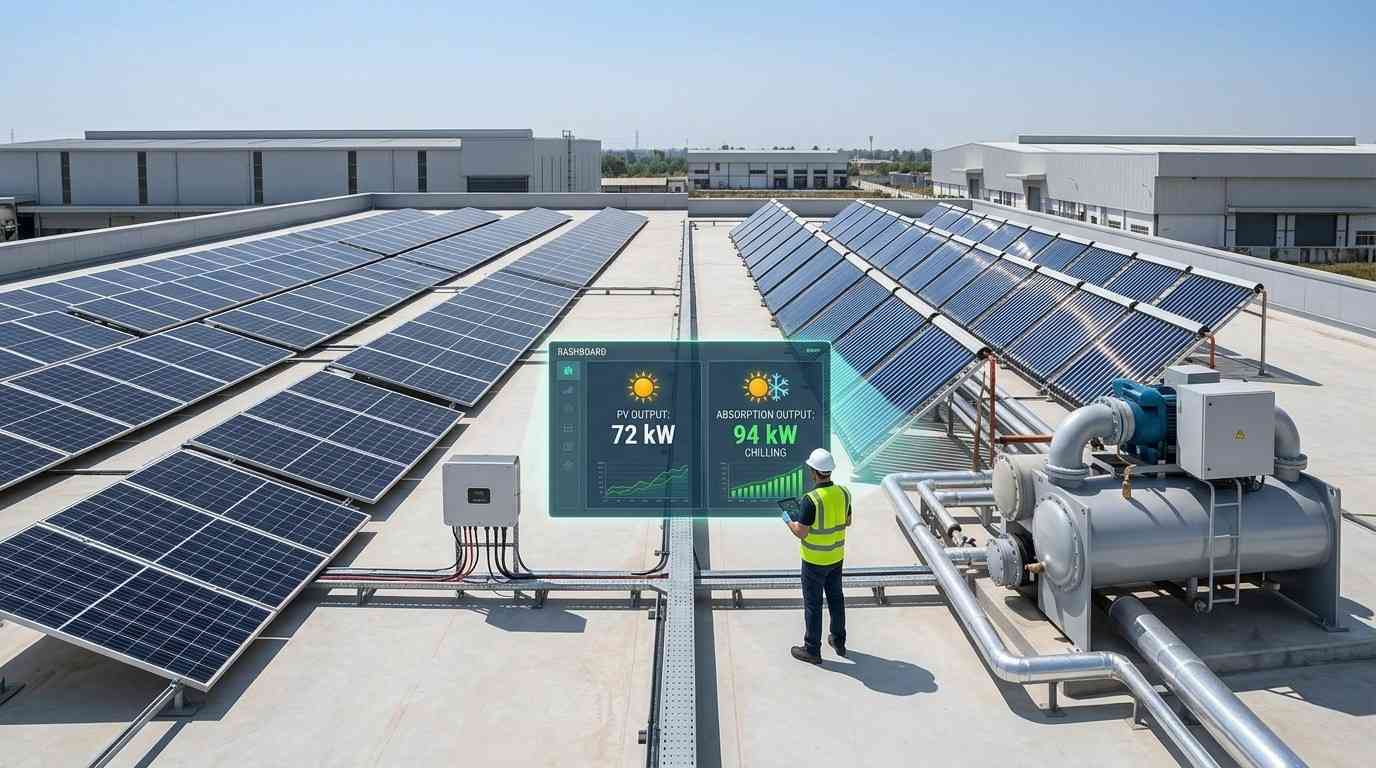
A solar absorption chiller is a cooling system driven by heat from solar thermal collectors rather than electricity - and in India's industrial context, it outperforms solar PV-powered compression cooling on five distinct criteria that rarely appear in global comparisons. This post breaks down each one, and names the conditions where the comparison reverses.
Why the global solar-vs-PV comparison doesn't apply in India
Academic comparisons of solar absorption chillers and solar PV compression systems consistently find PV wins on economics - but almost all of them model variable cooling demand in European or temperate climates, where cooling loads swing widely and solar availability is uncertain. A 2025 peer-reviewed study published in Energies (MDPI) found the opposite conclusion once the demand profile changes: absorption chillers are the better option specifically for continuous, base-load cooling demand.
India's industrial cooling profile is predominantly continuous. Process cooling in chemicals, pharmaceuticals, textiles, and food and beverage doesn't cycle with occupancy - it runs around the clock. That single shift in load profile changes which technology wins, for five reasons that are specific to the Indian context.
Reason 1: Solar thermal converts sunlight to useful energy far more efficiently than PV
Solar thermal collectors - the flat-plate or evacuated-tube panels that drive absorption chillers - convert incident solar radiation to heat at roughly 67% efficiency, according to technical comparisons published in Energies. High-efficiency mono-crystalline PV panels convert the same sunlight to electricity at approximately 21.3%.
For every square metre of collector area, solar thermal produces about three times as much useful energy as PV under comparable irradiance. When the goal is to drive a heat-powered absorption chiller, going via electricity - PV → inverter → compressor → cooling - is an inherently longer conversion chain with more losses than going directly from solar heat to absorption cooling.
Reason 2: India's cooling demand peaks when its solar irradiance peaks
India's national average GHI is 4.5 to 5.5 kWh/m²/day, rising to 5.5–6.2 kWh/m²/day in Rajasthan, Gujarat, and Andhra Pradesh, according to Heaven Green Energy's India solar irradiance data. That peak irradiance falls squarely in the April–June pre-monsoon period - exactly when industrial cooling loads are at their highest.
This coincidence is unusually strong by global standards. In northern Europe, cooling demand and solar availability are often mismatched - sunny winters don't produce cooling demand, and cloudy summers reduce solar yield when cooling is needed. In India, the sun and the load peak together, which means a solar absorption system operates at or near full output precisely when the plant needs it most.
Reason 3: Solar absorption chillers use low-grade heat that thermal storage can bank overnight
A solar PV system produces electricity only while the sun shines - without battery storage, it cannot shift cooling to off-peak or nighttime hours. Solar thermal systems paired with hot-water or phase-change storage tanks can bank daytime heat and continue driving absorption cooling into the evening, extending effective operating hours without the capital cost of battery storage.
For industrial plants that run two or three shifts, this thermal banking capability is practically valuable. A 2024 ScienceDirect review of solar cooling systems with thermal energy storage confirmed that storage-integrated designs significantly improve cooling fractions compared with non-storage configurations, according to the review's findings on variable-effect and double-effect absorption systems.
Reason 4: No electricity conversion means no grid dependency for cooling
A solar PV compression system still depends on the grid as a backup when sunlight is insufficient, or relies on batteries at significant additional cost. A solar-driven absorption chiller operates as part of a heat-driven system whose only electrical load is its pumps - the same design principle that makes direct-fired and waste-heat absorption chillers grid-independent.
For Indian plants in areas with grid instability, solar absorption cooling adds a renewable layer on top of grid independence. During peak irradiance hours, the chiller runs entirely on solar heat. When solar is insufficient, a secondary heat source - steam, gas, or exhaust - takes over without switching technology, because the absorption machine accepts multiple heat source types on the same unit.
Reason 5: No high-GWP refrigerants, no compressor, no oil
A solar PV compression chiller contains a vapour-compression circuit with refrigerant - typically R-410A or R-134a, both with global warming potentials many times that of CO₂. A solar absorption chiller uses water as the refrigerant and lithium bromide as the absorbent, both of which have zero GWP and carry no F-gas compliance risk.
As India's BEE standards tighten and ESG reporting expands, this matters beyond engineering. An absorption chiller eliminates the refrigerant leak liability, the compressor maintenance cycle, and the oil-fouling degradation that all reduce efficiency in compression systems over time. For a plant with a 20-year asset horizon, those avoided costs compound significantly.
Where solar PV still wins
Solar PV compression chillers remain the more economical choice where cooling demand is intermittent and variable - commercial buildings with occupancy-driven loads, for example, or facilities in monsoon-affected regions where four months of 25–40% GHI reduction reduces solar thermal yield enough to undermine system economics. The absorption route requires a consistent heat input; where solar supply is genuinely unreliable for extended periods, a backup heat source must be sized into the project, which adds capital cost.
Match Solar Cooling to Your Plant's Load Profile
Whether solar absorption or solar PV cooling fits your facility depends on your load curve, irradiance zone, and heat-source options. BROAD India's engineers assess all three before recommending a configuration, with 200+ installations nationwide.
Talk to BROAD India's HVAC engineers