
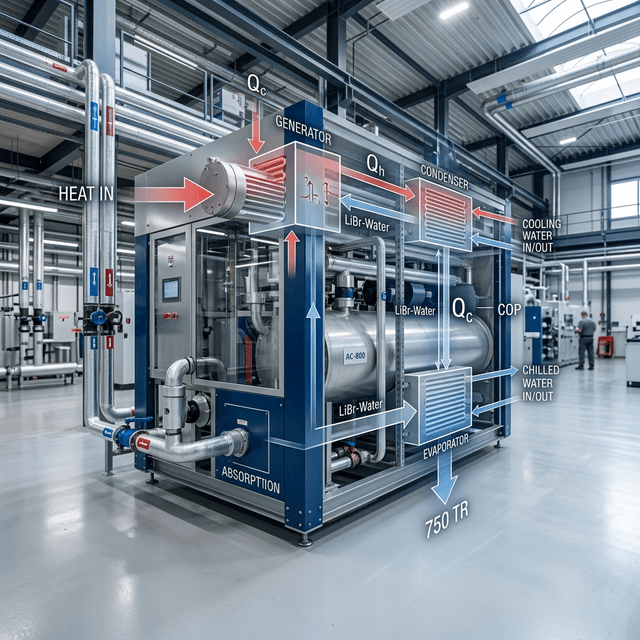
How Many TR Does Your Facility Need? Chiller Sizing Guide
TR in Chillers: What It Means and How to Calculate It for Absorption Systems
Ask a chiller salesman about capacity, and you'll hear "500 TR" or "1,200 TR." But what does TR actually mean? Why do we measure cooling in "tons", a unit normally reserved for weight? And more importantly, how do you calculate the TR capacity you actually need for your facility?
Understanding TR isn't academic trivia. Spec the wrong capacity, and you'll either waste capital on oversized equipment or suffer inadequate cooling from undersized systems. For absorption chillers where heat source availability matters as much as capacity, getting TR calculations right is essential.
What TR Actually Means
TR stands for "Ton of Refrigeration", a unit measuring cooling capacity. One TR equals the amount of heat required to melt one ton (2,000 pounds) of ice at 32°F (0°C) over 24 hours.
That seemingly random definition has historical roots. Before mechanical refrigeration, buildings and industrial processes were cooled using actual ice blocks. When refrigeration machines replaced ice, manufacturers rated capacity based on how much ice-melting equivalent they could provide.
The Physics:
Melting one pound of ice requires 144 BTU (British Thermal Units) of heat absorption.
One ton (2,000 lbs) of ice therefore absorbs: 2,000 × 144 = 288,000 BTU
Over 24 hours: 288,000 ÷ 24 = 12,000 BTU per hour
One TR = 12,000 BTU/hour of cooling capacity
In metric units: 1 TR = 3.517 kW of cooling (kilowatts of heat removal, not electrical consumption)
Why TR Matters for BROAD Absorption Chillers
When specifying BROAD absorption chillers, TR determines:
- Heat source requirements: A 500 TR single-effect steam VAM needs approximately 8-9 tons/hour of steam at 0.5-1.0 kg/cm². Underestimate capacity, and your steam supply becomes inadequate.
- Cooling tower sizing: Absorption chillers reject more heat to cooling towers than electric chillers (due to lower COP). A 500 TR BROAD VAM requires cooling tower capacity of 800-850 TR equivalent.
- Fuel consumption: Direct-fired BROAD chillers burning natural gas require approximately 10,000-11,000 cubic meters/hour of gas per 100 TR of cooling.
- Economics: Absorption chiller costs scale roughly with capacity. Understanding your actual TR needs prevents overbuying expensive equipment.
Calculating Required TR Capacity
Determining how much cooling capacity your facility needs involves several steps:
Step 1: Identify Cooling Loads
Cooling loads come from multiple sources:
- Building envelope loads: Solar gain, conduction, and air infiltration.
- Internal loads: Occupants (~100W/person), lighting, and industrial machinery.
- Ventilation loads: Fresh air cooling and dehumidification energy.
Step 2: Convert Loads to TR
Once quantified in BTU/hour or kW, convert to TR:
Example: A facility with 1,760,000 BTU/hour load needs: 1,760,000 ÷ 12,000 = 146.7 TR (round to 150 TR).
Step 3: Apply Safety Factors
Apply margins (10-20%) for peak conditions and future growth. BROAD absorption chillers operate efficiently across wide load ranges (10-100%), so modest oversizing doesn't penalize efficiency.
Step 4: Match to BROAD Standard Capacities
If calculated capacity falls between standards (e.g., 425 TR), options include choosing a single 500 TR unit or two 250 TR units for redundancy.
Special Considerations for Absorption Chillers
Unlike electric chillers, BROAD systems must match capacity to available heat sources:
| VAM Type | Consumption/Requirement | Example (500 TR) |
|---|---|---|
| Steam (Single) | ~16-18 kg/TR/hr | ~8-9 tons/hr steam |
| Steam (Double) | ~9-10 kg/TR/hr | ~4.5-5 tons/hr steam |
| Direct-Fired | Natural Gas or Fuel Oil | ~50k-55k m³/hr Gas |
| Exhaust-Fired | ~0.35-0.45 TR per kWe | 1MW Generator -> 400 TR |
Common Sizing Mistakes
- Ignoring Load Diversity: Assuming everything peaks simultaneously leads to over-sizing.
- Forgetting Altitude Correction: Performance decreases at higher elevations (>1,000m).
- Neglecting Dehumidification: Latent loads in humid regions require 20-30% more capacity.
- Heat Source Variability: Size conservatively based on worst-case waste heat availability.
Practical Example: Pharmaceutical Plant
Scenario: Total cooling load calculated at 441 TR (after 15% safety factor). Available waste steam from autoclaves supports 278 TR.
BROAD Solution: 1x 300 TR Steam VAM (base load) + 1x 200 TR Direct-Fired VAM (peak/backup). Total 500 TR meets the requirement with reliability.
Ready to Calculate Your Capacity?
Contact BROAD India for a detailed site evaluation.
Talk to an EngineerFrequently Asked Questions
What is a Vapour Absorption Chiller?
Can BROAD chillers run on waste heat?
Do you provide after-sales service in India?
Need Help With Your Cooling System?
BROAD India's engineering team can assess your facility's cooling requirements and recommend the most energy-efficient solution - from vapour absorption chillers to waste heat recovery systems.
Related Articles
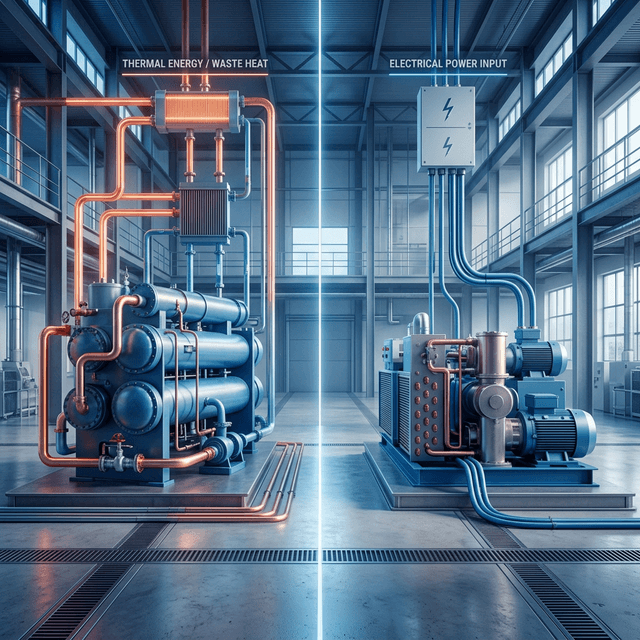
Disadvantages of Absorption Refrigeration Systems: When NOT to Choose Absorption Cooling
Read Post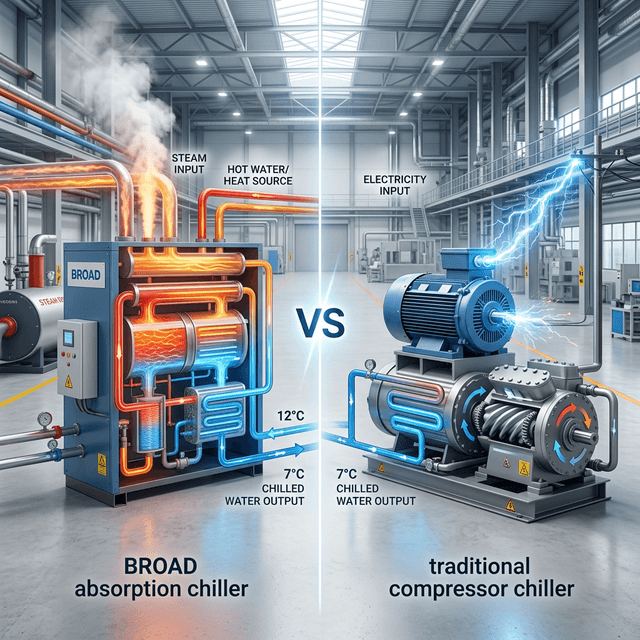
Absorption Chiller vs Compressor Chiller: A Side-by-Side Cost and Efficiency Comparison
Read Post