
Vapour Absorption Chiller: 4 Heat Sources Explained
A vapour absorption chiller makes cold water from heat, and in 2026, it's the difference between paying full power tariff and cooling on energy you already waste.
For Indian plants, where industrial electricity runs roughly ₹7–10 per unit and grid supply stays unpredictable, how you power your cooling quietly decides your energy bill. Absorption machines consume up to 90% less electricity than electric chillers because they have no compressor, only pumps. The catch is that performance depends entirely on which heat source drives them. This guide breaks down how the technology works and the four heat sources that can power it, so you can match the right one to your facility.
What Is a Vapour Absorption Chiller? Plus 4 Ways to Power It
A vapour absorption chiller is a cooling system that produces chilled water using heat, steam, hot water, or burning fuel, instead of an electricity-driven compressor. For Indian plants facing high power tariffs and unreliable grids, that single design choice matters: an absorption machine can consume up to 90% less electricity than a comparable electric chiller, because its only electrical load is a set of small pumps. This guide explains how the technology works and breaks down the four heat sources that can power it, so you can match the right one to your facility.
How does a vapour absorption chiller produce cooling without a compressor?
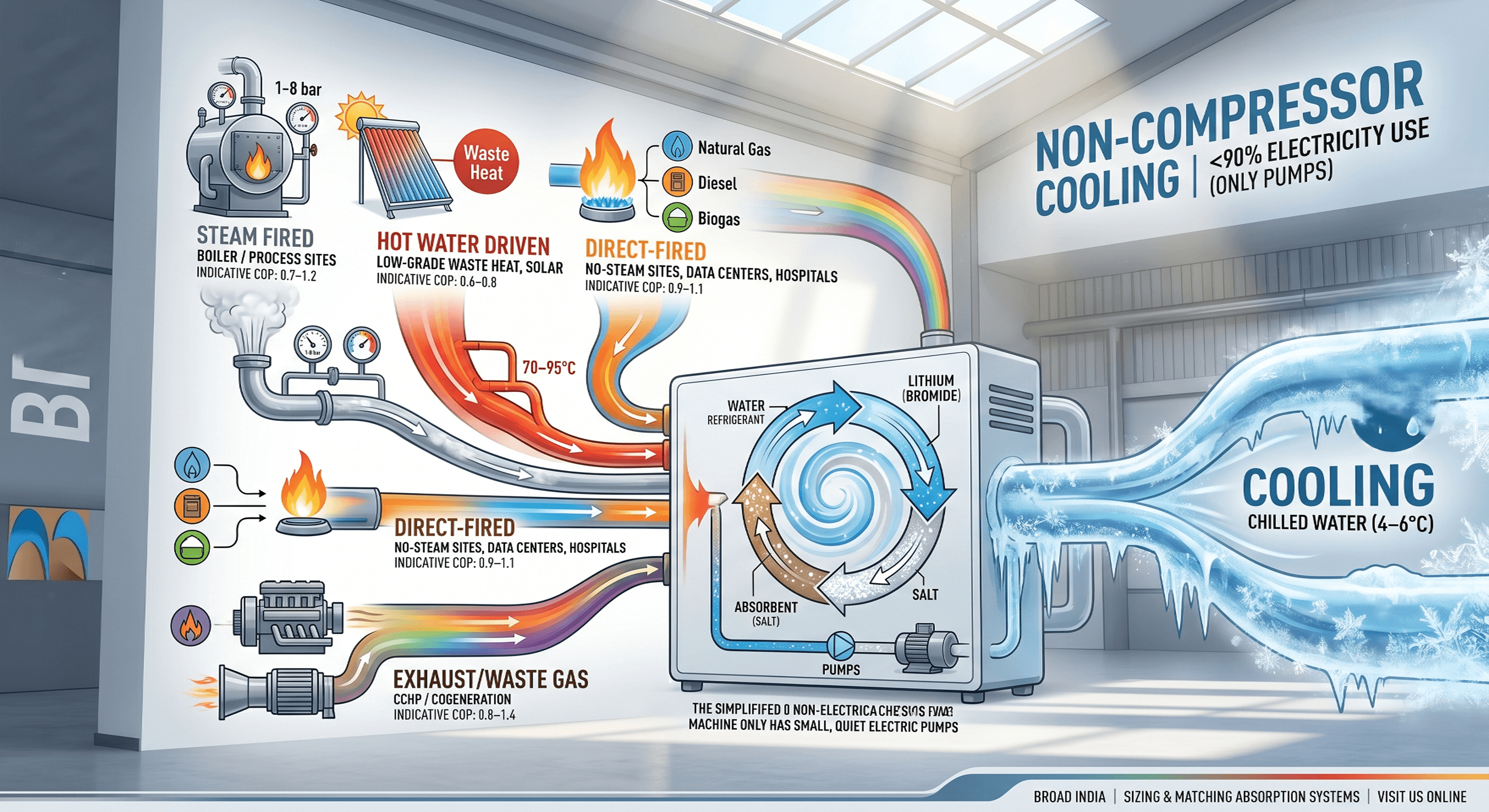
It replaces the electric compressor with a heat-driven chemical cycle that uses a refrigerant–absorbent pair, most commonly water and lithium bromide. In a lithium bromide chiller, water is the refrigerant (the fluid that does the cooling) and lithium bromide, a salt, is the absorbent that pulls the refrigerant vapour back in.
The cycle runs through four stages: evapouration, absorption, regeneration, and condensation. Water evapourates under deep vacuum at roughly 4–6°C, which is where the cooling effect is created; the lithium bromide then absorbs that vapour; a heat source boils the two apart in the generator; and the refrigerant condenses to begin again. According to EnergyLink, the only electricity the machine needs is for the pumps that move fluid between vessels, there is no power-hungry compressor at all.
Why does the heat source decide a chiller's performance?
The heat source sets the chiller's efficiency, its cooling capacity, and its running cost, which makes selecting it the single most important decision in any absorption project. A higher-temperature, more consistent heat input allows a more advanced internal cycle, and each step up raises the Coefficient of Performance (COP), the ratio of cooling output to heat input.
The economics follow the same logic. A non-electric chiller is cheapest to run when it uses heat the plant already produces and would otherwise vent to atmosphere. That is why the question is never "which chiller is best" in the abstract, it is "which heat do you already have?"
Which four heat sources can power a vapour absorption chiller?
Four heat inputs can drive the absorption cycle: steam, hot water, directly fired fuel, and exhaust gas. Each suits a different plant profile.
A steam fired absorption chiller taps low- or medium-pressure steam from boilers or process lines, the most common setup in Indian process industry. A hot-water-driven unit uses water between roughly 70–95°C, making it ideal for low-grade waste heat and solar thermal. A direct-fired machine burns natural gas, diesel, or biogas in its own generator, so it works where no steam exists, data centers, hospitals, and sites with unstable power. An exhaust-gas unit recovers heat from engine or turbine flue gas; this is the waste heat chiller at the core of CCHP and cogeneration plants.
| Heat source | Typical input | Best-fit plant | Indicative COP |
|---|---|---|---|
| Steam | ~1 bar (LP) to ~8 bar (MP) | Boiler / process-steam sites | 0.7–1.2 |
| Hot water | 70–95°C | Low-grade waste heat, solar | 0.6–0.8 |
| Direct-fired (gas/diesel) | Combustion in generator | No-steam sites, data centers, hospitals | 0.9–1.1 |
| Exhaust gas | Engine / turbine flue gas | CCHP / cogeneration | 0.8–1.4 |
What COP can each chiller type deliver?
Efficiency rises with the number of "effects", the times the cycle reuses its heat input before discarding it. According to chiller-engineering references such as C1S, a single-effect machine delivers a COP of roughly 0.6–0.8, a double effect chiller reaches 0.9–1.2, and a triple-effect unit can approach 1.8–2.0.
A VAM chiller's COP looks low beside an electric chiller's figure of 3 or more, but the comparison misleads. The absorption machine runs on near-free waste heat, while the electric unit draws grid power at full industrial tariff. The metric that actually decides the bill is cost per ton of cooling, not COP in isolation.
Which heat source fits your plant?
Match the chiller to the heat you already have, not the other way round. If your facility runs boilers or carries process steam, a steam-driven absorption chiller is usually the lowest-cost path. If you generate power on-site with gas engines or turbines, a waste-heat-driven chiller converts flue heat into cooling and forms the backbone of trigeneration.
Plants with no spare heat but unreliable grid power, common across Indian industrial belts, often choose a direct-fired chiller for cooling that is independent of the electricity supply. Where only low-grade heat or solar is available, hot-water units capture it. The rule that holds across every case: the cheapest cooling comes from the heat you would otherwise throw away.
Frequently Asked Questions
How does a vapour absorption chiller work?
What heat sources can power a vapour absorption chiller?
What is the COP of a vapour absorption chiller?
Can a vapour absorption chiller run on solar energy?
What is the lowest temperature a vapour absorption chiller can reach?
How much electricity does a vapour absorption chiller save?
Match the Right Chiller to Your Plant's Heat Source
Choosing between steam, hot water, direct-fired, and exhaust-gas units comes down to your facility's available heat and load profile. BROAD India's engineers size and match absorption systems for Indian industrial conditions, with 200+ installations nationwide.
Talk to BROAD India's HVAC engineersFrequently Asked Questions
Need Help With Your Cooling System?
BROAD India's engineering team can assess your facility's cooling requirements and recommend the most energy-efficient solution — from vapour absorption chillers to waste heat recovery systems.



BROAD Air Conditioning India Pvt. Ltd. (BROAD India) is a subsidiary of BROAD Group.
Powered by