What Is the Working Principle of a Vapour Absorption System? A Plain-English Guide for Engineers
The question of what is the working principle of a vapour absorption system typically surfaces at a specific point in an engineer's evaluation when efficiency claims have been reviewed, the waste heat opportunity is understood, and it is time to know what is actually happening inside the machine.
This guide answers it directly, using BROAD's system architecture as the reference.
The Fundamental Concept
A vapour absorption system produces cooling using heat as its primary energy input not electricity. The core principle: if you can maintain sufficiently low pressure inside a sealed chamber, water evapourates at temperatures low enough to cool industrial processes. The VAM working principle is built around maintaining that low pressure using chemistry rather than a mechanical compressor.
The Working Principle of a Vapour Absorption System: Step by Step
BROAD's lithium bromide-water system operates under deep vacuum throughout. Water is the refrigerant. Lithium bromide is the absorbent.
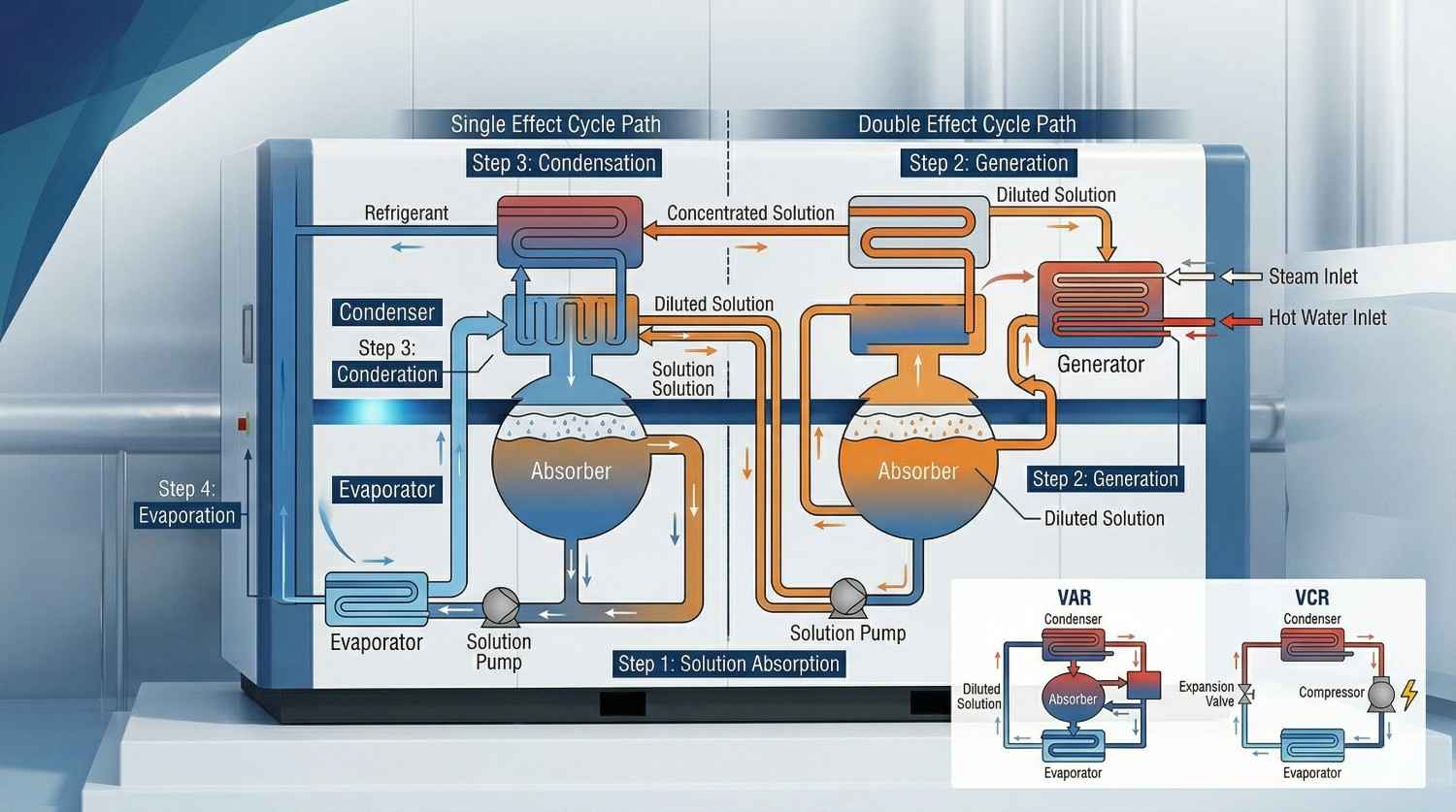
An external heat source steam, hot water, exhaust gas, or direct burner heats a dilute lithium bromide-water solution. Water evapourates out and moves to the next stage. This heat input drives the entire cycle.
Water vapour enters the condenser. Cooling tower water removes heat from the vapour, which condenses back into liquid water refrigerant.
Liquid water refrigerant enters the evapourator at very low pressure approximately 0.006–0.008 bar absolute. Under these conditions, water evapourates at 5–7°C, absorbing heat from the chilled water circuit. That chilled water typically supplied at 7°C, returned at 12°C serves the industrial process or air handling system.
As water vapour leaves the evapourator, it must be continuously removed to sustain the low pressure. Concentrated lithium bromide solution returned from the generator contacts the vapour in the absorber. Lithium bromide's powerful chemical affinity for water vapour pulls it in immediately, maintaining the evapourator vacuum. The now-diluted solution returns to the generator. The cycle repeats.
The generator-absorber pair performs the same function as a compressor maintaining the pressure differential that drives refrigerant circulation without any rotating machinery.
What Are the Benefits of Vapour Absorption?
The working principle of vapour absorption system translates into four operational advantages for industrial facilities:
- No compressor: No bearing wear, no oil management, no refrigerant leak detection. Maintenance costs run 25–35% lower than compressor-based systems.
- Thermally driven: The system consumes waste heat energy already produced by the facility and otherwise rejected to atmosphere. Incremental cooling cost is close to zero when waste heat is used.
- Water as refrigerant: Zero ozone depletion potential, zero global warming potential, no phase-out schedule, no specialist handling required.
- Temperature stability: BROAD installations maintain ±0.5°C chilled water supply temperature critical for pharmaceutical clean rooms and precision process applications.
Single-Effect vs. Double-Effect: What Changes in the Working Principle?
Single-Effect
One generator stage. Heat input at lower temperatures steam at 0.2–2.5 kg/cm² or hot water at 80–95°C. COP 0.70–0.75. Available from 50 TR to 1,400 TR. Most widely applicable configuration.
Double-Effect
Adds a high-temperature generator stage whose exhaust heat drives a second, lower-temperature generator. Internal heat recovery increases thermal efficiency. COP 1.20–1.35. Requires higher-pressure steam input at 4–8 kg/cm².
What Are the 4 Types of Refrigeration Systems?
For context, four main categories exist in industrial use:
- Vapour Compression Refrigeration (VCR) mechanically driven, electrically powered
- Vapour Absorption Refrigeration (VAR) thermally driven, BROAD's core technology
- Thermoelectric solid-state, Peltier-based, limited to small precision applications
- Magnetic Refrigeration emerging, not yet commercially viable at industrial scale
For large industrial process cooling and commercial HVAC, only VCR and VAR are practically relevant.
The Right Question for Your Facility
Once the working principle of vapour absorption system is clear, the evaluation becomes practical: what thermal energy sources does your facility already produce? Boiler steam? Generator exhaust? Process waste heat? Hot water from engine jackets? Any of these can drive a BROAD vapour absorption system converting energy that is currently being wasted into chilled water that serves your process, HVAC, or utility cooling requirements.
Get a Working Principle Demonstration
Contact BROAD India for a heat source assessment and a system demonstration specific to your facility's load profile.
Talk to an Engineer