
Absorption Chiller COP: 4 Efficiency Myths Busted
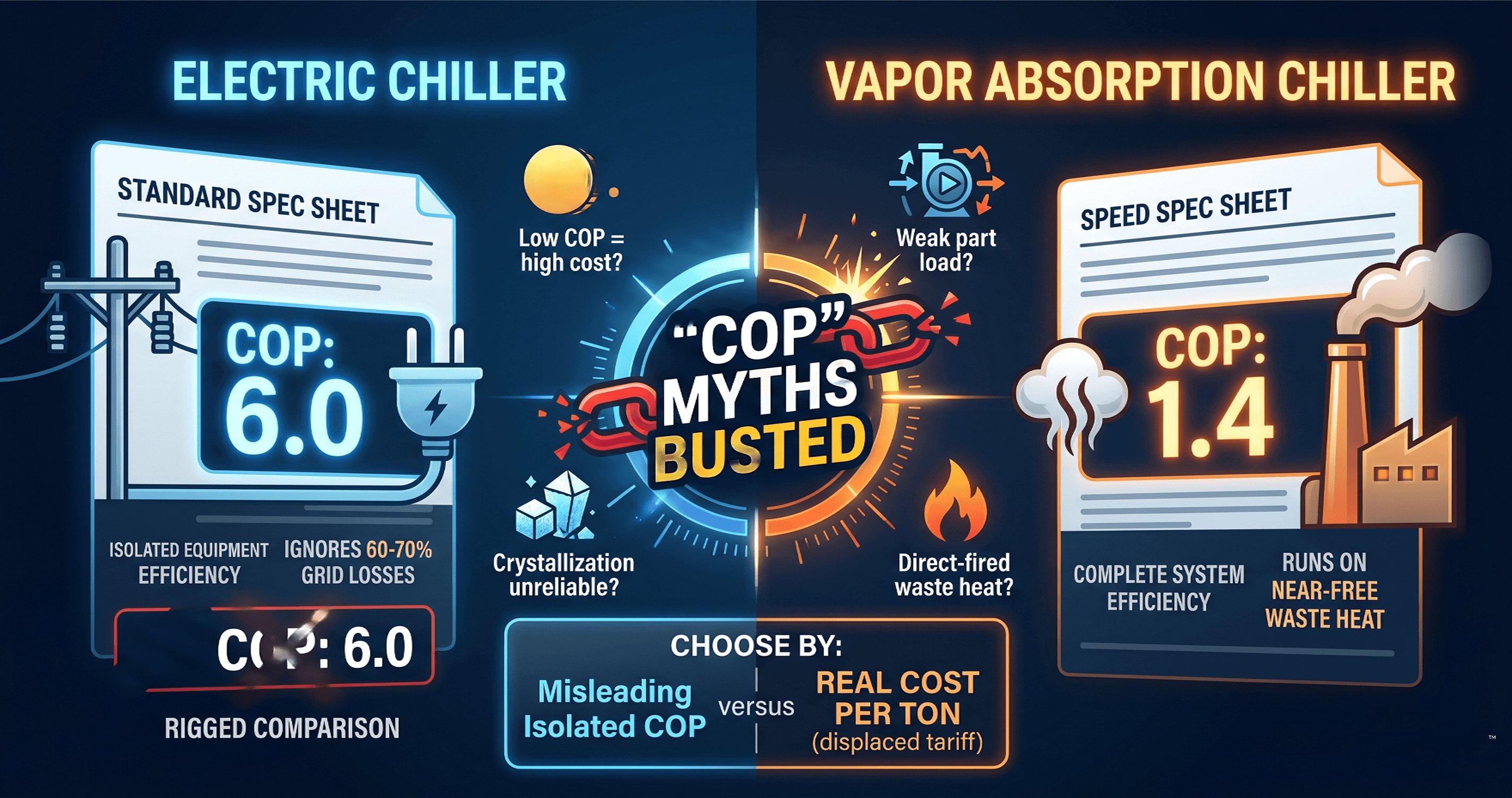
Every spec sheet says an electric chiller's COP of 6 crushes an absorption chiller's 1.4, but that comparison is rigged.
For Indian plants choosing a cooling system, that single misread number can lock in years of higher power bills. An electric chiller's COP ignores the 60–70% of energy lost in generating and delivering grid power, while an absorption chiller runs on heat the plant often already has, according to Chiller & Cooling Best Practices. The efficiency gap is far smaller than the spec sheets suggest. This post busts the four most common myths about absorption chiller efficiency, including the "slow at part load" claim, and names the metric that actually decides your cost.
Why Vapour Absorption Chillers Aren't 'Slow', Myth Busted
A vapour absorption chiller is widely dismissed as slow and inefficient because its Coefficient of Performance (COP), the ratio of cooling output to heat input, looks tiny next to an electric chiller's. That single comparison is misleading, and it costs Indian plants real money in avoidable power bills. This post dismantles the four most common myths about absorption chiller efficiency and names the metric that actually decides cost.
Are absorption chillers really slow at part load?
No, absorption chillers hold their efficiency unusually well as load drops. According to the CIBSE Journal, the COP of an absorption chiller remains practically constant down to about 50% of design cooling load, only falling below that point.
That matters because real plants rarely run at 100% load. A machine that stays efficient through the part-load range it actually operates in is, in practice, more consistent than the "slow" label suggests. The perception of sluggishness usually comes from start-up warm-up time, not from running performance, and for the continuous-duty industrial sites these machines serve, that one-time warm-up is irrelevant.
Does a low COP mean higher running costs?
A low COP does not mean high cost, because COP for an absorption chiller is measured on a completely different basis than for an electric one. An electric chiller posts a COP of roughly 6 to 6.5; an absorption chiller, 0.7 to 1.4, according to Chiller & Cooling Best Practices.
The catch is what the electric figure leaves out. That COP ignores the 60–70% of energy lost in generating grid electricity and moving it across transmission and distribution networks. The absorption chiller, by contrast, runs on heat the plant often already produces, or on directly fired fuel. The honest comparison is cost per ton of cooling, not COP, and where power tariffs are high or waste heat is available, the low-COP machine frequently wins. For the COP each chiller type delivers by design, see our heat-source breakdown.
| Common belief | The reality |
|---|---|
| Low COP = expensive to run | Cost per ton decides cost; the electric COP ignores 60–70% grid losses |
| Slow / weak at part load | COP stays roughly constant down to ~50% of design load |
| Crystallization makes them unreliable | Causes are known and preventable with controls and cooling-water management |
| Only viable with waste heat | Best with waste heat, but direct-fired units suit high-tariff or weak-grid sites |
Are absorption chillers a maintenance headache?
Crystallization is the one maintenance issue unique to absorption chillers, but its causes are well understood and preventable. Because lithium bromide is a salt, the solution can solidify if it falls below its saturation temperature, and that happens for specific, controllable reasons.
C1S identifies the main triggers as air and non-condensables leaking into the machine, cooling water that runs too cold or fluctuates, and electrical power failures. Modern units counter all three with automatic decrystallization routines, purge systems, and cooling-water controls. Routine upkeep is modest: pump teardown and inspection every 5 to 10 years, plus standard burner checks on direct-fired models. Treated as a controlled parameter rather than a surprise, crystallization is a design consideration, not a dealbreaker.
What are the real trade-offs of absorption chillers?
Absorption chillers do carry genuine trade-offs, and an honest case has to name them. They are physically larger and heavier than electric centrifugal chillers of the same capacity, so they demand more plant room.
They also reject more heat. The heat-rejection factor for an absorption machine is roughly 1.85 against about 1.25 for a vapour-compression chiller, which means a larger cooling tower and higher condenser-water flow, per industry engineering references. And their economics are strongest when low-cost heat is on hand; without waste heat or cheap fuel, an electric chiller can be the better choice. These are real constraints to design around, not reasons the technology is "slow."
When does an absorption chiller actually make sense?
An absorption chiller makes sense whenever heat is cheaper than power for your site, which is common across Indian industry. Plants with waste heat, process steam, or on-site power generation get the strongest returns, because the cooling runs on energy already paid for.
Sites without spare heat but with high tariffs or an unreliable grid are the second clear case: a direct-fired unit delivers cooling independent of the electricity supply. The decision is never "high COP versus low COP." It is which energy your plant can supply most cheaply and reliably, and for many Indian facilities, that answer is heat.
Frequently Asked Questions
What is the COP of an absorption chiller?
Why is an absorption chiller's COP lower than an electric chiller's?
Are absorption chillers efficient at part load?
What causes crystallization in an absorption chiller, and is it preventable?
Are absorption chillers more expensive to run than electric chillers?
Do absorption chillers need more space?
Compare the Real Numbers for Your Plant
COP alone never tells you which chiller is cheapest to run, your tariff, load profile, and available heat do. BROAD India's engineers run that cost-per-ton comparison for Indian industrial conditions, with 200+ installations nationwide.
Talk to BROAD India's HVAC engineersFrequently Asked Questions
Need Help With Your Cooling System?
BROAD India's engineering team can assess your facility's cooling requirements and recommend the most energy-efficient solution — from vapour absorption chillers to waste heat recovery systems.



BROAD Air Conditioning India Pvt. Ltd. (BROAD India) is a subsidiary of BROAD Group.
Powered by