Electric Chiller Efficiency: 3 Outdated Assumptions
Every plant engineer has heard it: electric chillers waste power. The data says that's only true for one specific design - and it isn't the one being sold today.
The belief comes from fixed-speed centrifugal chillers, which throttle refrigerant flow instead of slowing the motor and lose real efficiency at part load, where most chillers actually operate. A single retrofit from fixed-speed to variable-speed control improved one district cooling plant's annual COP by about 20%, according to Mitsubishi Heavy Industries - without changing the power source at all. This post breaks down three reasons the blanket "electric chillers waste power" claim is outdated, and the one place it still holds true.
3 Reasons "All Electric Chillers Waste Power" Is Outdated
Electric chiller efficiency varies enormously by compressor design, which makes the blanket claim that "all electric chillers waste power" outdated and misleading. The belief comes from older fixed-speed centrifugal and screw machines, not from the variable-speed and magnetic bearing designs now standard in efficient installations. This post breaks down three reasons that assumption no longer holds, and where it still has a grain of truth.
Where did the "electric chillers waste power" belief come from?
The claim traces back to fixed-speed compressors, which dominated the chiller market for decades and do, in fact, lose efficiency badly at part load. A fixed-speed centrifugal chiller throttles refrigerant flow using inlet guide vanes instead of slowing the motor, and that throttling action creates frictional losses that get worse as load drops, according to the ACHR News.
Because most chillers run at part load far more often than at full design capacity, that loss compounds across the year. The belief isn't wrong about this generation of equipment - it's simply outdated about what "electric chiller" means in 2026.
Reason 1: Variable-speed drives close the part-load gap
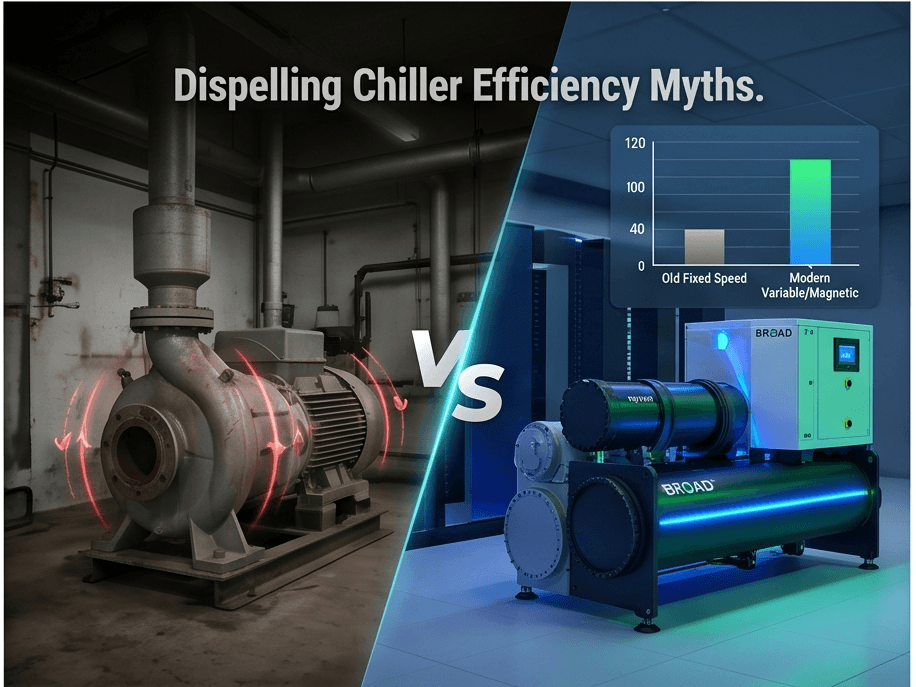
A variable-speed drive (VSD) cuts compressor speed instead of throttling refrigerant flow, and that single change improves real-world performance by 25-30% over a fixed-speed unit across realistic load and condenser-water conditions, per the ACHR News. The mechanism is straightforward: lower head requirements at part load allow lower impeller speed, and a VSD captures that saving directly rather than wasting it through vane throttling.
The gains aren't theoretical. After a constant-speed centrifugal chiller at a Japanese district cooling plant was retrofitted to variable speed, annual chilled-water-supply COP improved by approximately 20%, according to Mitsubishi Heavy Industries. That single design change, not a switch away from electric power, delivered the saving.
Reason 2: Magnetic bearing chillers remove the next layer of loss
Variable speed closes one gap; removing oil-lubricated bearings closes another. A magnetic bearing chiller suspends its compressor shaft on a magnetic field, eliminating the mechanical friction and oil-fouling losses that persist even in variable-speed conventional units, as detailed in our magnetic bearing chiller breakdown.
Field and simulation studies comparing the two confirm the gap is real: oil-lubrication-based operation showed roughly 3.2% lower performance, with the gap widening over time as oil fouling degrades heat transfer. BROAD's own design pushes this further, reaching an IPLV of up to 13.26 with variable-speed control as fine as 0.1 Hz.
Reason 3: Power factor and grid penalties favor the newer designs
A fixed-speed chiller's power factor sits around 0.85 at full load and can fall to as low as 0.60 at part load - and many Indian utilities financially penalize low power factor operation. That penalty is a direct, billed cost of running an inefficient electric chiller, separate from the energy bill itself.
Variable-speed and magnetic bearing chillers avoid the worst of this because they don't rely on throttling to manage part load. For facilities billed on power factor, as most large Indian industrial connections are, this alone can shift the economics meaningfully in favor of modern electric designs.
Where is the old belief still partly right?
A fixed-speed chiller, especially an aging one, genuinely does waste power at part load, and no amount of reframing changes that. If your facility runs an older constant-speed unit, the efficiency gap described above is real and worth acting on, whether by retrofit or replacement.
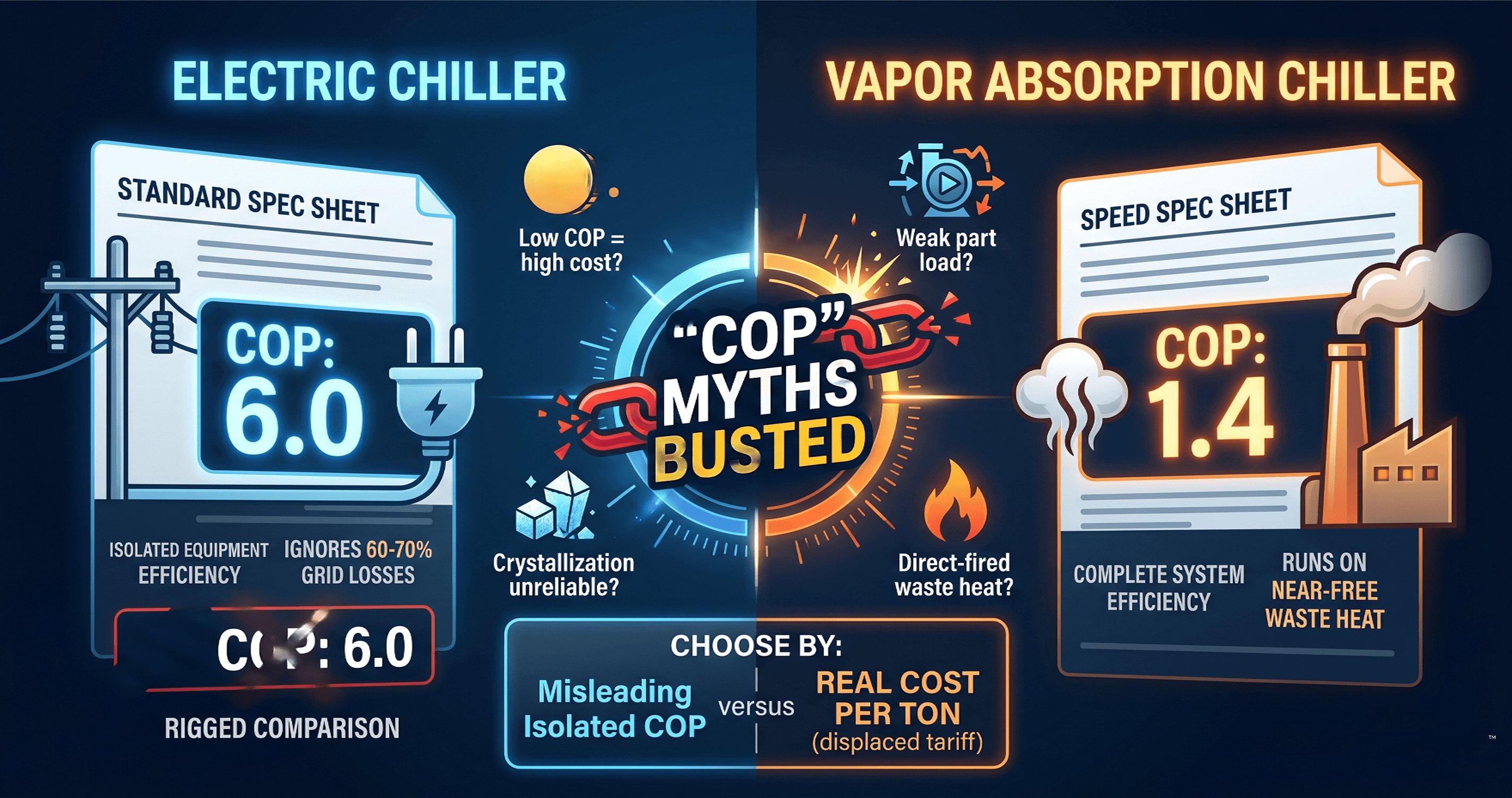
The other honest limit is comparative, not absolute: where waste heat or steam exists on-site, a vapour absorption chiller still beats any electric design on running cost, because it uses energy the plant has already paid for once. The outdated part of the belief isn't "electric chillers can waste power" - some clearly do. It's the word "all."
How does this change a buying decision?
The practical takeaway is to evaluate the compressor generation, not the power source alone. A 15-year-old fixed-speed centrifugal chiller and a current-generation magnetic bearing unit are both "electric chillers," but they sit at opposite ends of the efficiency spectrum.
| Compressor type | Part-load behavior | Typical efficiency note |
|---|---|---|
| Fixed-speed centrifugal/screw | Throttles via guide vanes; loses efficiency as load drops | Power factor can fall to ~0.60 at part load |
| Variable-speed centrifugal | Slows motor speed to match load | ~25-30% better real-world performance than fixed-speed |
| Magnetic bearing (oil-free) | No mechanical friction or oil fouling | IPLV up to 13.26 in top-tier designs |
For sites without a waste-heat or steam source, a current-generation variable-speed or magnetic bearing chiller is the efficient electric choice - not a step back from the non-electric ideal, but the right tool when that ideal isn't available.
Frequently Asked Questions
Do all electric chillers waste energy?
What is the difference between a fixed-speed and variable-speed chiller?
How much more efficient is a variable-speed chiller than a fixed-speed one?
Is a magnetic bearing chiller more efficient than a standard variable-speed chiller?
Can retrofitting an old chiller to variable speed improve efficiency?
Should I choose an electric chiller or a vapour absorption chiller?
Match the Right Chiller Technology to Your Load
Whether the answer is absorption, variable-speed, or magnetic bearing depends on your heat sources, load profile, and power tariff structure. BROAD India's engineers assess all three to recommend the most efficient fit, with 200+ installations nationwide.
Talk to BROAD India's HVAC engineersFrequently Asked Questions
What is a Vapour Absorption Chiller?
Can BROAD chillers run on waste heat?
Do you provide after-sales service in India?
Need Help With Your Cooling System?
BROAD India's engineering team can assess your facility's cooling requirements and recommend the most energy-efficient solution - from vapour absorption chillers to waste heat recovery systems.