Direct Fired vs. Indirect Fired Absorption Chillers: Which Fits Your Infrastructure?
BROAD India Engineering Team
Jan 27, 2026
8 min read
Energy & Industrial Efficiency
Direct Fired vs.Indirect Fired Absorption Chillers: Which Fits Your Infrastructure ?
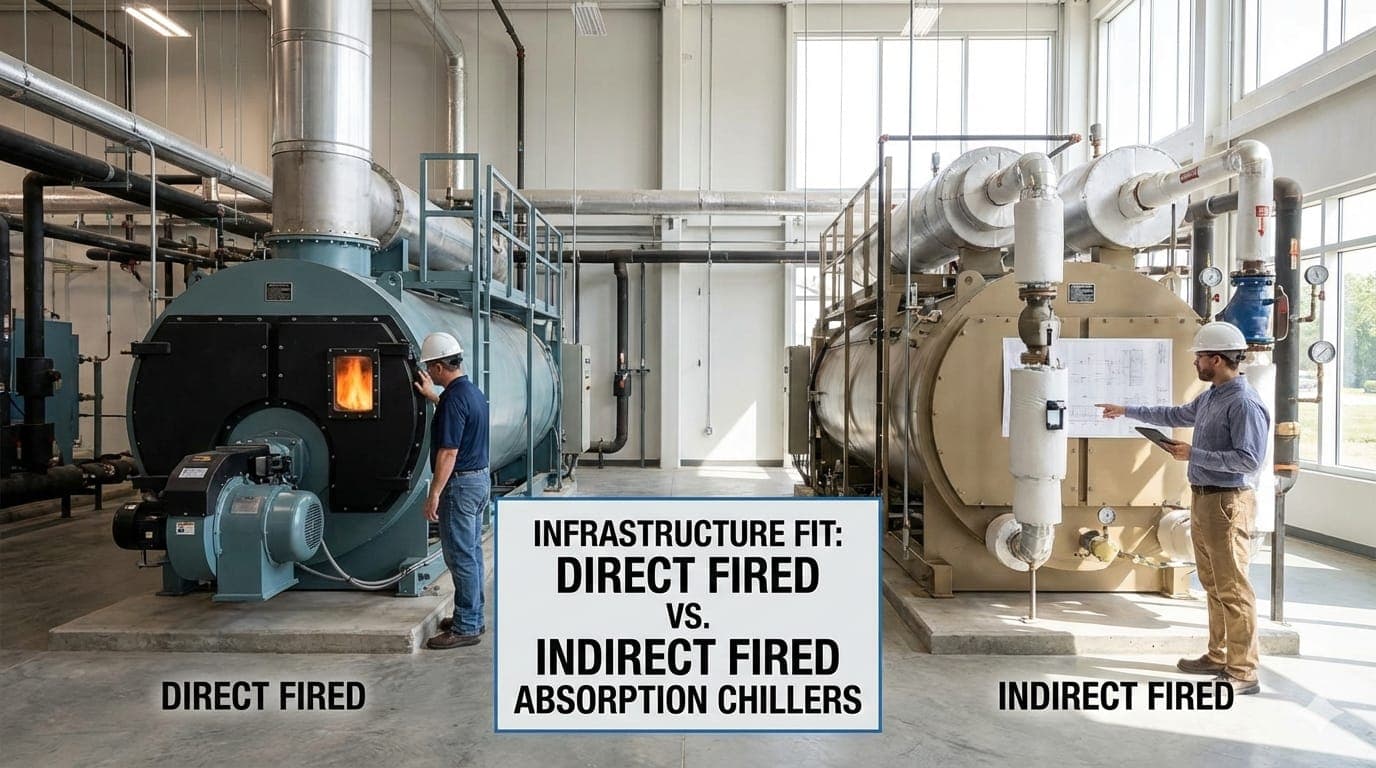
Choosing an absorption cooling solution depends on your facility's energy sources, infrastructure, and operational priorities. Both direct-fired and indirect-fired VAM chillers produce chilled water using thermal energy rather than electricity, but their energy paths differ significantly.
Understanding the Core Difference 🔍
| Chiller Type | How It Works | Energy Flow |
|---|---|---|
| Direct - Fired VAM | Burner integrated in chiller.Natural gas, diesel, or fuel oil combusted inside the unit. | Fuel → Direct combustion → Heat → Absorption cycle → Chilled water |
| Indirect - Fired VAM | Receives heat from external source: steam, hot water, or exhaust gases. | Fuel → External equipment → Steam / Hot water / Exhaust → Absorption cycle → Chilled water |
Infrastructure Requirements Comparison 🏗️
| Requirement | Direct - Fired | Indirect - Fired |
|---|---|---|
| External Heat Source | Not required | Required(boiler, generator, process heat) |
| Fuel Supply | Gas line or diesel tank | Depends on heat source |
| Steam Piping | None | Required for steam systems |
| Exhaust Ducting | Simple flue stack | Complex for exhaust recovery |
| Combustion Air | Required | Not required |
| Space Requirements | Compact, single unit | Distributed(heat source + chiller) |
| Environmental Permits | Combustion permits required | May not need if using existing source |
When Direct - Fired Makes Perfect Sense 🔥
- New facilities without steam infrastructure: Avoid boiler cost(₹80 lakhs–1.2 cr).
- Commercial buildings(hotels, hospitals, offices).
- Grid - constrained areas with gas access.
- District cooling plants with large central capacity.
When Indirect - Fired Excels ♻️
- Facilities with existing steam infrastructure.
- Waste heat recovery applications.
- Combined Cooling, Heating & Power(CCHP).
- Industrial plants with multiple heat sources.
Efficiency & Performance ⚡
| Chiller Type | COP | Fuel & Flexibility |
|---|---|---|
| Direct - Fired | 1.20–1.35 | Natural gas, LPG, diesel, dual - fuel |
| Indirect - Fired | 0.70–1.35 | Steam, hot water, exhaust heat |
Capital Cost(500 TR System) 💰
| Chiller Type | Equipment | Aux & Installation | Total CAPEX |
|---|---|---|---|
| Direct - Fired VAM | ₹6.5–7.5 cr + gas train ₹0.4–0.6 cr | ₹1.5–2 cr | ₹8.5–10.1 cr |
| Indirect - Fired Steam VAM | ₹3.2–3.8 cr + steam integration ₹0.4–0.8 cr | ₹1.8–2.2 cr | ₹5.4–6.8 cr |
Operating Cost Reality 🏭
- Direct - Fired: Fuel dominates cost; best where fuel cheaper than electricity.
- Indirect - Fired Waste Heat: Lowest operating cost.
- Indirect - Fired Steam: Higher cost unless high - pressure steam is free / available.
Decision Framework ✅
- Choose Direct - Fired: No steam/waste heat, gas available, commercial buildings.
- Choose Indirect - Fired: Steam/waste heat available, CCHP, industrial plants.
- Hybrid: Indirect base load + direct-fired peak load.
💡 Need Help Choosing the Right Absorption Chiller ?
BROAD India's engineers can guide you based on your heat sources and infrastructure.
Frequently Asked Questions
What is a Vapour Absorption Chiller?
It's a thermally-driven cooling system that uses water/LiBr solution and heat (from steam, hot water, exhaust, or gas) instead of electricity to produce chilled water, drastically reducing energy costs.
Can BROAD chillers run on waste heat?
Yes, our absorption chillers can capture waste heat from industrial processes, generator exhaust, or boiler steam to provide free cooling, resulting in significant OPEX savings.
Do you provide after-sales service in India?
Absolutely. BROAD India provides comprehensive design consultation, commissioning, operator training, and 24/7 after-sales support with remote monitoring capabilities.
Need Help With Your Cooling System?
BROAD India's engineering team can assess your facility's cooling requirements and recommend the most energy-efficient solution - from vapour absorption chillers to waste heat recovery systems.