
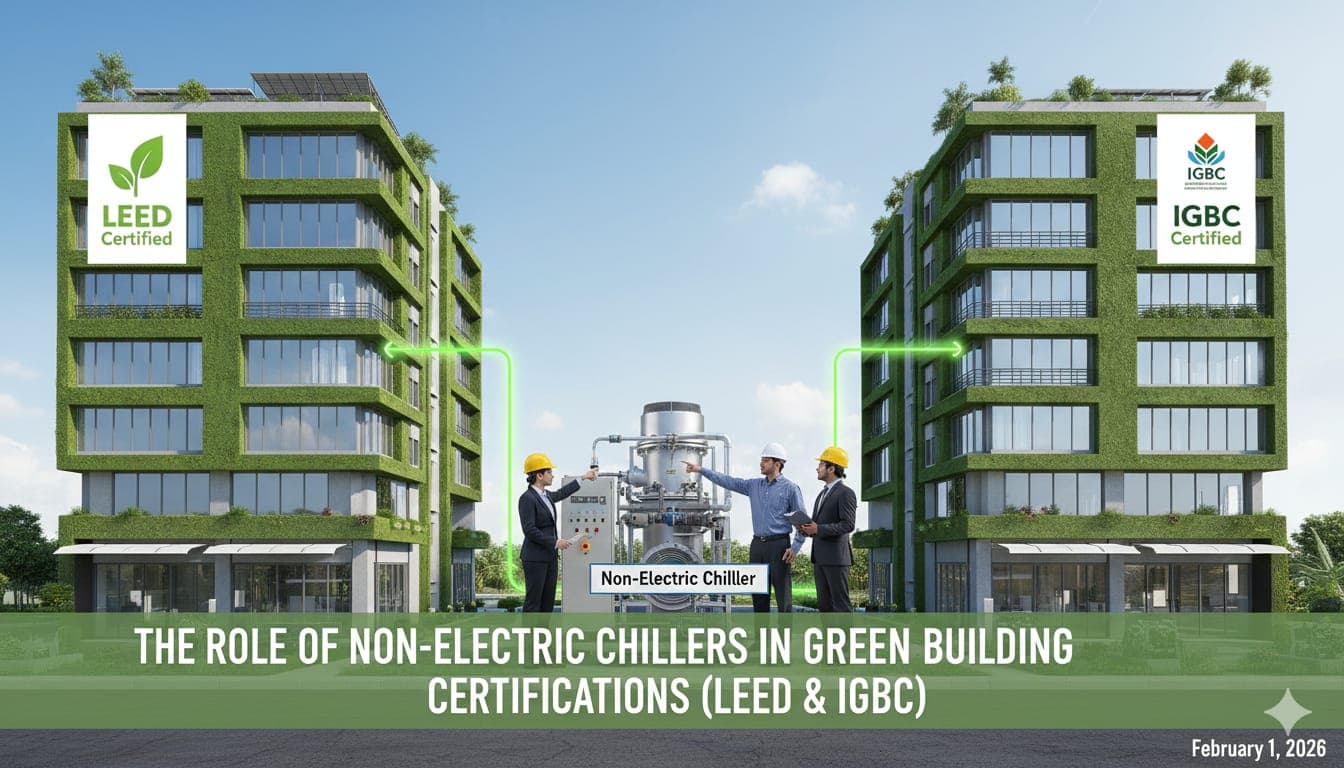
The Role of Non-Electric Chillers in Green Building Certifications (LEED & IGBC)
The Role of Non - Electric Chillers in Green Building Certifications(LEED & IGBC)
Green building certifications like LEED and IGBC are becoming market differentiators, tenant attractions, and regulatory requirements.HVAC systems, as the largest energy consumers, are pivotal for earning certification points.BROAD's non-electric absorption chillers (VAM) offer thermal-energy-based cooling that supports high certification scores while providing operational benefits.
Understanding Green Building Certifications in India 🌱
LEED(Leadership in Energy and Environmental Design)
- Developed by USGBC
- Point categories: Energy & Atmosphere, Water Efficiency, Materials & Resources, Indoor Environmental Quality, Sustainable Sites
- Certification Levels: Certified(40–49 pts), Silver(50–59 pts), Gold(60–79 pts), Platinum(80 + pts)
IGBC(Indian Green Building Council)
- Part of CII; India - specific green building certifications
- Rating systems include: Green New Buildings, Existing Buildings, Homes, Factories, Healthcare, Data Centers
- Certification Levels: Certified, Silver, Gold, Platinum
Both systems aim to reduce energy consumption, minimize environmental impact, and improve indoor environments.
How Non - Electric Chillers Contribute to Certification Points 💡
| Category | Contribution by BROAD VAM | Points Earned |
|---|---|---|
| Energy & Atmosphere | Reduces electrical consumption(500 TR VAM replaces 300–350 kW electric load), supports solar / biogas integration, reduces peak demand | 15–25 % of HVAC energy points, renewable energy credits, 1–2 demand response points |
| Enhanced Refrigerant Management | Water as refrigerant: ODP = 0, GWP = 0, zero emissions | Typically 1 point, differentiating factor |
| Indoor Environmental Quality | Quiet operation(15–20 dB lower), precise humidity control | Acoustic performance & thermal comfort credits(1–2 pts) |
| Innovation in Design | Waste heat recovery, trigeneration / CCHP, carbon footprint reduction | 1–2 points per innovative strategy + exemplary performance bonus |
Real - World Examples Using BROAD VAM 🌍
LEED Platinum Office Tower, Bangalore
- 50,000 m² commercial office
- 800 TR exhaust - fired VAM + rooftop solar thermal
- Energy performance: +42 % vs baseline(12 pts)
- Renewable energy: 18 % of total building energy(4 pts)
- Refrigerant management: 1 pt
- Innovation: waste heat recovery 2 pts
- Total contribution: 19 pts(~25 % of Platinum requirement)
- Annual energy savings: ₹1.8 cr, CO₂ reduction: 1, 850 tons / year
IGBC Gold Hospital, Mumbai
- 300 - bed multispecialty hospital
- 600 TR steam VAM using medical waste heat
- Energy efficiency: +38 % vs benchmarks(15 pts)
- Water heating efficiency: 60 % from waste heat(3 pts)
- Indoor air quality: improved dehumidification(2 pts)
- Total VAM contribution: 20 pts
- Continuous cooling during grid failures, 35 % lower boiler fuel consumption
IGBC Platinum Industrial Facility, Gujarat
- 75,000 m² pharmaceutical manufacturing
- 1, 200 TR hot water VAM using process waste heat
- Energy optimization: 48 % HVAC energy reduction(18 pts)
- Waste heat utilization: 3 bonus pts
- CO₂ reduction: 2, 400 tons / year(4 pts)
- Total VAM contribution: 25 pts
Certification Strategy & Integration 🏗️
- Design Phase: Engage BROAD early, right-size, identify waste heat, coordinate with MEP, document energy models.
- Detailed Design: Configure VAM (steam, hot water, exhaust), integrate with building systems, prepare documentation.
- Construction: Equipment installation, commissioning, operator training.
- Certification & Operations: Submit data, continuous monitoring, plan recertification.
Comparison: Electric Chillers vs BROAD Non - Electric Chillers ⚡
| Aspect | Electric Chillers | BROAD VAM Chillers |
|---|---|---|
| Energy Performance | Baseline/modest improvement | 30–50% better than baseline |
| Renewable Integration | Difficult (solar PV) | Easy(solar thermal, biogas, biomass) |
| Refrigerant Impact | High GWP (675–2,088) | Zero GWP(water refrigerant) |
| Innovation Potential | Limited | High(waste heat, CCHP, hybrid) |
| Operational Resilience | Grid-dependent | Independent(thermal energy) |
| Maintenance Complexity | High (compressor service) | Lower(absorption cycle) |
| Indoor Environment | Standard | Superior(quiet, humidity control) |
BROAD's non-electric VAM chillers provide energy efficiency, operational resilience, and innovation advantages to help your project achieve LEED or IGBC certification.
Frequently Asked Questions
What is a Vapour Absorption Chiller?
Can BROAD chillers run on waste heat?
Do you provide after-sales service in India?
Need Help With Your Cooling System?
BROAD India's engineering team can assess your facility's cooling requirements and recommend the most energy-efficient solution - from vapour absorption chillers to waste heat recovery systems.