
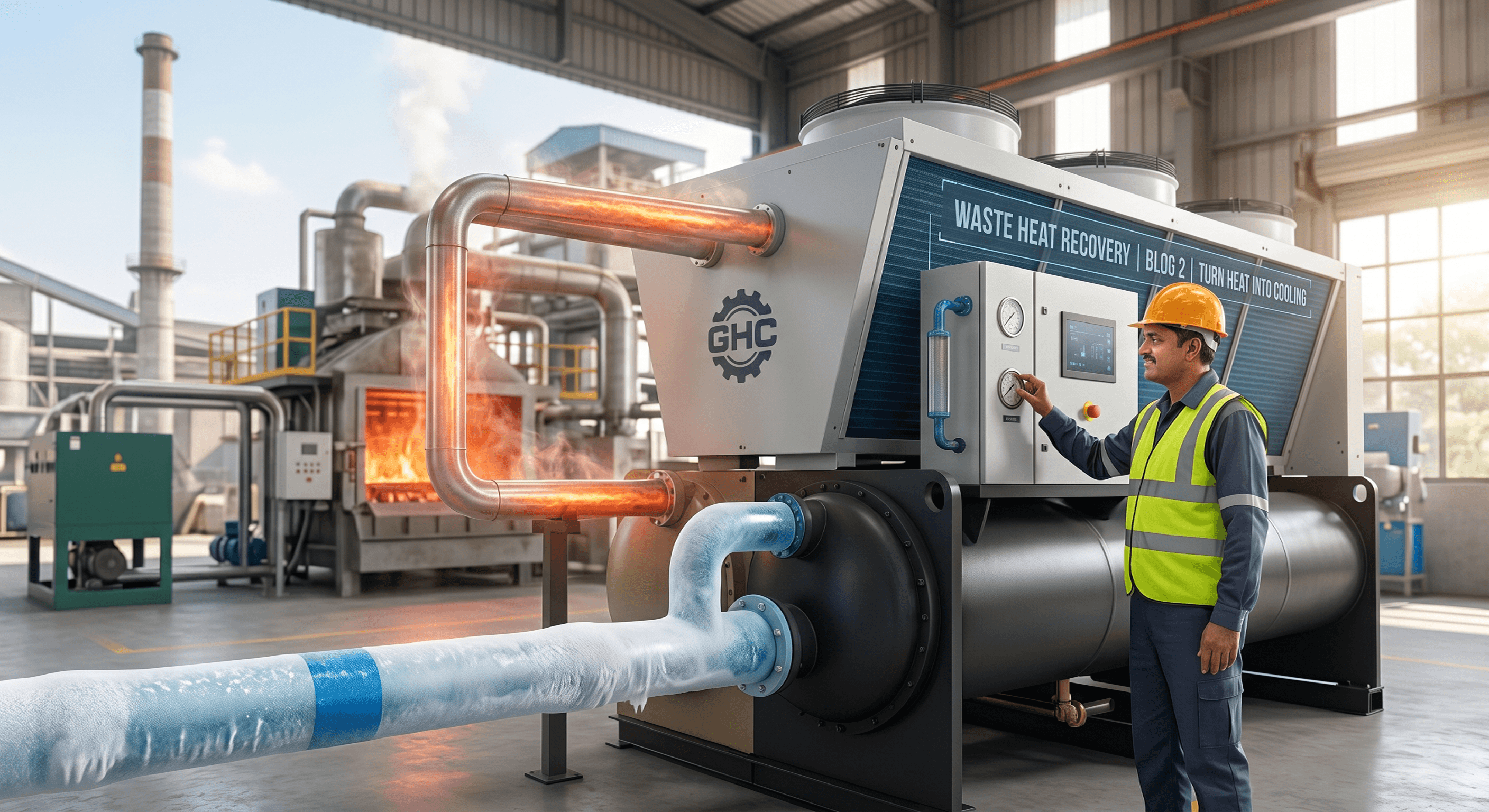
Waste Heat Absorption Chiller: Turn Heat Into Cooling
If your plant vents hot flue gas to the sky, you're paying twice, once to create that heat, and again to buy grid power for cooling.
Across Indian industry, low- and medium-grade waste heat escapes from boilers, kilns, and engines every hour, energy that has already been paid for. The global absorption chiller market is set to grow from USD 1.88 billion in 2026 to USD 2.98 billion by 2036, with waste heat recovery cited as a primary driver, per Future Market Insights. The opportunity is simply to stop wasting what you already produce. This guide shows how a waste-heat-driven vapour absorption chiller converts that lost heat into chilled water, which streams qualify, and what the savings look like.
From High Power Bills to Waste-Heat Cooling: VAC in India
A waste-heat-driven vapour absorption chiller turns the heat your plant already vents, flue gas, engine exhaust, or process steam, into chilled water, using almost no extra electricity. For Indian manufacturers paying roughly ₹7–10 per unit of power, that converts a disposal problem into a cooling asset. This guide covers what qualifies as usable waste heat, how the conversion works, and what the savings realistically look like.
What counts as waste heat in an industrial plant?
Waste heat is the thermal energy a process rejects to the atmosphere after doing its job, and most facilities discard far more than they realise. It arrives in tiers: low-grade streams at 50–100°C such as jacket water and hot condensate, medium-grade exhaust and process steam, and high-grade flue gas from boilers, kilns, and engines that can exceed 300°C.
Each tier can drive a different absorption chiller configuration. The higher and steadier the temperature, the more efficient the cycle it can support. The table below maps the common streams to what they can realistically power.
| Waste heat stream | Typical temperature | What it can drive |
|---|---|---|
| Jacket water / hot condensate | 50–100°C | Hot-water single-effect chiller |
| Process / exhaust steam | ~1–8 bar | Steam-driven single or double effect |
| Boiler / kiln flue gas | 200–400°C | Flue-gas-driven absorption chiller |
| Engine / turbine exhaust gas | 300–500°C+ | Exhaust-gas double-effect chiller |
How does waste heat turn into cooling?
The recovered heat simply replaces the burner or steam input that would otherwise drive the absorption cycle. Inside the machine, that heat boils a lithium bromide–water solution to regenerate the refrigerant, which then evapourates under vacuum to chill water, the same thermally driven process used by any vapour absorption chiller, whatever its heat source.
The only difference is the input. Instead of buying fuel or grid power, the chiller runs on energy the plant has already spent. Because the sole electrical load is a set of pumps, a waste heat absorption chiller can cut cooling-related power use by up to 90% compared with an electric chiller serving the same load.
How much can waste-heat cooling actually save?
The economics are strong enough to be reshaping the market. The global absorption chiller market is projected to grow from USD 1.88 billion in 2026 to USD 2.98 billion by 2036, with waste heat recovery named as a primary driver, according to Future Market Insights.
The savings come from two places: displaced electricity and avoided fuel. A plant that recovers flue gas to run a waste-heat-driven chiller stops paying grid tariff for that cooling load entirely, while continuing to use heat it was already producing.
Payback follows quickly. Industrial waste-heat cooling projects typically recover their capital in roughly 3–4 years, after which the cooling is effectively free for the 20-plus-year service life of the machine. At Indian industrial tariffs, the displaced electricity alone often justifies the project.
Which industries gain the most from waste-heat cooling?
Any plant that runs hot and runs continuously is a strong candidate, which describes much of Indian heavy industry. Cement plants recover kiln exhaust, steel and glass works tap furnace flue gas, and chemical, textile, and pharmaceutical sites reuse boiler steam and process heat.
Facilities with on-site gas engines or turbines have an additional advantage: their exhaust can feed a chiller as part of a CCHP (combined cooling, heating, and power) loop, extracting cooling, heating, and electricity from a single fuel input. In one Indian deployment, a 400 TR absorption system was run entirely on recovered flue-gas heat for process cooling, displacing electric chillers, as documented by Green Power. The pattern repeats wherever heat generation and cooling demand sit side by side.
How do you start a waste-heat recovery project?
Begin with a heat audit, measure the temperature and flow of every reject stream before specifying any equipment. A site cannot size a recovery chiller without knowing how much heat is genuinely available and how steady it is.
Rank the streams next. A continuous 300°C exhaust is worth far more than an intermittent 120°C one, because consistency determines how reliably the chiller can carry load. Match the strongest stream to the right drive, steam, hot water, or exhaust gas, and size the machine to the recoverable heat, not the peak cooling demand. Capacities scale widely, with BROAD's waste-heat units ranging from 233 kW to 11,630 kW (66–3,307 RT), so the practical limit is usually available heat rather than machine size.
Frequently Asked Questions
What is waste heat recovery cooling?
What temperature of waste heat is needed to run an absorption chiller?
How much can a waste heat absorption chiller save?
What is the payback period for a waste heat recovery chiller?
Which industries use waste heat for cooling?
Can flue gas be used to run a chiller?
Turn Your Plant's Waste Heat Into Cooling
If your facility vents flue gas, exhaust, or process steam, that energy could be running your chillers instead of escaping to the atmosphere. BROAD India's engineers audit waste-heat streams and size recovery systems for Indian industrial conditions, with 200+ installations nationwide.
Talk to BROAD India's HVAC engineersFrequently Asked Questions
Need Help With Your Cooling System?
BROAD India's engineering team can assess your facility's cooling requirements and recommend the most energy-efficient solution — from vapour absorption chillers to waste heat recovery systems.



BROAD Air Conditioning India Pvt. Ltd. (BROAD India) is a subsidiary of BROAD Group.
Powered by