
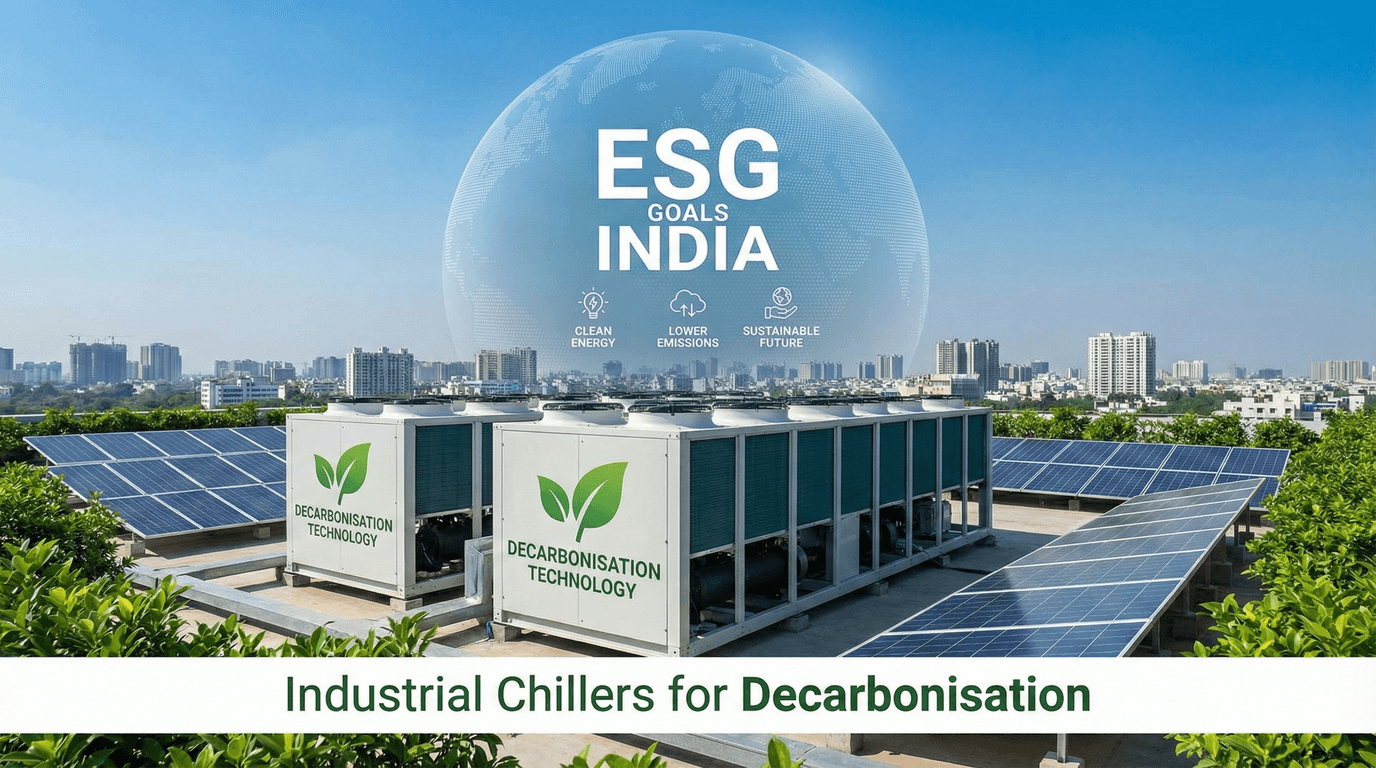
Industrial Chillers for Decarbonisation: How to Meet ESG Goals in India
Industrial Chillers for Decarbonisation: How to Meet ESG Goals in India
Quick Links: VAM Chillers | CCHP Systems | Request Assessment
The ESG Revolution: Why Chillers Matter
The conversation in boardrooms has changed significantly.What used to focus solely on quarterly profits now also includes carbon footprints, sustainability goals, and ESG(Environmental, Social, and Governance) ratings . For industrial facilities in India often overlooked, a major energy consumer has become a key concern: the chiller system.
Here's how forward-thinking companies are upgrading their cooling systems to achieve ambitious ESG goals while also ensuring operational efficiency.
Understanding the Decarbonisation Challenge
Decarbonisation isn't just a trendy term; it's a measurable goal to cut carbon dioxide emissions in industrial operations.For manufacturing facilities, this involves tackling two main sources:
| Emission Scope | Source | Impact on Chillers |
|---|---|---|
| Scope 1 Emissions | Direct emissions from owned or controlled sources(on - site fuel burning) | Direct - fired VAM chillers reduce by using natural gas |
| Scope 2 Emissions | Indirect emissions from purchased electricity | Primary targetreplacing electric chillers with waste - heat VAMs |
- Coal produces approximately 70 % of India's electricity
- Each kilowatt - hour consumed = ~0.82 kg of CO₂ emissions
- For a facility using 1,000 TR of conventional electric chillers: Over 5,000 tons of CO₂ annually
The numbers are alarming, but solutions are becoming more available.
Why Industrial Chillers Are Decarbonisation Priorities
Chillers represent a large portion of energy use in industries crucial to India's economy. Understanding their footprint is essential:
Temperature - sensitive manufacturing and storage facilities operate chillers around the clock, consuming 40 - 60 % of total electricity .
From cooling dairy products to cold storage, the food sector uses one of the largest chiller fleets in India .
Process cooling often requires refrigeration capacity exceeding 5,000 TR per plant .
Precise temperature control is vital, with chillers making up 35 - 45 % of total energy expenses .
Energy used for cooling nearly equals that of IT equipment, making chillers key to decarbonisation .
Decarbonising cooling systems leads to immediate, measurable emissions cuts and lower electricity exposure.
Vapour Absorption Machines: The Game - Changer
The most game - changing technology for reducing chiller emissions is vapour absorption cooling , especially when paired with waste heat recovery or renewable thermal energy sources.
Unlike standard electric chillers that rely on compressors and grid electricity, vapour absorption machines(VAMs) use thermal energy to power the refrigeration cycle. This essential difference opens up various decarbonisation pathways:
BROAD's exhaust-fired VAM chillers convert waste heat from industrial processes, generators, or boilers into usable cooling. Energy that would typically escape into the atmosphere is used productively, decreasing overall facility carbon intensity.
Direct - fired VAM chillers that use natural gas emit fewer emissions per cooling unit than coal - powered electric chillers. Emission reductions range from 35 - 50 % , depending on grid emission factors.
VAM systems work well with solar thermal energy, biomass boilers, or biogas systems, enabling truly zero - carbon cooling when connected to renewable heat sources.
Non - electric cooling lessens peak demand, allowing facilities to decrease grid consumption during high - tariff periods when emissions from coal plants peak.
Real Decarbonisation Outcomes from Indian Industries
Numbers speak louder than theoretical concepts.These outcomes come from real commissioned projects that tracked performance data. Here are real outcomes from BROAD India projects:
| Previous System | 500 TR electric centrifugal chillers |
| New System | BROAD steam VAM chillers using waste steam from process boilers |
| Annual Electricity Savings | 2.8 million kWh |
| CO₂ Reduction | 2, 296 tons annually |
| ESG Impact | 31 % drop in Scope 2 emissions |
| Previous System | Multiple electric screw chillers(800 TR total) |
| New System | BROAD hot water VAM chillers using boiler waste heat |
| Annual Electricity Savings | 4.5 million kWh |
| CO₂ Reduction | 3, 690 tons annually |
| Additional Benefit | 25 % cut in boiler fuel use (better heat integration) |
| Previous System | 350 TR electric chillers |
| New System | BROAD exhaust - fired VAM using diesel generator exhaust |
| Annual Electricity Savings | 1.96 million kWh |
| CO₂ Reduction | 1, 607 tons annually |
| Payback Period | 3.8 years (from electricity savings and efficiency gains) |
Integrating Chillers into Comprehensive ESG Strategies
Achieving ESG goals involves more than just replacing equipment.It requires strategic planning regarding energy flows throughout entire facilities.Here's how leading companies are undertaking chiller decarbonisation:
Conduct comprehensive energy audits and establish a carbon baseline for comparison.
Identify available waste heat sources across your facility for VAM integration.
Roll out VAM chillers in phases to manage costs and ensure operational continuity.
Track emissions reductions and document for ESG reporting requirements.
Use performance data to refine operations and maximize efficiency gains.
Overcoming Common Decarbonisation Barriers
While upfront costs are significant, consider that most VAM systems generate payback in 3 - 5 years through electricity savings alone.Government incentives(PAT Scheme, PLI) can offset 20 - 40 % of capital costs.
Most industrial facilities generate more waste heat than they realize.BROAD's energy audits identify hidden heat sources. If waste heat is truly unavailable, direct-fired VAMs using natural gas still offer 35-50% lower emissions than grid-based electric chillers.
VAM technology has been deployed for decades globally.BROAD has over 30 years of experience with thousands of installations across diverse industries in India and internationally.
BROAD VAM chillers use lithium bromide - water refrigerant, requiring minimal maintenance.They operate with less complexity than electric chillers, with no oil contamination risks and quieter operation.
Regulatory Drivers Supporting Chiller Decarbonisation
India's regulations increasingly favor low-carbon cooling options. These policies are turning decarbonisation from voluntary efforts into competitive necessities:
| Regulatory Framework | Impact on Chillers |
|---|---|
| Energy Conservation Building Code(ECBC) | Sets minimum energy efficiency standards for commercial buildings |
| Perform, Achieve, Trade(PAT) Scheme | Mandates energy consumption targets for large industrial facilities |
| Carbon Border Adjustment Mechanism(CBAM) | Penalizes high - carbon exports; low - carbon industries gain competitive advantage |
| State - Level Incentives | Various states offer subsidies for energy - efficient cooling upgrades |
| Corporate Reporting Requirements | Large corporations must report Scope 2 emissions; VAM systems directly reduce reportable emissions |
The Financial Case: Beyond Carbon Credits
Decarbonisation offers clear financial benefits that go beyond ESG ratings:
Industrial rates: ₹6 - 12 / kWh.Replacing 500 TR electric chillers with VAM systems saves₹60 - 90 lakhs annually .
Cutting peak loads reduces demand charges, which account for 30 - 40 % of industrial bills .
Non - electric cooling maintains operations during outages, preventing production losses in temperature - sensitive processes.
Emission reduction projects generate voluntary carbon credits.While prices fluctuate, they enhance project ROI.
Strong sustainability records attract higher valuations and easier access to green financing at better rates.
Low - carbon certified products command premium prices in export markets and supply chain partnerships.
BROAD's Decarbonisation Technology Portfolio
- Use low to medium - pressure steam(0.2 - 2.5 kg / cm²) from boilers or process waste
- Single - effect and double - effect configurations
- Capacities: 50 TR to 1, 500 TR per unit
- Operate with hot water(80 - 95°C) from engine jackets or solar thermal collectors
- Best for lower - temperature waste heat sources
- COP values: 0.7 - 0.75
- Transform engine or turbine exhaust(400 - 550°C) directly into cooling
- Ideal for cogeneration systems and generator sets
- COP values: 1.2 - 1.3
- Use natural gas, biogas, or diesel fuel directly
- No waste heat requiredstill deliver 35 - 50 % lower emissions than grid chillers
- Flexible for facilities without process heat sources
All BROAD VAM chillers use lithium bromide - water refrigerant pairs with non - toxic, zero ozone depletion potential, and zero global warming potential, aligning with international environmental standards.
The Implementation Roadmap
Conduct energy audits, identify heat sources, and preliminary design.Set carbon baseline and project emissions reductions.
Detailed engineering, equipment selection, and financial modeling.Get management approval and arrange financing.
Equipment procurement, site preparation, and installation.BROAD manages civil works, piping, electrical integration, and controls.
Commissioning, performance testing, and operator training.Verify emission reduction calculations against actual performance.
Monitoring, optimization, and documentation for ESG reporting.BROAD offers preventive maintenance contracts and remote monitoring services.
Conclusion: Decarbonisation as Competitive Advantage
Chiller decarbonisation is not just about being environmentally responsible; it makes sound business sense.As global accountability for carbon emissions increases and electricity costs keep rising, facilities with low - carbon cooling systems gain a significant edge .
Early adopters enjoy benefits that later entrants will find hard to replicate:
- ✔ Stable, low energy prices
- ✔ Established ESG credentials
- ✔ Better operational resilience
- ✔ Proven routes to net - zero goals
- ✔ Competitive advantage in global markets
BROAD India's vapour absorption technology, validated across numerous installations and backed by over 30 years of global experience, serves as a solid foundation for effective industrial decarbonisation.
The shift from conventional electric chillers to waste - heat - powered, low - carbon cooling ranks among the most impactful strategies for reducing emissions in Indian industries today.
Let BROAD India assess your chiller systems and design a tailored decarbonisation strategy aligned with your ESG goals.
Explore VAM Solutions | Learn About CCHP Systems | Schedule Your Energy Audit
Frequently Asked Questions
What is a Vapour Absorption Chiller?
Can BROAD chillers run on waste heat?
Do you provide after-sales service in India?
Need Help With Your Cooling System?
BROAD India's engineering team can assess your facility's cooling requirements and recommend the most energy-efficient solution - from vapour absorption chillers to waste heat recovery systems.