
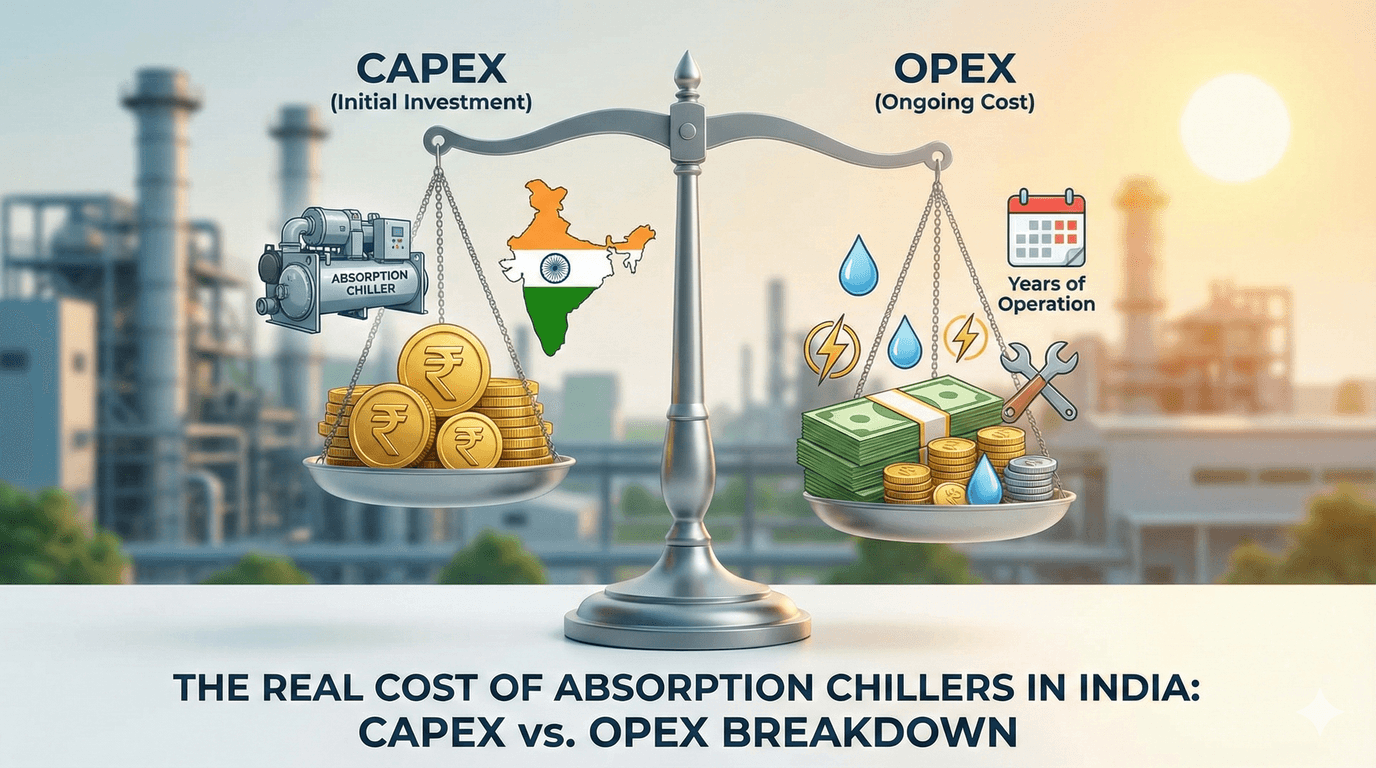
Understanding the full economic picture of vapour absorption machines, including capital expenses, operating costs, and hidden costs, is essential.It helps determine if your cooling system will be a valuable asset or a financial burden for the next two decades.
Capital Expenditure(CAPEX) Reality
₹60 - 80 lakhs per unit
₹2.5 - 3.5 crores per unit
₹5 - 7 crores per unit
Complete Installation Example(500 TR Steam VAM)
| Cost Component | Amount |
|---|---|
| Equipment | ₹3.2 crores |
| Auxiliaries(cooling towers, pumps, controls) | ₹1.1 crores |
| Installation and commissioning | ₹0.4 crores |
| Contingency | ₹0.5 crores |
| Total CAPEX | ₹5.2 crores(₹10.4 lakhs / TR) |
Operating Expenditure(OPEX) Breakdown
Annual Operating Costs(500 TR Steam VAM, 6,000 hours)
| Cost Item | Annual Cost |
|---|---|
| Steam consumption(₹1, 800 / ton) | ₹9.07 crores |
| Auxiliary electricity | ₹72 lakhs |
| Water and treatment | ₹10 lakhs |
| Maintenance | ₹9 lakhs |
| Total Annual OPEX | ₹9.98 crores |
VAM vs.Electric Chiller Economics
500 TR Electric Chiller Comparison
₹3.2 crores
₹2 crores less than VAM
₹2.22 crores
Electricity(2.5M kWh @ ₹8 / kWh) + maintenance
Initial Advantage: Electric chillers cost 38% less upfront
Operating Advantage: VAM saves ₹1.76 crores annually when using dedicated steam
The critical factor: if steam comes from waste heat recovery or existing processes with very low fuel costs, VAM economics change dramatically.
The Game - Changer: Waste Heat Applications
500 TR Exhaust - Fired VAM(using generator exhaust)
| Parameter | Value |
|---|---|
| CAPEX | ₹4.8 crores |
| Premium over electric: ₹1.6 crores | |
| Annual OPEX: | |
| Fuel cost(waste heat recovery) | ₹0 |
| Generator efficiency improvement credit | (₹15 lakhs) |
| Auxiliary electricity and water | ₹82 lakhs |
| Maintenance | ₹8 lakhs |
| Net Annual OPEX | ₹75 lakhs |
Compared to electric chiller OPEX of ₹2.22 crores, exhaust - fired VAM saves₹1.47 crores annually
Payback Period: Only 13 months
This explains why engineers are increasingly choosing BROAD's exhaust-fired and waste heat recovery solutions despite higher upfront costs.
Hidden Costs That Matter
Downtime Expenses
₹15 - 40 lakhs per hour
₹8 - 25 lakhs per hour
₹50 + lakhs per hour
VAM Reliability Advantage: With fewer moving parts and no compressors, VAM systems significantly lower downtime risks compared to electric chillers.
Carbon Costs(Emerging Reality)
A 500 TR electric chiller produces about 2,050 tons of CO₂ annually
At a conservative estimate of₹5,000 / ton for carbon pricing, that amounts to ₹1.03 crores in annual carbon costs
VAM systems can cut this by 50 - 100 % , making them economically competitive even without considering other savings
Demand Charges
Reducing a 1,000 kW peak load from a 500 TR electric chiller can save₹43 - 72 lakhs every year in demand charges alonea significant financial benefit for facilities with high power consumption peaks.
Configuration - Specific Economics
Best when steam is a waste product or boiler has extra capacity | ₹9 - 11 lakhs / TR installed
Ideal for low - temperature waste heat or solar thermal integration | ₹8 - 10 lakhs / TR installed
Great for facilities with generators or high - temperature exhaust | ₹11 - 14 lakhs / TR installed , often with low operating costs
Suitable when no heat source available but natural gas is accessible | ₹12 - 16 lakhs / TR installed
BROAD's Value Proposition
BROAD equipment typically carries a price premium of 10 - 15 %.Is this worth it ? Let's examine the economics:
Example: 500 TR Steam VAM
| Manufacturer | COP | Equipment Cost |
|---|---|---|
| Standard Manufacturer | 0.68 | ₹3.0 crores |
| BROAD | 0.74 | ₹3.3 crores |
| BROAD Premium | +0.06 | ₹30 lakhs |
₹80 lakhs per year
Payback on Premium: 4.5 months
Higher efficiency, lower maintenance, and 20 years of spare parts availability make BROAD's pricing economically logical despite higher initial costs.
Decision Framework
- Capital is limited
- No heat source is available
- Cooling is seasonal(less than 3,000 hours annually)
- Electricity rates are very low(below ₹5 / kWh)
- Waste heat sources are not fully used
- Year - round cooling is required
- Electricity rates are high(₹8 + per kWh) or grid reliability is poor
- Carbon reduction is required
- Natural gas is available at competitive prices
Conclusion
Absorption chiller decisions involve more than just upfront costs; they require a clear understanding of your energy situation and long - term goals.BROAD's vapour absorption machines provide better efficiency, flexible heat source options, and proven reliability, resulting in lower lifecycle costs for most industrial applications.
Facilities that achieve the best return on investment share common traits: consistent year - round cooling needs, access to waste heat or favorable fuel prices, and a willingness to consider the total cost of ownership rather than just the purchase price.
Contact BROAD India for a detailed techno - economic analysis that includes site - specific costs, energy modeling, and total cost of ownership comparison.