Ask any HVAC engineer what are the 4 components of chillers and the textbook answer comes quickly: compressor, condenser, expansion valve, evapourator. That is correct for compressor-based systems. But it misses something important.
BROAD's vapour absorption chillers also operate with four core components. The difference is what those components are, and what that difference costs you over the next 20 years.
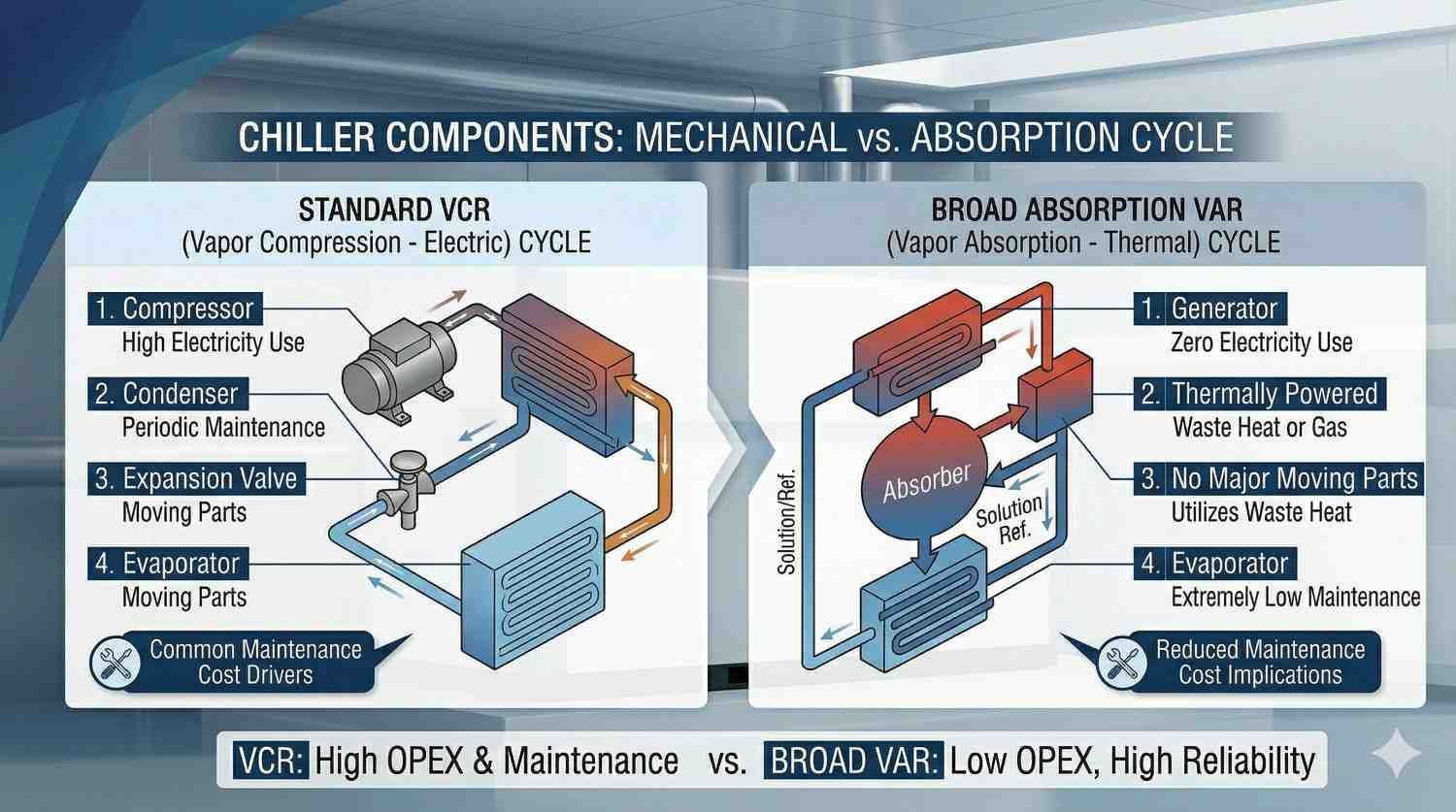
The 4 Components of a Compressor Chiller
In a conventional electric chiller centrifugal, screw, or scroll refrigeration is mechanically driven through four stages:
- 1. Compressor: Raises refrigerant vapour from low to high pressure. Consumes 85–90% of total system power. The highest-cost maintenance item in the system.
- 2. Condenser: High-pressure refrigerant vapour rejects heat to cooling water or air and condenses to liquid.
- 3. Expansion Device: Liquid refrigerant drops sharply in pressure and temperature through the expansion valve.
- 4. Evapourator: Low-pressure refrigerant evapourates, absorbing heat from the chilled water circuit to produce cooling.
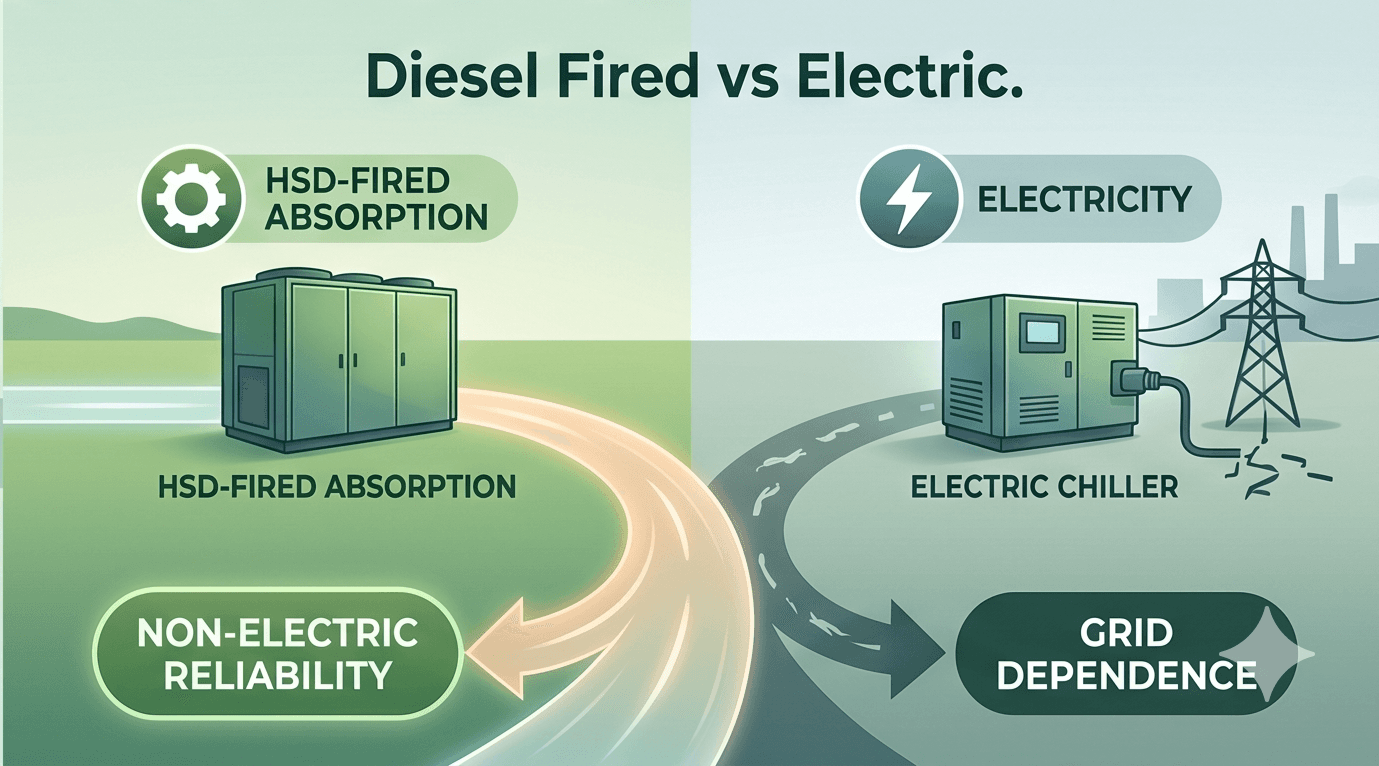
This cycle requires continuous electrical energy. Stop the compressor, stop the cooling.
The 4 Components of BROAD Vapour Absorption Chillers
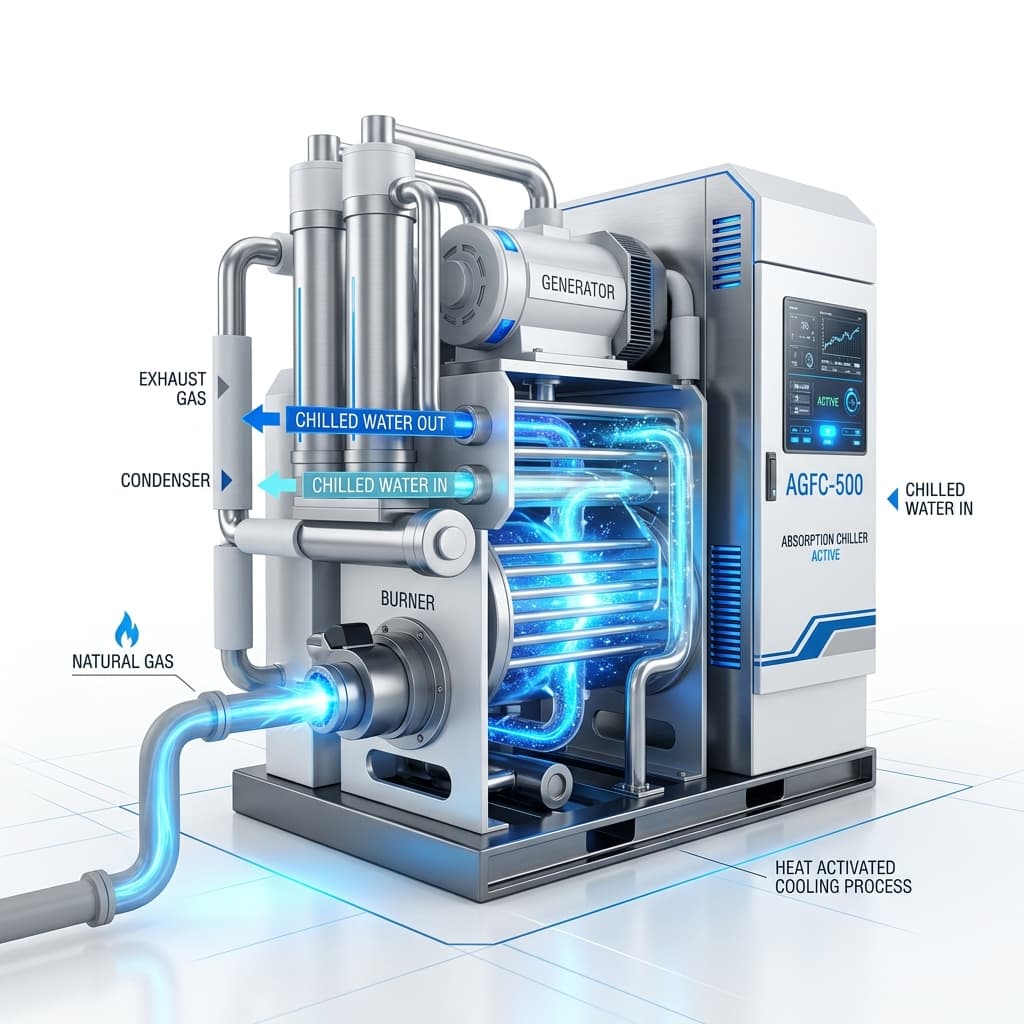
BROAD's lithium bromide absorption chillers also use four components but the compressor is absent:
Thermal energy heats a dilute lithium bromide-water solution. Water evapourates and separates. No rotating equipment.
Water vapour from the generator condenses to liquid water refrigerant, rejecting heat to the cooling water circuit.
Liquid water refrigerant expands under deep vacuum approximately 0.006–0.008 bar absolute evapourating at 5–7°C and absorbing heat from the chilled water circuit.
Concentrated lithium bromide solution absorbs the water vapour leaving the evapourator, maintaining the low pressure that makes 5–7°C evapouration possible. The diluted solution returns to the generator. The cycle repeats.
The generator-absorber pairing performs what the compressor does in a VCR system maintaining the pressure differential that drives refrigerant circulation without any rotating machinery.
What Is the Working Principle of the Absorption Chiller?
The working principle of absorption chiller technology rests on two physical properties. First: water evapourates at very low temperatures when pressure is sufficiently reduced. Second: lithium bromide has an extreme chemical affinity for water vapour, which the absorber exploits to continuously pull vapour from the evapourator and sustain the vacuum. Together, these two properties drive a closed-loop refrigeration cycle powered entirely by heat not electricity.
Why the 4th Component Changes Everything Financially
Compressor-related costs in a conventional chiller
- Bearing replacements every 7–10 years
- Annual oil analysis and changes
- Refrigerant leak detection and top-up
- Compressor overhaul or replacement at 15–20 years
- Specialized technicians at premium service rates
Absorber-related costs in a BROAD VAR system
- Annual solution analysis and inhibitor treatment
- Heat exchanger tube cleaning every 2–3 years
- Vacuum integrity checks
- No oil system, no refrigerant charge, no compressor overhaul
Documented case Pharmaceutical facility, Hyderabad:
Total 12-year maintenance cost reduced from ₹4.2 crores (VCR) to ₹1.2 crores (BROAD VAR). Zero unplanned failures in five years of operation.
BROAD's 4-component architecture delivers 25–35% lower annual maintenance costs.
How BROAD's 4 Components Scale Across Product Configurations
| Configuration | Heat Source | COP | Capacity Range |
|---|---|---|---|
| Single-effect | Steam 0.2–2.5 kg/cm² or hot water 80–95°C | 0.70–0.75 | 50 TR – 1,400 TR |
| Double-effect | High-pressure steam | 1.20–1.35 | 100 TR – 1,500 TR |
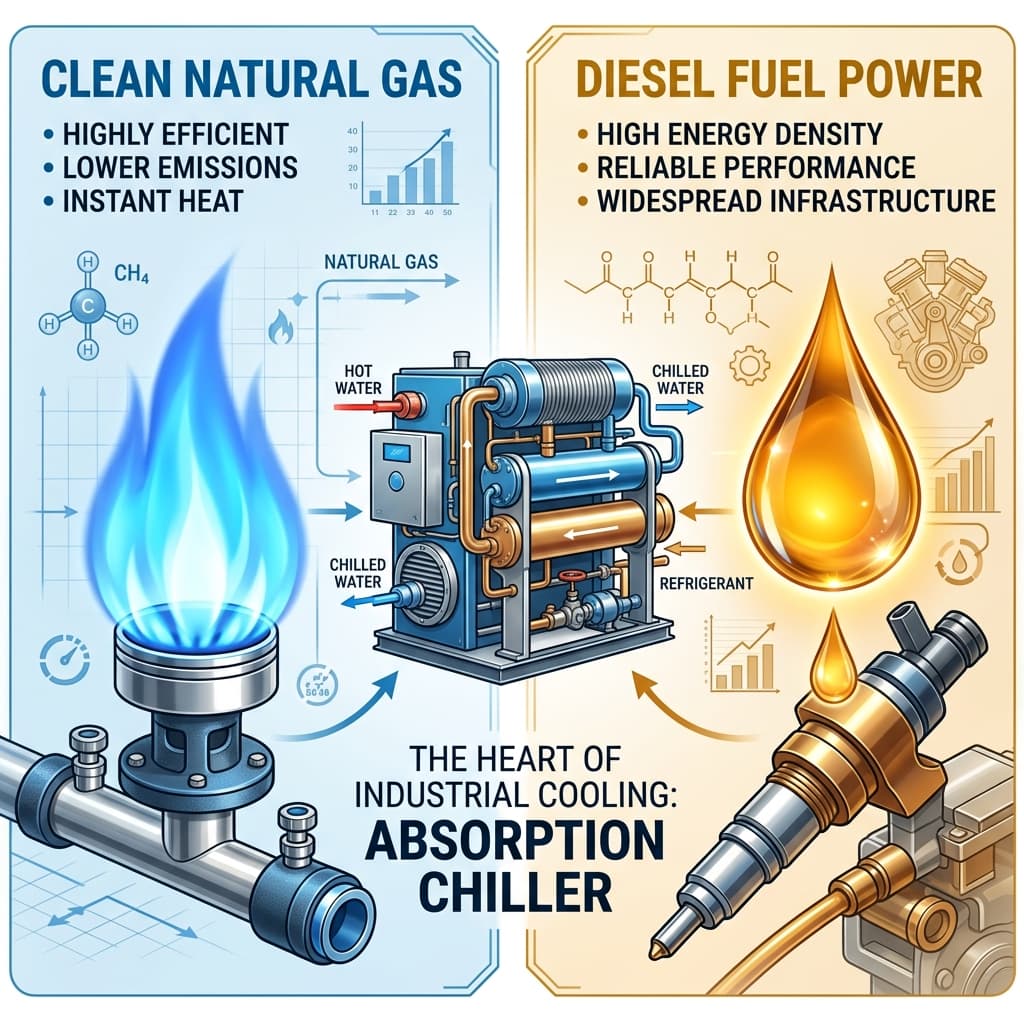
| Direct-fired | Natural gas or diesel burner | 1.2–1.3 | 100 TR – 1,500 TR |
| Exhaust-fired | Engine/turbine exhaust 400–550°C | 0.75–0.90 | 100 TR – 1,000 TR |
In all configurations, the fundamental 4-component cycle is unchanged. The heat source changes. The maintenance advantage does not.
Get a Lifecycle Cost Comparison
Contact BROAD India for a site-specific comparison of lifecycle costs across both technologies for your facility's actual load and heat source profile.
Talk to a Specialist