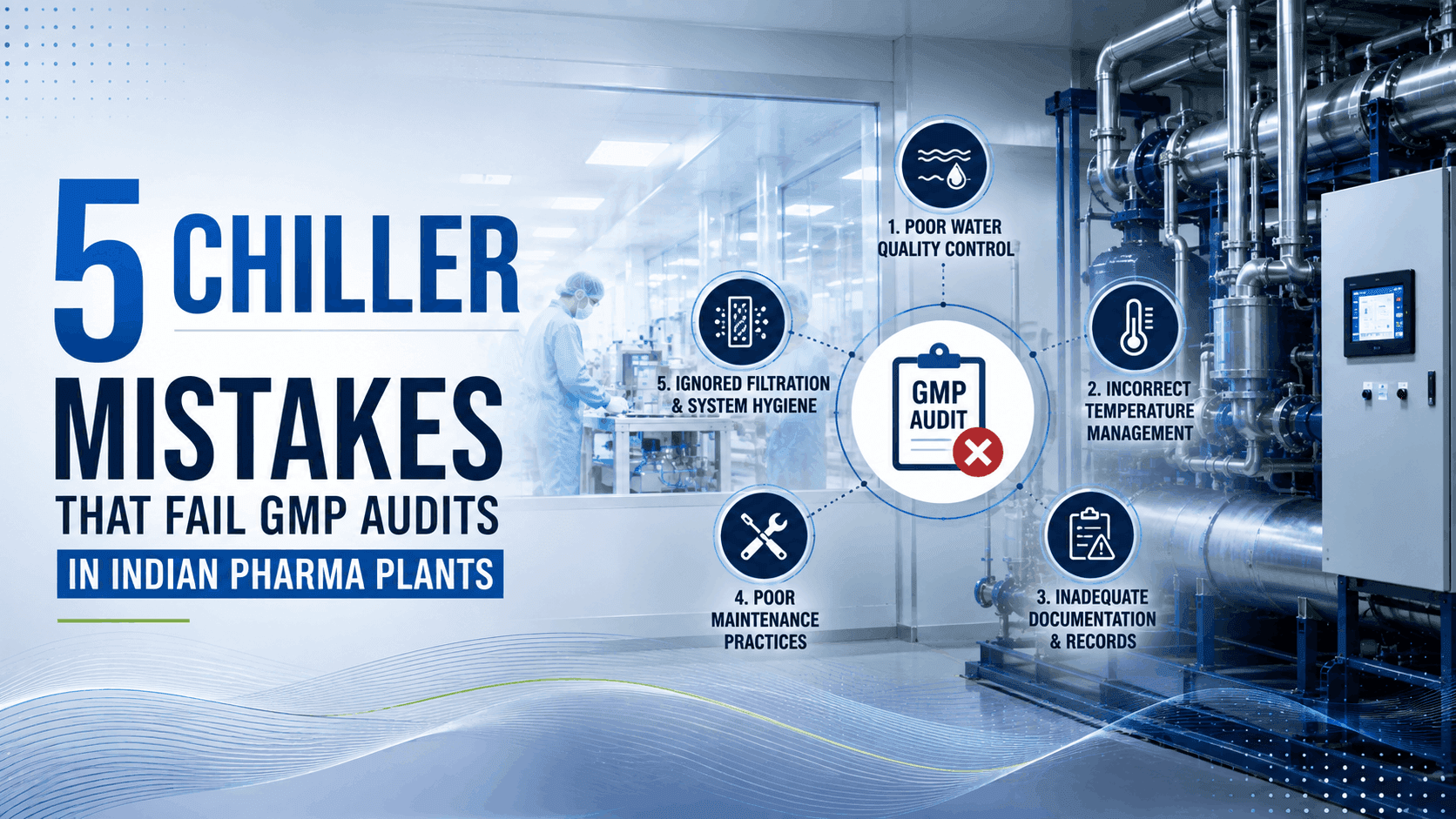
A pharmaceutical chiller is not merely a utility in a GMP facility - it is a qualified piece of equipment whose performance directly determines whether the controlled environments it serves remain compliant under Schedule M, WHO-GMP, and CDSCO standards. India's April 2023 revision of Schedule M aligned Indian GMP with WHO TRS 986 and EU GMP, introducing mandatory ISO 5/7/8 cleanroom classification, HVAC validation requirements, and environmental monitoring infrastructure as regulatory prerequisites for manufacturing licence. A chiller malfunction that allows a Grade C sterile area to drift outside its validated temperature range is a critical GMP deviation - explicitly cited in deviation management guidance as a cause of warning letters, import alerts, and product recalls. This post covers the five chiller-side mistakes that most commonly produce that finding.
Why the revised Schedule M raised the stakes for chiller qualification
The April 2023 Schedule M revision is not an incremental update. According to Popprobe's regulatory analysis, it mandates ISO 5/7/8 cleanroom classification aligned with EU GMP Grade A/B/C/D, computerised system validation equivalent to FDA 21 CFR Part 11, and enhanced HVAC validation requirements. Manufacturing drugs in contravention of GMP licence conditions is a cognisable offence under Section 27 of the Drugs and Cosmetics Act 1940, carrying imprisonment and fines. A single CDSCO warning letter costs ₹1–3 crore in legal, remediation, and market loss; a facility shutdown costs ₹2–10 crore in lost output and remediation fees, according to iFactory's Schedule M compliance analysis.
The chiller's role in this regulatory picture is direct: it provides the cooling capacity that maintains the validated temperature and humidity conditions in classified manufacturing areas. If the chiller underperforms, the zone fails. If the zone fails, the deviation must be documented, investigated, and remediated under Schedule M's CAPA framework before manufacturing can resume - and if the auditor finds it first, the finding becomes a regulatory record.
Mistake 1: Operating an unqualified or unvalidated chiller
Schedule M requires that process equipment be qualified and validated before use in GMP manufacturing areas. A chiller that has not undergone Installation Qualification (IQ), Operational Qualification (OQ), and Performance Qualification (PQ) - or whose qualification documents are outdated after a repair, replacement, or significant process change - is operating outside its validated state. Under the revised Schedule M, HVAC system validation is specifically required to demonstrate that the system maintains the required cleanroom classification under all operating conditions, including peak summer load and single-unit failure scenarios, according to CDSCO Schedule M guidance. A chiller audit trail that shows gaps in qualification records is a direct finding during a CDSCO or WHO-GMP inspection.
Mistake 2: No continuous temperature monitoring linked to the BMS
Environmental monitoring in classified manufacturing areas requires continuous temperature and humidity data, not spot checks. Where the chiller fails to maintain setpoint - due to a refrigerant charge fault, tube fouling, or load mismatch - and that deviation is not captured in real time, the facility cannot demonstrate that the manufacturing environment was controlled during the batch concerned. Computerised system validation requirements under revised Schedule M, aligned with FDA 21 CFR Part 11 equivalence, mean that temperature data must come from a validated monitoring system with audit-trail capability, not from a standalone logger or manual record. A chiller whose performance is not integrated into a validated BMS or environmental monitoring system leaves a data gap that auditors treat as a compliance gap, regardless of whether a temperature excursion actually occurred.
Mistake 3: Inadequate chiller redundancy for critical manufacturing zones
A GMP facility cannot lose cooling to a classified manufacturing area and continue production - the deviation from validated conditions constitutes an immediate batch quality risk and must be managed under Schedule M's deviation management framework. An operating theatre or Grade B fill-finish suite with no N+1 chiller redundancy relies entirely on the reliability of a single machine. IMARC Engineering's 2026 pharmaceutical compliance analysis confirms that HVAC system rebuilds to meet current Schedule M requirements must include validated air handling that meets specified criteria under all conditions, including equipment failure. A facility design with insufficient chiller redundancy for its critical zones - particularly in sterile injectables and API manufacturing - is a systemic finding, not an observation, during WHO-GMP inspection.
Mistake 4: Chiller maintenance not documented under a qualified equipment programme
Under Schedule M's revised equipment qualification framework, maintenance of GMP-critical equipment - including chillers serving classified areas - must be performed under documented procedures, by trained personnel, and recorded in a system that links maintenance history to batch manufacturing records. Ad hoc maintenance, undocumented repairs, or replacement of components without change control creates an uncontrolled variable in the manufacturing environment. Pharmaceutical microbiology guidance explicitly cites chiller malfunction due to poor preventive maintenance as a cause of temperature deviation in Grade C sterile manufacturing - a regulatory finding under EU GMP Chapter 1 and FDA 21 CFR Part 211.192. A preventive maintenance programme that lacks documented chiller inspection intervals, performance verification after service, and change control for replacement parts is an audit risk at every CDSCO inspection.
Mistake 5: Chiller sizing that cannot sustain validated conditions at peak load
A chiller sized to average summer conditions may fail to maintain validated temperature setpoints during peak ambient temperature in April–June - the same period when Indian grid instability adds load variability. If the manufacturing environment exceeds its validated range during production, every batch made during that excursion is a potential deviation event requiring investigation. This is a design-stage error that surfaces at audit. Schedule M's emphasis on quality risk management requires manufacturers to demonstrate that their facility design - including cooling capacity - has been evaluated against worst-case operating conditions. A chiller that cannot sustain Grade C or Grade D conditions at 45°C ambient and reduced grid voltage is an unmitigated risk in the facility's risk assessment, and its absence from the risk register is itself a finding.
5 GMP chiller audit mistakes at a glance
| Mistake | GMP finding type |
|---|---|
| 1 Unqualified or unvalidated chiller | Critical - equipment outside validated state |
| 2 No continuous BMS-linked temperature monitoring | Major - data integrity gap in environmental records |
| 3 No N+1 redundancy for critical zones | Major - systemic risk to classified environment |
| 4 Maintenance undocumented or outside change control | Major - uncontrolled variable in manufacturing environment |
| 5 Undersized for worst-case ambient load | Other/Major - risk assessment gap, confirmed at peak conditions |
Design Your Pharma Chiller Plant for Audit, Not Just Operation
GMP compliance is built in at the design and qualification stage - not remediated after the inspection. BROAD India's engineers specify, size, and qualify chiller systems for Indian pharmaceutical manufacturing environments under Schedule M and WHO-GMP requirements.
Talk to BROAD India's HVAC engineers