
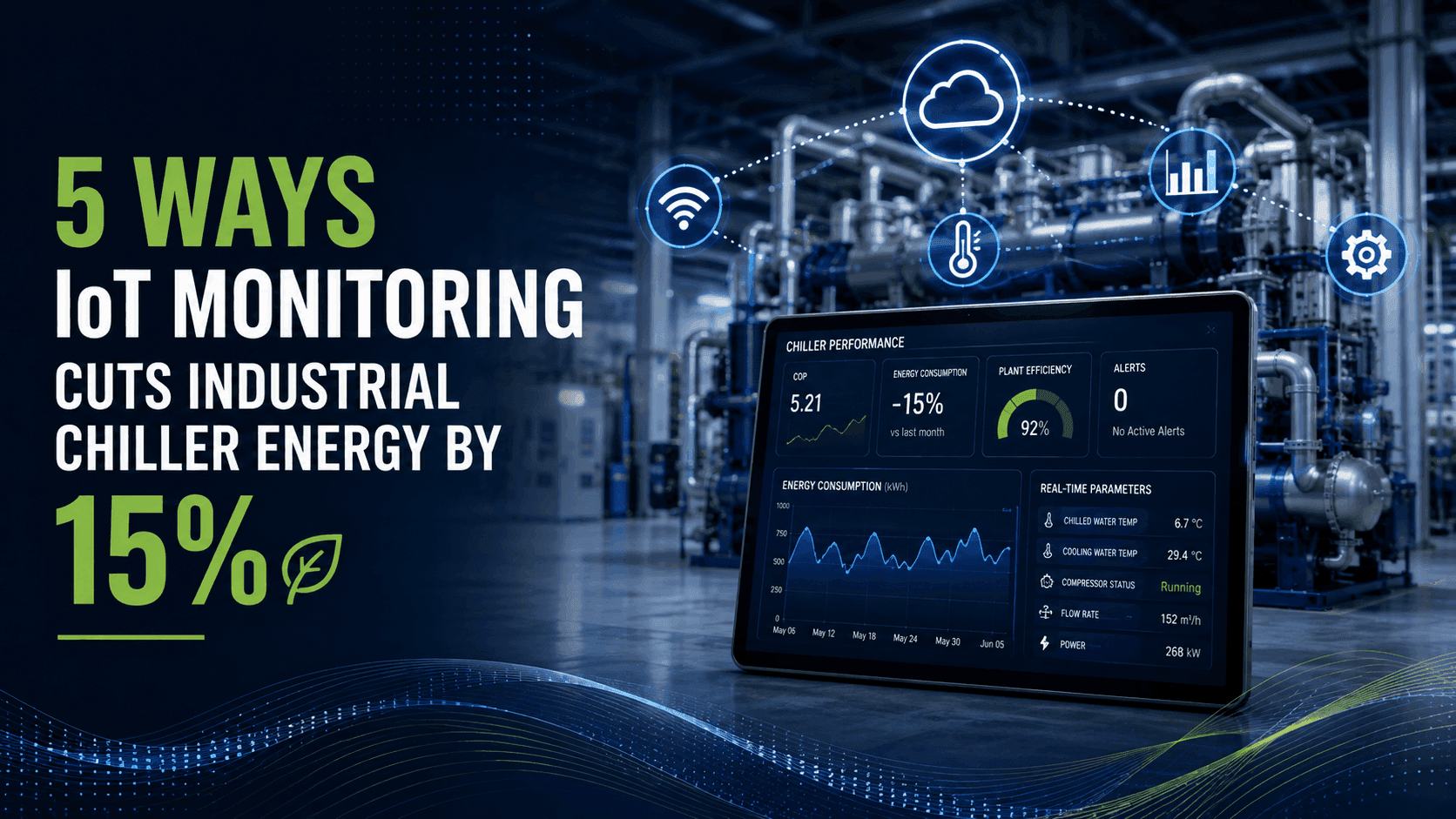
Industrial chiller IoT monitoring is the continuous, sensor-based tracking of a chiller's key operating parameters - kW/TR, COP, approach temperatures, pressure differentials, and flow rates - to detect efficiency degradation and fault conditions in real time before they compound into energy waste or equipment failure. For Indian plant energy managers whose chiller plant is typically the single largest electricity consumer on site, IoT monitoring is also the most direct route to the documented SEC data that PAT compliance and BEE audits require. This post covers five specific ways the technology reduces chiller energy consumption, with the India compliance dimension built in.
Why chiller energy waste is invisible without continuous monitoring
A chiller can deliver its rated cooling capacity in tons of refrigeration while consuming 20% more electricity than it should - and without continuous kW/TR tracking, that degradation goes undetected for months, according to OxMaint's 2026 chiller predictive maintenance analysis. The machine appears to be working because temperatures are met; the inefficiency only shows up on the energy bill, buried in aggregate consumption. Manual monthly inspections miss this entirely because they capture a single point in time. Gradual tube fouling, refrigerant charge drift, and cooling-water temperature creep all degrade efficiency progressively - showing no alarm-triggering event, only a slow accumulation of excess consumption across the full cooling season. IoT monitoring tracks the trend, not just the reading, which is what makes it effective.
Way 1: kW/TR tracking catches hidden energy degradation
The most important single metric for chiller energy health is kW/TR - kilowatts consumed per ton of refrigeration delivered. Comparing this in real time against the manufacturer's design curve at the same load and condenser-water conditions reveals performance degradation that tonnage monitoring alone misses entirely, according to OxMaint's chiller predictive maintenance platform. A chiller running at 0.8 kW/TR against a design curve of 0.65 kW/TR is consuming 23% more electricity for the same cooling output. IoT sensors that log kW and TR continuously - normalised automatically for ambient and load - flag that gap within days of its onset, allowing maintenance to identify the cause (fouling, refrigerant charge, control drift) before it costs a full season of excess consumption. India-specific IoT energy monitoring platforms such as Itify now track chiller kW, kWh, COP, and cooling load with automatic Energy Performance Indicator (EnPI) reporting for ISO 50001 and PAT SEC compliance.
Way 2: Condenser approach temperature monitoring catches tube fouling early
Condenser approach temperature - the difference between the condensing refrigerant temperature and the leaving condenser-water temperature - is the single most sensitive early indicator of tube fouling. According to OxMaint's 2026 analysis, AI-based systems can detect condenser approach temperature trending upward at 0.12°F per week, identifying fouling onset 2–3 weeks before it crosses any alarm threshold. Uncorrected fouling costs $8,000–$22,000 per year in excess energy on a mid-size chiller, per the same analysis. Tube cleaning costs $1,200–$3,500. The arithmetic makes IoT-driven fouling detection one of the highest-ROI applications of chiller monitoring, and the sensor required - a thermocouple on the condenser water line - costs approximately $35. For Indian plants where chiller condenser water is often treated imperfectly and scaling is common, this monitoring pays back in weeks.
Way 3: Heat input monitoring on absorption chillers prevents crystallization risk
Absorption chillers carry a specific monitoring requirement that electric chillers do not: the heat input to the generator must stay within the operating band that keeps the lithium bromide solution in the safe concentration range. Below the minimum firing rate, the solution risks crystallization; above the maximum, it risks overconcentration on the high-pressure side. IoT monitoring of steam pressure, hot-water temperature and flow, or exhaust-gas temperature at the generator inlet - alongside real-time solution concentration inference from absorber temperature - provides the early warning layer that prevents crystallization shutdowns. An IoT-connected absorption chiller that flags a drop in steam pressure 20 minutes before it triggers a protective shutdown gives the plant operator time to intervene rather than restart from a crystallization event. This is the monitoring dimension absent from every global IoT-chiller platform guide, which focuses exclusively on electric compression chillers.
Way 4: Load-matching and sequencing optimises multi-chiller plants
Plants with multiple chillers - the N+1 or staged configurations recommended across this series for hospitals, data centers, and large industrial sites - lose significant energy when load-matching is done manually. Starting two chillers at 50% load each instead of running one at 100% and one idle can double or triple the kW/TR inefficiency, depending on where each machine sits on its efficiency curve. IoT-connected BMS integration enables automatic sequencing: the system monitors real-time cooling demand, compares it against each chiller's efficiency curve at the required load point, and stages machines on and off to minimise aggregate kW/TR across the plant, according to Messung BACD's chiller plant optimisation analysis. For absorption chillers, this includes optimising which heat source is routed to which machine based on real-time temperature and flow data - not a fixed schedule.
Way 5: Real-time PAT SEC and BEE data eliminates manual audit preparation
The most India-specific advantage of continuous chiller IoT monitoring is the elimination of manual energy data collection for PAT designated consumers and BEE audit preparation. PAT requires gate-to-gate Specific Energy Consumption (SEC) data across all major energy inputs, including cooling-related electricity. Without IoT monitoring, that data is assembled from meter readings, log sheets, and estimates - a process that introduces errors and consumes engineering hours before every assessment year. An IoT platform logging chiller kW, TR, COP, and run hours continuously produces the SEC input data automatically, with timestamped records that withstand audit scrutiny. As covered in the PAT scheme cooling guide, the gap between a plant's achieved SEC and its assigned target decides whether it earns ESCerts or must buy them - and that gap cannot be managed without real-time visibility of the chiller plant's actual consumption.
5 IoT monitoring gains at a glance
| Monitoring action | Energy or compliance gain |
|---|---|
| 1 kW/TR tracking vs design curve | Catches 20%+ energy degradation before it accumulates |
| 2 Condenser approach temperature trending | Prevents $8,000–$22,000/yr fouling losses |
| 3 Heat input monitoring (absorption) | Prevents crystallization shutdowns and off-spec operation |
| 4 Multi-chiller load sequencing via BMS | Minimises aggregate kW/TR across the plant |
| 5 Continuous SEC data for PAT/BEE | Eliminates manual audit preparation; supports ESCert position |
Connect Your Chiller Plant to Real-Time Energy Visibility
Continuous kW/TR monitoring, condenser approach temperature trending, and PAT-ready SEC data are the three outputs that pay back fastest. BROAD India's engineers help Indian plant teams specify and integrate IoT monitoring for both electric and absorption chiller plants, with 200+ installations nationwide.
Talk to BROAD India's HVAC engineers