Overview
About the Single-Stage Absorption Chiller
Single-Stage Absorption Chiller
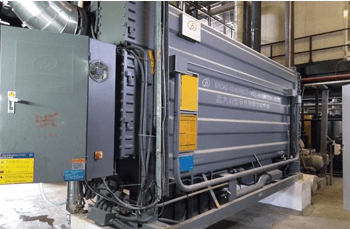
A single-stage absorption chiller is a thermal cooling system that uses a single generator to vaporise refrigerant (water) from the absorbent (lithium bromide). Because it only requires one stage of heat input, it can operate on low-grade thermal energy - such as hot water as low as 70°C or low-pressure steam (0.1–1.5 kg/cm²). While its COP (0.7–0.8) is lower than a two-stage machine, its ability to run on low-grade waste heat makes it an exceptionally cost-effective energy recovery solution.
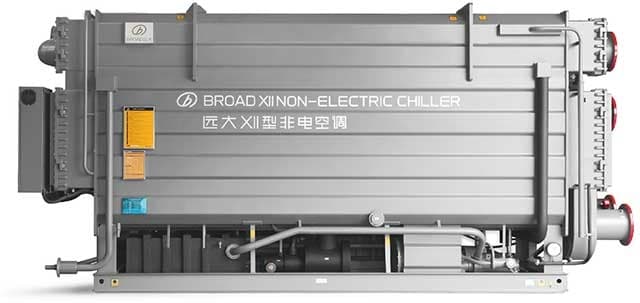
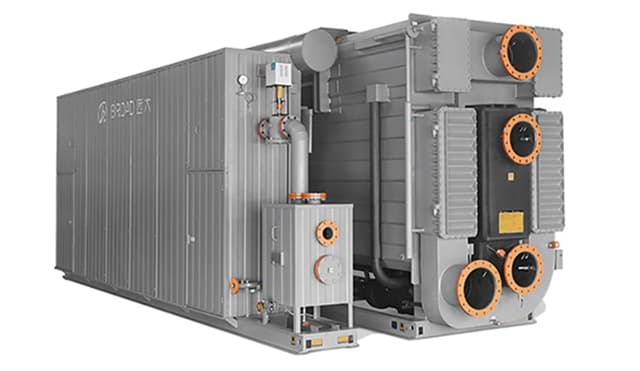
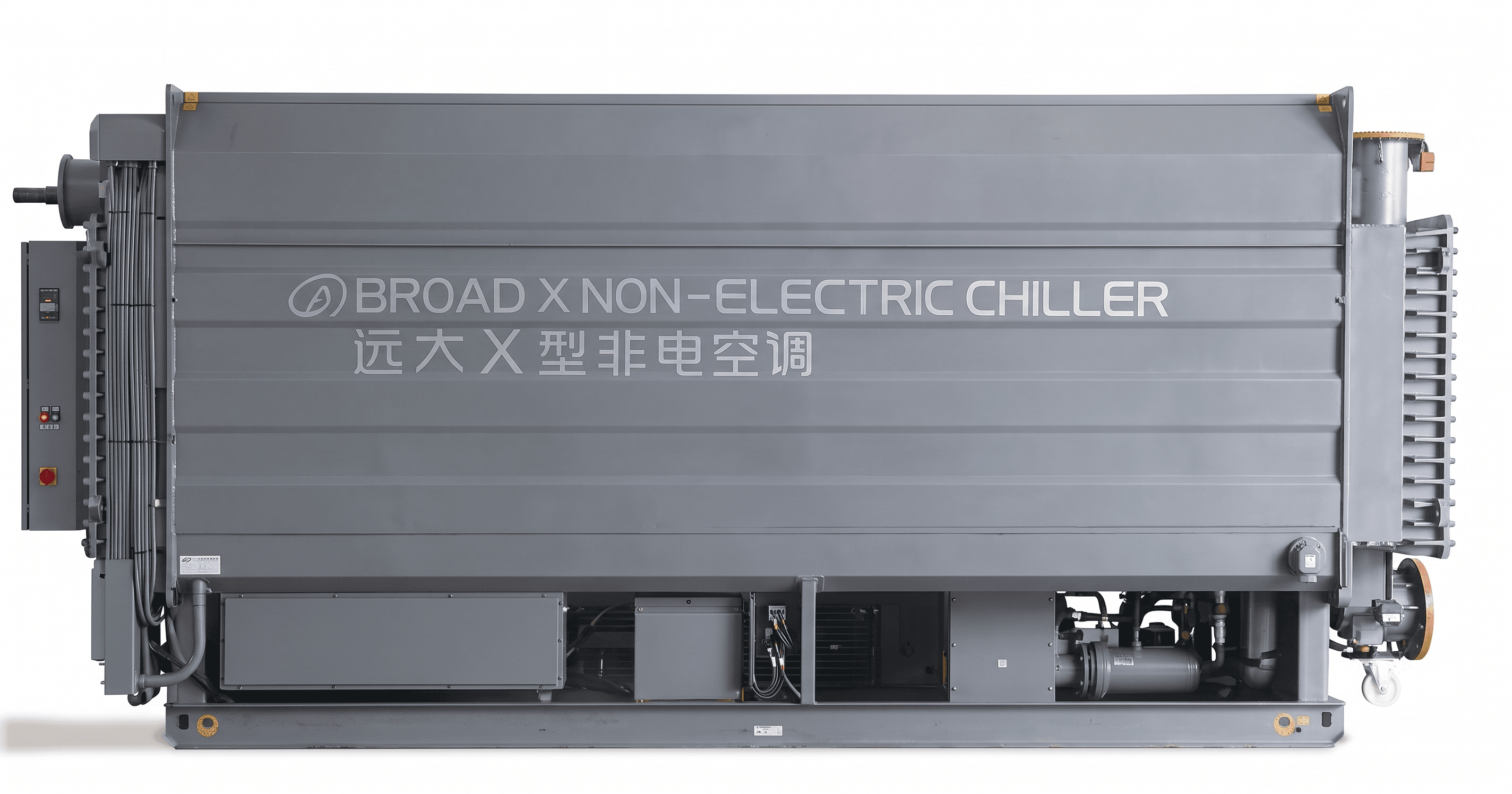
The BROAD Single-Stage Absorption Chiller is designed to monetise low-grade thermal energy that would otherwise be wasted. Ideal for industrial processes, cogeneration plants, and district energy systems, this chiller converts low-pressure steam or hot water into reliable, continuous chilled water for HVAC or process cooling.
While single-stage chillers have a lower Coefficient of Performance (COP) compared to two-stage models, their distinct advantage lies in their heat source requirements. They can effectively utilise waste heat as low as 70°C, making them the perfect solution for recovering heat from jacket water, low-pressure exhaust steam, or solar thermal collectors - turning previously unusable thermal energy into valuable cooling.
Key specifications
Performance at a glance
- Cooling capacity
- 100–3,300 TR
- Hot water input
- 70–95°C
- Steam pressure
- 0.1–1.5 kg/cm²
- Efficiency
- COP 0.7–0.8
How it works
The absorption cycle, step by step
- 1
Heat input
Steam, hot water, exhaust gas or a gas/oil burner heats the generator. No compressor is needed.
- 2
Generator
The heat boils water vapour (the refrigerant) out of the lithium bromide solution.
- 3
Condenser & evaporator
The vapour condenses, then evaporates under deep vacuum, pulling heat out of the chilled-water circuit.
- 4
Absorber
Concentrated lithium bromide re-absorbs the vapour and the solution returns to the generator.
- 5
Chilled water out
Chilled water leaves for process cooling or air conditioning, with water as a zero-ODP, zero-GWP refrigerant.
Model finder
Model Specifications
| Model | Cooling Capacity | Dimensions (L×W×H) | Energy Input |
|---|---|---|---|
| Single-Stage Steam | 100 - 3,300 TR | Varies by capacity | Low-Pressure Steam |
| Single-Stage Hot Water | 100 - 3,300 TR | Varies by capacity | Hot Water (70–95°C) |
Engineering
Key Features
Low-Grade Heat Utilisation
Operates efficiently on hot water (70–95°C) or low-pressure steam, capturing heat that two-stage chillers cannot use.
Simplified Single-Generator Design
Fewer components than two-stage chillers, resulting in lower capital cost, simpler operation, and exceptional reliability.
Anti-Crystallisation Technology
Advanced control logic prevents lithium bromide crystallisation even under fluctuating heat input conditions.
Minimal Electric Load
Consumes only 1–3% of the electricity required by a conventional mechanical chiller of equivalent capacity.
Low Maintenance
Virtually no moving parts in the primary refrigeration cycle, ensuring a 25+ year lifespan with minimal servicing.
Business case
Core Benefits
Monetise Low-Grade Heat
Turn previously unusable low-temperature waste heat into valuable cooling, generating a rapid return on investment.
Zero ODP & Low GWP
Uses water as a natural refrigerant and lithium bromide as the absorbent - environmentally benign and future-proof.
Peak Demand Reduction
Significantly reduces electrical peak demand, avoiding high demand charges and freeing up grid capacity.
Quiet & Vibration-Free
Absence of large mechanical compressors ensures whisper-quiet operation and zero structural vibration.
Where it’s used
Applications
- Industrial Process Cooling
- Cogeneration & Trigeneration
- District Cooling Systems
- Hospitals & Campuses
- Hotels & Commercial Buildings
Case studies
Proven in the field
Real-world implementations of this technology across industrial facilities.
Frequently Asked Questions
When should I choose a single-stage over a two-stage absorption chiller?
What is the minimum hot water temperature required for a single-stage chiller?
Can a single-stage chiller be used with solar thermal collectors?
Request a Quote
Get custom pricing and engineering specifications for the Single-Stage Absorption Chiller.