
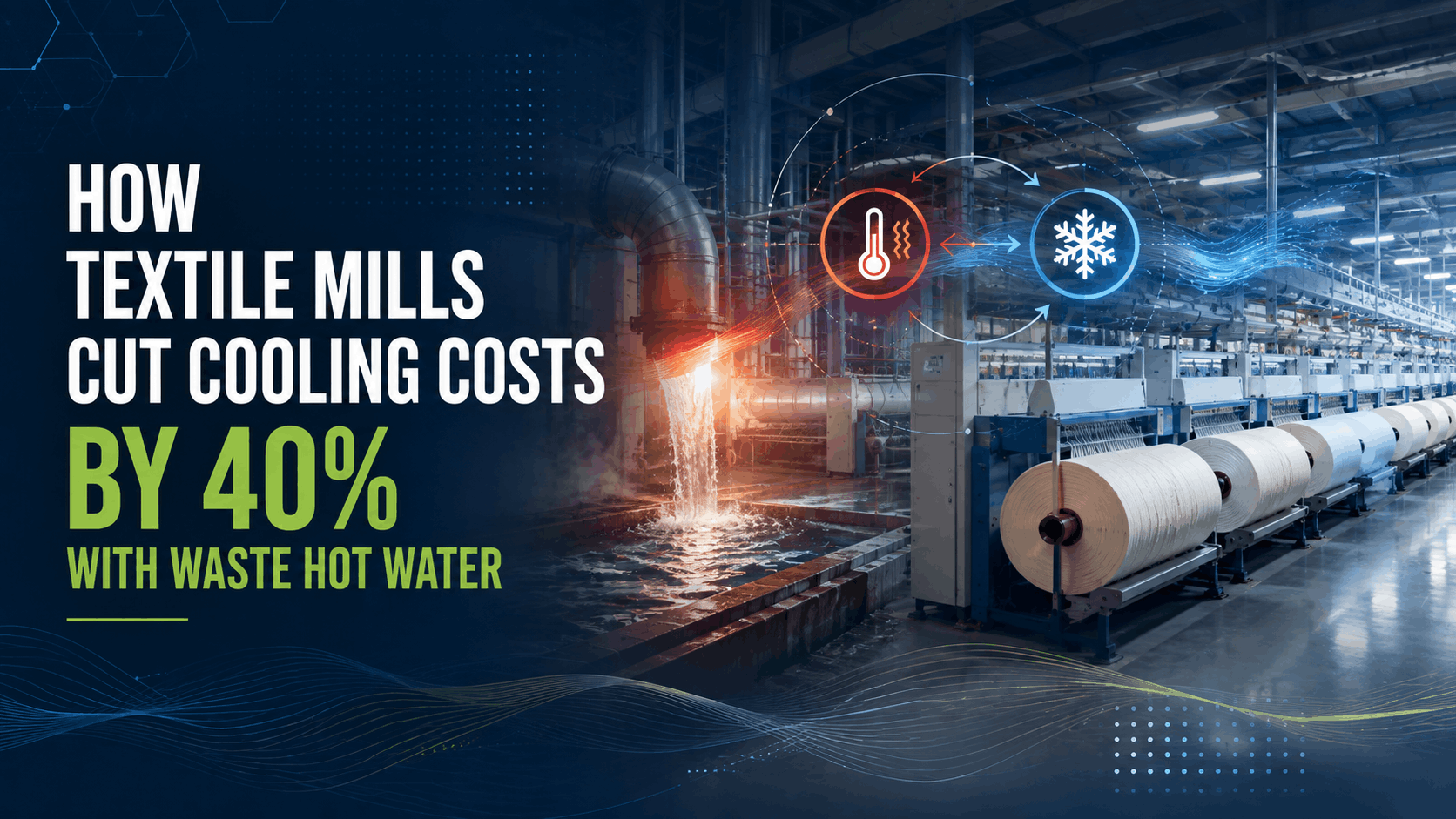
Textile mill cooling in India is an energy-intensive problem with a built-in solution: the dyeing and finishing processes that generate the largest cooling demand also discharge hot water at 40–60°C - exactly the temperature range that drives a hot-water absorption chiller. Converting that waste stream into process cooling reduces cooling-related electricity by up to 40%, and in storage-integrated configurations the savings run higher still. This guide maps the waste heat streams available in a typical Indian textile plant and explains how each one connects to the absorption chiller that converts it into cooling.
Why Indian textile mills are paying twice for cooling
India's textile and apparel industry contributes 2% of GDP and employs 45 million people, with a government export target of US$100 billion by FY2031 - pressure that makes energy cost a competitiveness issue, not just an efficiency metric, according to Fashion for Good's India Blueprint report (2026). Energy in a typical wet-processing facility - dyeing, scouring, bleaching, finishing - is consumed in two directions simultaneously: heat goes into the process, and cooling capacity is bought separately to manage machine zones, process water, and worker environments. The inefficiency is structural. The same processes that require cooling (dyeing machines, stenters, calendering zones) produce hot effluent and exhaust that most mills discharge or vent to the atmosphere. The result is a facility paying for both the energy that created the heat and the electricity that removes it - twice - when an absorption chiller would convert the first cost into the second output.
What waste heat streams does a textile mill actually generate?
Three primary streams carry recoverable heat in a wet-processing facility. The first is dyeing effluent: continuous scouring and bleaching vats discharge wastewater at approximately 40–60°C, according to beta.co.id's textile heat recovery analysis. Without recovery, this energy leaves the plant through the drain. The second is stenter and heat-setting machine exhaust. Stenters - the machines that tension and dry fabric - require hot air at around 200°C for heat-setting operations and discharge large volumes of exhaust at temperatures well above the absorption chiller's minimum input requirement. The third is boiler blowdown and condensate return, which carries heat at moderate temperatures and flows continuously during production.
| Waste heat stream | Typical temperature | Absorption chiller fit |
|---|---|---|
| Dyeing effluent / scouring wastewater | 40–60°C | Hot-water single-effect absorption chiller |
| Stenter / heat-setting exhaust | 150–200°C | High-grade - drives double-effect unit |
| Boiler blowdown / condensate return | 80–100°C | Steam or hot-water single-effect unit |
| Engine / generator exhaust (if on-site genset) | 300–500°C | Exhaust-gas double-effect chiller |
How does hot water from a dyeing plant drive a chiller?
A hot-water-driven absorption chiller accepts the recovered waste stream - after it passes through a heat exchanger - as its driving heat input. That heat boils a lithium bromide–water solution in the generator, releasing refrigerant vapour that circulates through the absorption cycle and produces chilled water at 7–12°C for process cooling or comfort air conditioning. The only electrical load is the solution pump. A pilot absorption heat pump operating on engine exhaust at a textile facility produced 34.4 kW of cooling from 16 kW of waste heat input, achieving a COP of 0.96, according to research published in MDPI. When combined with hot-water storage - a tank that banks heat from batch dyeing processes and releases it steadily to the chiller - a storage-integrated system achieved a 63% energy reduction in a modelled dyeing facility, per ResearchGate analysis, because the chiller runs on stored heat even when the dyeing batch is not actively running.
What cooling savings can a textile mill realistically expect?
Heat recovery from stenters, boilers, and wastewater typically delivers 10–25% fuel savings in thermal energy with paybacks of 2–5 years, according to Energy Solutions' 2026 textile industry analysis. Where the absorption chiller replaces a large electric cooling load entirely - running on recovered hot water rather than grid power - the electricity saving on the cooling circuit alone reaches 40% or more, depending on the size of the recoverable stream and the existing cooling load. At mill scale the numbers are substantial. One documented implementation of exhaust-duct boilers and economisers on on-site generators eliminated approximately 131,772 MWh per year of fuel use and 52,700 tonnes of CO₂, with around 80% of those engines' fuel energy recoverable through waste-heat systems, according to MDPI research. The cooling component of that recovery - the waste-heat-driven absorption chiller portion - is where the electricity displacement compounds fastest.
Which process zones benefit most from absorption cooling?
Process cooling in dyeing and finishing is the primary application: maintaining the temperature of dye baths, cooling fabric after heat-setting, and managing machine-zone temperatures in continuous operations. These loads run continuously during production and are currently served by electric compression chillers or cooling towers in most Indian mills. Comfort cooling for workers in weaving and spinning halls is a secondary application. Unlike process cooling - which requires stable chilled water at a specific setpoint - comfort zones tolerate more variability and can absorb hot water at the lower end of the available temperature range. For mills with both demands, the absorption system serves process cooling first and diverts surplus capacity to comfort zones.
How does a textile mill start a waste-heat cooling project?
Begin with a heat audit that maps every discharge stream: temperature, flow rate, and operating hours. The audit typically reveals that dyeing effluent alone, if recovered before treatment, carries enough recoverable heat to drive a meaningful share of the plant's cooling load - and that the stenter exhaust, if heat-exchanged, adds a higher-grade stream capable of running a double-effect unit. Size the absorption chiller to the recoverable heat, not the peak cooling demand. A correctly sized hot-water unit running continuously on recovered heat outperforms an oversized unit that runs intermittently because the heat stream is variable. Pair it with a storage tank to buffer batch-process variability, and integrate the output to the process cooling distribution system first before extending to comfort zones. For mills with on-site generators, the exhaust heat from those engines is a higher-grade stream worth recovering separately.
Turn Your Mill's Waste Heat Into Process Cooling
A heat audit is the first step: measure your dyeing effluent, stenter exhaust, and condensate streams before specifying any equipment. BROAD India's engineers run waste-heat assessments for Indian textile plants and size hot-water absorption cooling systems to what your mill actually produces.
Talk to BROAD India's HVAC engineers